

A statically typed programming language for scientific computations with first class support for physical dimensions and units
Numbat - scientific calculator
High precision scientific calculator with full support for physical units.

Symbolica | Modern Computer Algebra
High-performance symbolic-numeric computing for Python and Rust.

Nelua
Minimal, simple, efficient, statically typed, compiled, meta programmable, safe and extensible systems programming language with a Lua flavor.
Array programming with NumPy
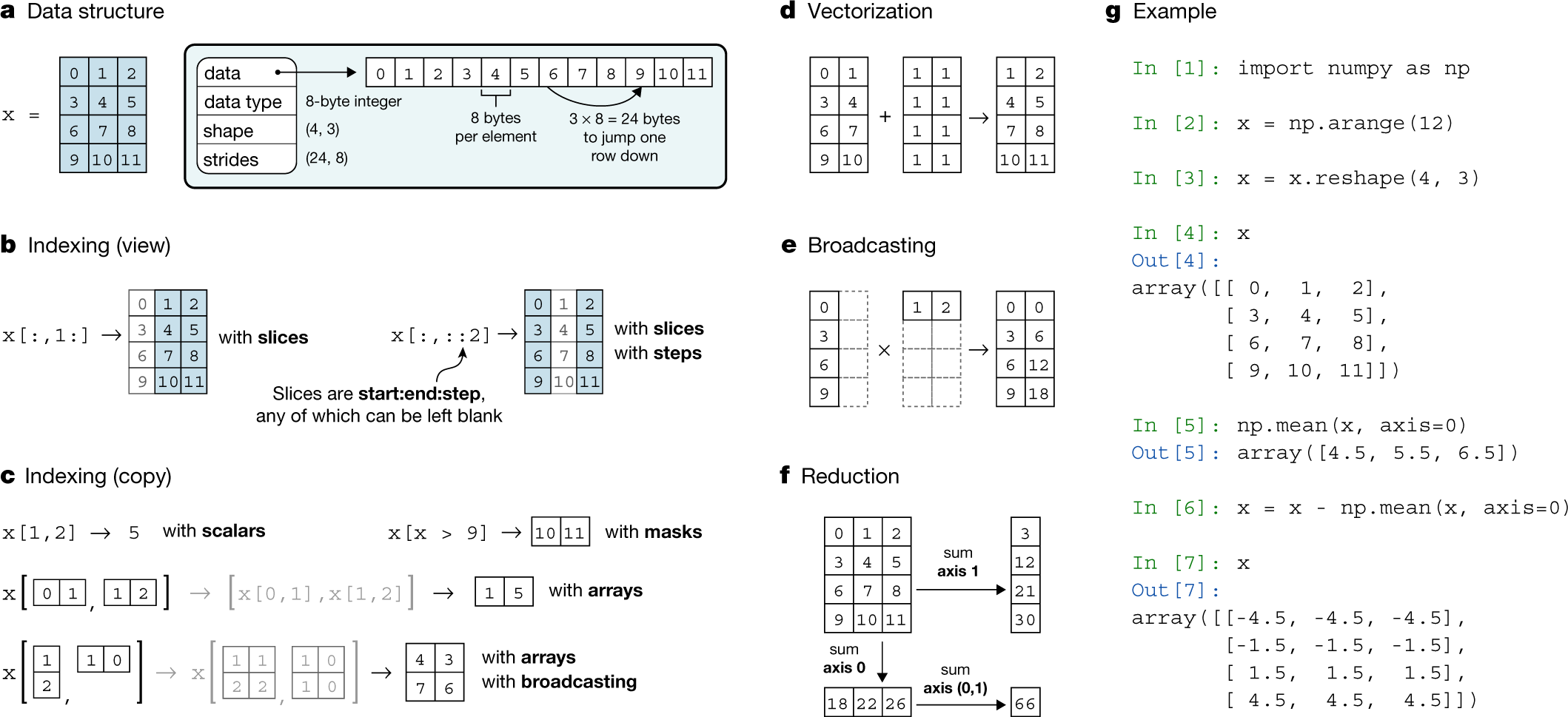
Array programming provides a powerful, compact and expressive syntax for accessing, manipulating and operating on data in vectors, matrices and higher-dimensional arrays. NumPy is the primary array programming library for the Python language. It has an essential role in research analysis pipelines in fields as diverse as physics, chemistry, astronomy, geoscience, biology, psychology, materials science, engineering, finance and economics. For example, in astronomy, NumPy was an important part of the software stack used in the discovery of gravitational waves1 and in the first imaging of a black hole2. Here we review how a few fundamental array concepts lead to a simple and powerful programming paradigm for organizing, exploring and analysing scientific data. NumPy is the foundation upon which the scientific Python ecosystem is constructed. It is so pervasive that several projects, targeting audiences with specialized needs, have developed their own NumPy-like interfaces and array objects. Owing to its central position in the ecosystem, NumPy increasingly acts as an interoperability layer between such array computation libraries and, together with its application programming interface (API), provides a flexible framework to support the next decade of scientific and industrial analysis.
Bitwuzla
An SMT solver for bit-vectors, floating-points, arrays and uninterpreted functions.
Structure and Interpretation of Computer Programs - 2nd Edition
Structure and Interpretation of Computer Programs has had a dramatic impact on computer science curricula over the past decade. This long-awaited revision contains changes throughout the text.There are new implementations of most of the major programming systems in the book, including the interpreters and compilers, and the authors have incorporated many small changes that reflect their experience teaching the course at MIT since the first edition was published.A new theme has been introduced that emphasizes the central role played by different approaches to dealing with time in computational models: objects with state, concurrent programming, functional programming and lazy evaluation, and nondeterministic programming. There are new example sections on higher-order procedures in graphics and on applications of stream processing in numerical programming, and many new exercises.In addition, all the programs have been reworked to run in any Scheme implementation that adheres to the IEEE standard.

Practical Foundations for Programming Languages
The Coalton Programming Language
A statically typed, functional programming language that compiles to Common Lisp
Julia motivation: why weren't Numpy, Scipy, Numba, good enough?
I recently gave a Why Julia? talk to a roomful of computational fluid dynamicists and astrophysicists. (John Gibson, UNH & KITP, Julia - a high-performance dynamic programming language for technical computing, Kavli Institute, UCSB 2017-02-02). I got two main skeptical responses. One Python expert in the audience pointed out that much of what I was touting in Julia is available in Python: Numba for fast array math, %jit macros for just-in-time computation. I read up on these things afterwards a...

SciPy 1.0: fundamental algorithms for scientific computing in Python
SciPy is an open-source scientific computing library for the Python programming language. Since its initial release in 2001, SciPy has become a de facto standard for leveraging scientific algorithms in Python, with over 600 unique code contributors, thousands of dependent packages, over 100,000 dependent repositories and millions of downloads per year. In this work, we provide an overview of the capabilities and development practices of SciPy 1.0 and highlight some recent technical developments.

Theorems for free! | Proceedings of the fourth international conference on Functional programming languages and computer architecture
The polymorphic blame calculus integrates static typing, including universal types, with dynamic typing. The primary challenge with this integration is preserving parametricity: even dynamically-typed code should satisfy it once it has been cast to a ...
Principal type-schemes for functional programs | Proceedings of the 9th ACM SIGPLAN-SIGACT symposium on Principles of programming languages
As part of the Digital Library's transition to Open Access, new features for researchers are available in the Premium Edition. Click here to learn more.
GATlab: Modeling and Programming with Generalized Algebraic Theories
Categories and categorical structures are increasingly recognized as useful abstractions for modeling in science and engineering. To uniformly implement category-theoretic mathematical models in software, we introduce GATlab, a domain-specific language for algebraic specification embedded in a technical programming language. GATlab is based on generalized algebraic theories (GATs), a logical system extending algebraic theories with dependent types so as to encompass category theory. Using GATlab, the programmer can specify generalized algebraic theories and their models, including both free models, based on symbolic expressions, and computational models, defined by arbitrary code in the host language. Moreover, the programmer can define maps between theories and use them to declaratively migrate models of one theory to models of another. In short, GATlab aims to provide a unified environment for both computer algebra and software interface design with generalized algebraic theories. In this paper, we describe the design, implementation, and applications of GATlab.
