

A Julia framework for building interactive 3D experiances
WorldClaw: Agentic 3D Open-World Generation at Scale
From one open-ended prompt to an explicit, explorable, and editable 3D world.


Why I no longer recommend Julia
For many years I used the Julia programming language for transforming, cleaning, analyzing, and visualizing data, doing statistics, and performing simulations.
Massively Parallel Rendering of Complex Closed-Form Implicit Surfaces
Figure 1: An assortment of implicit surfaces rendered using our technique. Left: an extruded text string, rotated and rendered as a heightmap. Center: a bear head sculpted using smooth blending operations, with normals found by automatic differentiation. Right: a complex architectural model rendered with screen-space ambient occlusion and perspective. All models are rendered directly from their mathematical representations, without triangulation or raytracing.
Learning Modern 3D Graphics Programming
3D Models Free Download - Open3dModel.com
Free 3D Models with over 150.000+ 3d models for Free Download. Available in Blend, Max, Obj, Fbx, Skp, C4d, Ma, Mb, Fbx, Dae, Stl formats with highly detailed, low poly, rigged, animated, and printable.

Uniform | Sparseal
General purpose 3D editor with sculpting, modeling, texturing, and rendering capabilities.

RoboScape: Physics-informed Embodied World Model
World models have become indispensable tools for embodied intelligence, serving as powerful simulators capable of generating realistic robotic videos while addressing critical data scarcity challenges. However, current embodied world models exhibit limited physical awareness, particularly in modeling 3D geometry and motion dynamics, resulting in unrealistic video generation for contact-rich robotic scenarios. In this paper, we present RoboScape, a unified physics-informed world model that jointly learns RGB video generation and physics knowledge within an integrated framework. We introduce two key physics-informed joint training tasks: temporal depth prediction that enhances 3D geometric consistency in video rendering, and keypoint dynamics learning that implicitly encodes physical properties (e.g., object shape and material characteristics) while improving complex motion modeling. Extensive experiments demonstrate that RoboScape generates videos with superior visual fidelity and physical plausibility across diverse robotic scenarios. We further validate its practical utility through downstream applications including robotic policy training with generated data and policy evaluation. Our work provides new insights for building efficient physics-informed world models to advance embodied intelligence research. The code is available at: https://github.com/tsinghua-fib-lab/RoboScape.
Pixal3D: Pixel-Aligned 3D Generation from Images
Recent advances in 3D generative models have rapidly improved image-to-3D synthesis quality, enabling higher-resolution geometry and more realistic appearance. Yet fidelity, which measures pixel-level faithfulness of the generated 3D asset to the input image, still remains a central bottleneck. We argue this stems from an implicit 2D-3D correspondence issue: most 3D-native generators synthesize shape in canonical space and inject image cues via attention, leaving pixel-to-3D associations ambiguous. To tackle this issue, we draw inspiration from 3D reconstruction and propose Pixal3D, a pixel-aligned 3D generation paradigm for high-fidelity 3D asset creation from images. Instead of generating in a canonical pose, Pixal3D directly generates 3D in a pixel-aligned way, consistent with the input view. To enable this, we introduce a pixel back-projection conditioning scheme that explicitly lifts multi-scale image features into a 3D feature volume, establishing direct pixel-to-3D correspondence without ambiguity. We show that Pixal3D is not only scalable and capable of producing high-quality 3D assets, but also substantially improves fidelity, approaching the fidelity level of reconstruction. Furthermore, Pixal3D naturally extends to multi-view generation by aggregating back-projected feature volumes across views. Finally, we show pixel-aligned generation benefits scene synthesis, and present a modular pipeline that produces high-fidelity, object-separated 3D scenes from images. Pixal3D for the first time demonstrates 3D-native pixel-aligned generation at scale, and provides a new inspiring way towards high-fidelity 3D generation of object or scene from single or multi-view images. Project page: https://ldyang694.github.io/projects/pixal3d/


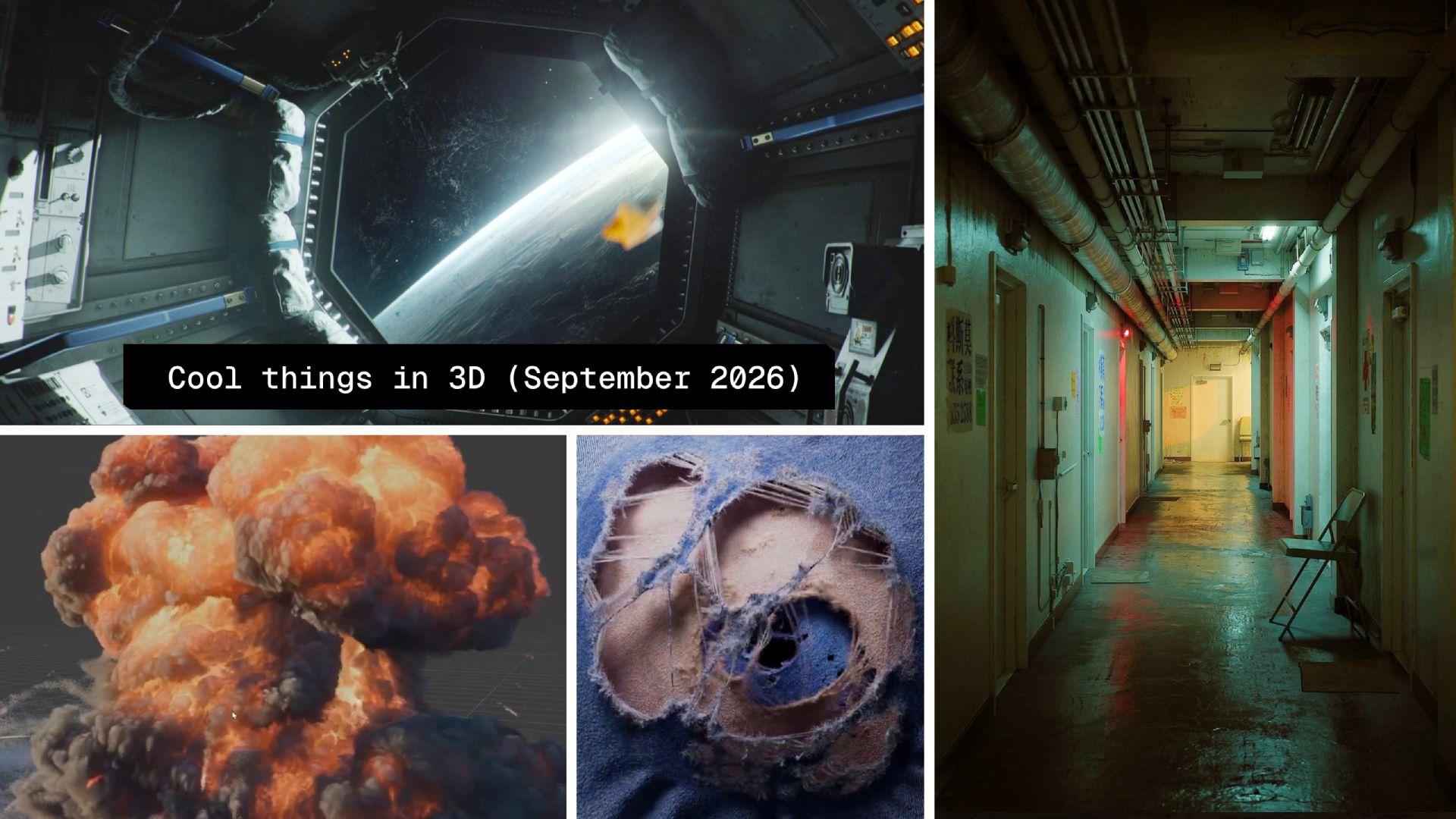
Cool Things in 3D (September 2026) • Creative Shrimp
Here’s a look at some of the coolest things happening in 3D this month - from Gaussian splats in Blender 5.3 and panoramic cameras in EEVEE to dispersion in Cycles, the most realistic Blender short film, and the GPUs the Blender community is actually using.
Marketing Distribution Agreement
Unreal Engine is the world’s most open and advanced real-time 3D creation platform for photoreal visuals and immersive experiences.

Oculus Executive Calls For 3D Equivalent Of JPEG To Build The Metaverse
A new standard for 3D scenes is gaining momentum with support from graphics industry leaders, potentially laying the groundwork for science fiction’s “metaverse” to be realized.

Julia vs Numba and Cython: Looking Beyond Microbenchmarks
We compare the performance of Julia and Numba, for a minimal benchmark that enables to see some fundamental difference between Julia and accelerated-Python.