Tool for automatically detecting predatory journals and conferences using multiple authoritative data sources
Duplicate and fake publications in the scientific literature: how many SCIgen papers in computer science?
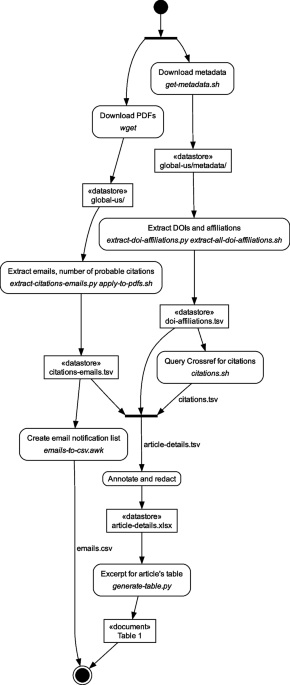
Two kinds of bibliographic tools are used to retrieve scientific publications and make them available online. For one kind, access is free as they store information made publicly available online. For the other kind, access fees are required as they are compiled on information provided by the major publishers of scientific literature. The former can easily be interfered with, but it is generally assumed that the latter guarantee the integrity of the data they sell. Unfortunately, duplicate and fake publications are appearing in scientific conferences and, as a result, in the bibliographic services. We demonstrate a software method of detecting these duplicate and fake publications. Both the free services (such as Google Scholar and DBLP) and the charged-for services (such as IEEE Xplore) accept and index these publications.

Beall's List – of Potential Predatory Journals and Publishers
Instructions: first, find the journal’s publisher – it is usually written at the bottom of the journal’s webpage or in the “About” section. Then simply enter the publisher’s name or its URL in the search box above. If the journal does not have a publisher use the Standalone Journals list.All journals published by a predatory publisher are potentially predatory unless stated otherwise.
“Paging Dr. Fraud”: The Fake Publishers That Are Ruining Science
For years, spurious journals have proliferated online, promising academic credibility in exchange for cash.

The strain on scientific publishing
Scientists are increasingly overwhelmed by the volume of articles being published. Total articles indexed in Scopus and Web of Science have grown exponentially in recent years; in 2022 the article total was approximately ~47% higher than in 2016, which has outpaced the limited growth - if any - in the number of practising scientists. Thus, publication workload per scientist (writing, reviewing, editing) has increased dramatically. We define this problem as the strain on scientific publishing. To analyse this strain, we present five data-driven metrics showing publisher growth, processing times, and citation behaviours. We draw these data from web scrapes, requests for data from publishers, and material that is freely available through publisher websites. Our findings are based on millions of papers produced by leading academic publishers. We find specific groups have disproportionately grown in their articles published per year, contributing to this strain. Some publishers enabled this growth by adopting a strategy of hosting special issues, which publish articles with reduced turnaround times. Given pressures on researchers to publish or perish to be competitive for funding applications, this strain was likely amplified by these offers to publish more articles. We also observed widespread year-over-year inflation of journal impact factors coinciding with this strain, which risks confusing quality signals. Such exponential growth cannot be sustained. The metrics we define here should enable this evolving conversation to reach actionable solutions to address the strain on scientific publishing.

False authorship: an explorative case study around an AI-generated article published under my name
The proliferation of generative artificial intelligence (AI) has facilitated the creation and publication of fraudulent scientific articles, often in predatory journals. This study investigates the extent of AI-generated content in the Global International Journal of Innovative Research (GIJIR), where a fabricated article was falsely attributed to me.
Mikel Artetxe on Twitter / X
3/4 papers I reviewed and 2/3 reviews I got this ARR cycle were AI slop. Fraudsters are already outnumbering honest researchers. Unless drastic measures are urgently adopted, conference publications will have zero value or even become negative signal, and academia will be toast.— Mikel Artetxe (@artetxem) September 19, 2026
The Dissemination of Scholarly Information: Journals, Open-Access and Distributed Filtering
Current methods of disseminating scholarly information focus on the use of journals who retain exclusive rights in the material they publish. Recently there has been increasing dissatisfaction with this model, with suggestions for alternative approaches such as "Open Access".
permadeath.com/substandard
Browser extension: detect and subscribe to standard.site publications on ATProto
Reformation of science publishing: the Stockholm Declaration
Science relies on integrity and trustworthiness. But scientists under career pressure are lured to purchase fake publications from ‘paper mills’ that use AI-generated data, text and image fabrication. The number of low-quality or fraudulent publications is rising to hundreds of thousands per year, which—if unchecked—will damage the scientific and economic progress of our societies. The result is editor and reviewer fatigue, irreproducible experiments, misguided experiments, disinformation and escalating costs that devour funding from taxpayers intended for research. It is high time to reevaluate current publishing models and outline a global plan to stop this unhealthy development. A conference was therefore organized by the Royal Swedish Academy of Sciences to draft an action plan with specific recommendations, as follows. (i) Academia should resume control of publishing using non-profit publishing models (e.g. diamond open-access). (ii) Adjust incentive systems to merit quality, not quantity, in a reputation economy where the gaming of publication numbers and citation metrics distorts the perception of academic excellence. (iii) Implement mechanisms to prevent and detect fake publications and fraud which are independent of publishers. (iv) Draft and implement legislations, regulations and policies to increase publishing quality and integrity. This is a call to action for universities, academies, science organizations and funders to unite and join this effort.

Wikipedia Is Battling for the Soul of the Internet
The internet’s largest stockpile of free knowledge is under threat from MAGA, A.I. and foreign autocrats. A bibliophile ex-ambassador is here to help.

Incorrect Citation Association for Articles in Online-Only Springer Nature Journals
We show that citation metrics of journal articles in many of the online-only Springer Nature journals and associated ones are distorted, going back to articles from 2001. We find that most likely due to an API response error, there are many incorrect references which typically lead to Article Number 1 of a given Volume. Among others, the issue affects journals such as Scientific Reports, Nature Communications, Communications journals, Cell Death & Disease, Light: Science & Applications, as well as many BMC, Discovery and npj journals. Beyond the negative effect of introducing incorrect reference information, this distorts the citation statistics of articles in these journals, with a few articles being massively over-cited compared to their peers, while many lose citations; e.g. both in Scientific Reports and in Nature Communications, 5 of the 10 top cited articles have article numbers of 1. We validate the distorted statistics by assessing data from multiple scientific literature databases: Crossref, OpenCitations, Semantic Scholar, and the journals' websites. The issue primarily arises from the inconsistent transition from page-based referencing of articles to article number-based referencing, as well as the improper handling of the change in the publisher's article metadata API. It seems that the most pressing problem has been present since approximately 2011, which we estimate affects the citation count of millions of authors.
Who's downloading pirated papers? Everyone
Data from the controversial website Sci-Hub reveal that the whole world turns to it for journal articles.

AI search engines cite incorrect news sources at an alarming 60% rate, study says
CJR study shows AI search services misinform users and ignore publisher exclusion requests.
Guest Post — Scholarly AI Search Shortcomings and the Need for Better Metadata - The Scholarly Kitchen
AI scholarly search tools often miss important literature due to incomplete metadata. Better full-text-derived metadata could significantly improve discovery.
Halupedia: An AI-Generated Wikipedia-Style Encyclopedia of Fabricated Knowledge and Absurd AI Fabulation - BizTech Weekly
Analysis of Halupedia’s AI-driven on-demand encyclopedia model reveals real-time, non-persistent article generation that simulates authoritative references through fabricated citations and internal “canon” consistency, highlighting challenges in provenance, hallucination, moderation, and the evolving trade-offs between novelty-driven engagement and information integrity in generative AI systems.