

DeepSeek Harness plugins for RLMs & program agents
DeepSeek on Twitter / X
🧩 DeepSeek Harness v0.1 is now available in Developer Preview!🔹 We’re opening it up to developers building agent harnesses worldwide and open-sourcing the codebase in MIT license.🔹 Powered by the Cordis meta-framework, DeepSeek Harness is an agent harness built around one…— DeepSeek (@deepseek_ai) August 13, 2026
DeepSeek Harness developer preview: Everything is a plugin
DeepSeek Harness is now available in developer preview to developers building agent harnesses worldwide, with the source code released at the same time. Every agent capability is implemented as a plugin that can be swapped or recomposed.
pi/packages/agent/docs/harness-v2.md at harness-v2/j4 · earendil-works/pi
AI agent toolkit: unified LLM API, agent loop, TUI, coding agent CLI - earendil-works/pi
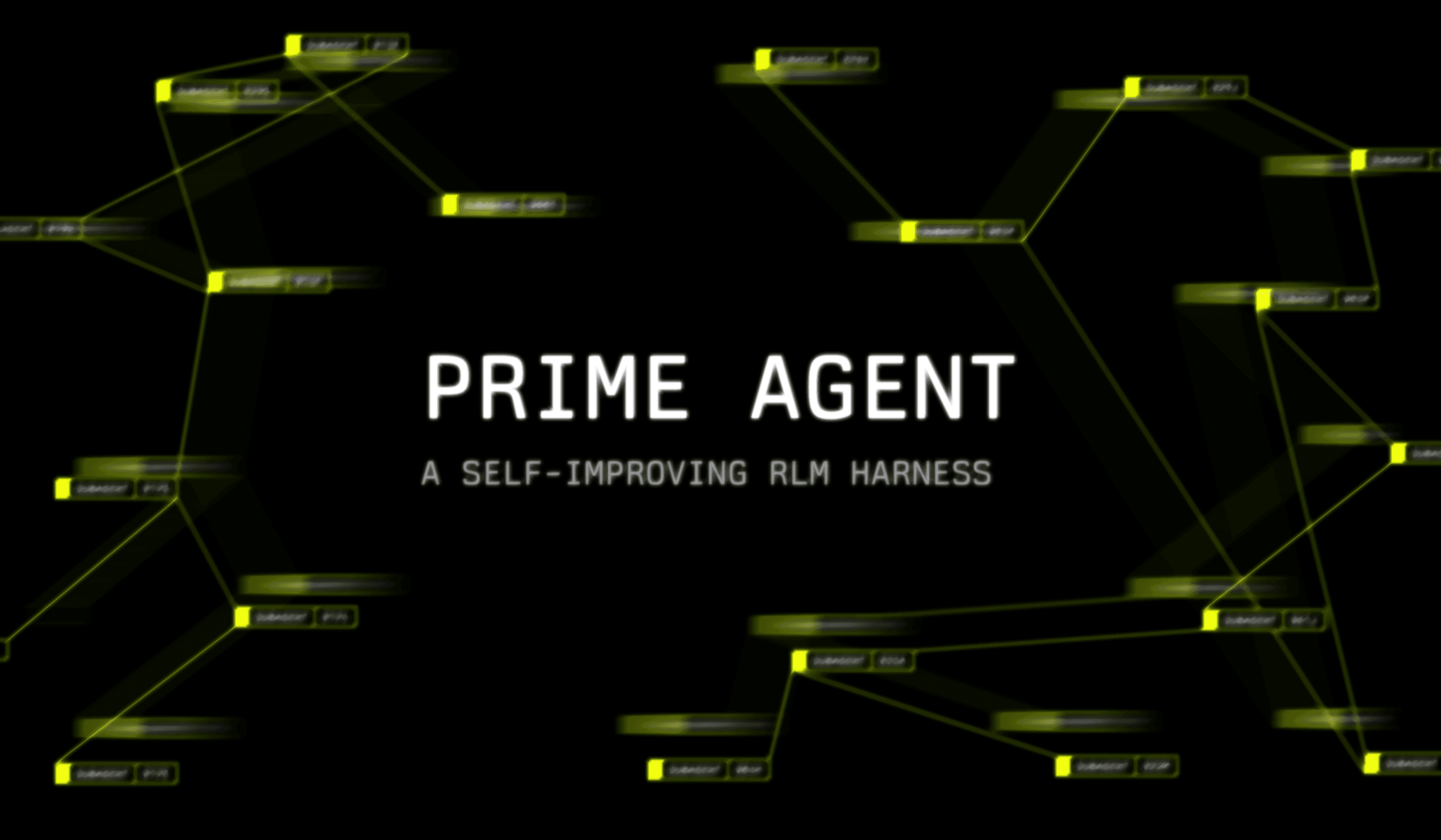
Prime Agent: A self-improving RLM agent
Prime Agent is our open-source, self-improving coding harness built around two abstractions: the Recursive Language Model (RLM) and the Continual Harness. With Opus 5, it achieves 95.5% on ARC-AGI-3, surpassing the reported human expert baseline.
What is a Harness? | EARENDIL
An agent harness is a piece of software that provides an environment for an AI model to operate within.

Codex harness · OpenClaw
Run OpenClaw embedded agent turns through the bundled Codex app-server harness

Agent Plugins
A portable package format for reusable components that extend AI agents.
How to fully automate software engineering
Current AI coding tools assist but don't fully automate software engineering. Better RL environments are what's missing.

All the Agents — 549 Coding Agent Harnesses
The maintained catalog of every coding agent harness, the multiplexers that manage them, and the SDKs used to build them.
Introducing Mods: Enabling Agents to Self-Improve through Harness-Level Adaptation
We’re introducing Mods to Letta Code — an agent-friendly way to extend and adapt the Letta Code harness.

What is an Agent Harness? | Rubric Labs
A harness is the software that translates a model into a system that can affect its environment. Agent = Model + Harness.
Harness engineering: leveraging Codex in an agent-first world
By Ryan Lopopolo, Member of the Technical Staff
Harness engineering: leveraging Codex in an agent-first world
By Ryan Lopopolo, Member of the Technical Staff
The Hitchhiker's Guide to Agentic AI: From Foundations to Systems
The Hitchhiker's Guide to Agentic AI is a comprehensive practitioner's reference for building autonomous AI systems. The book covers the full stack from first principles to production deployment, organized around a central thesis: building great agentic systems requires understanding every layer of the pipeline, not just one. The book opens with the LLM substrate -- transformer architecture, GPU systems, training and fine-tuning (SFT,LoRA, MoE), model compression, and inference optimization -- treated as essential foundations rather than the primary focus. It then develops the alignment and reasoning layer: reinforcement learning from human feedback (RLHF), PPO, DPO and its variants, GRPO, reward modeling, and RL for large reasoning models including chain-of-thought and test-time scaling. The second half is devoted to agentic AI proper. Topics include agentic training and trajectory-based RL, retrieval-augmented generation (RAG and Agentic RAG), memory systems (in-context, external, episodic, and semantic), agent harness design and context management, and a taxonomy of agent design patterns. Inter-agent coordination is covered in depth: the Model Context Protocol (MCP), agent skills and tool use, the Agent-to-Agent (A2A) communication protocol, and multi-agent architectures spanning centralized, decentralized, and hierarchical topologies. The book concludes with agent development frameworks, agentic UI design, evaluation methodology for agentic tasks, and production deployment. Each chapter pairs rigorous theoretical foundations with implementation guidance, code examples, and references to the primary literature.
