

the groundbreaking new LLM-based C->WASM compiler you didn't need
Compiling knowledge, not retrieving it: a hands-on deep dive into llm-wiki-compiler
The thesis of this piece is simple and uncomfortable: the problem of making an LLM “remember” what you’ve read isn’t solved with more…
A Complete Guide to LLVM for Programming Language Creators
We'll explain the concepts underlying LLVM IR, and how you can use the LLVM C++ API in your programming language's compiler.
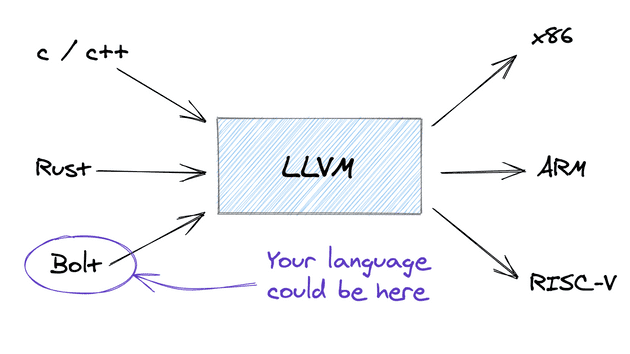
Constructing an LLM-Computer | Percepta
How we analytically compiled a WebAssembly VM into a transformer using a code-to-weights compiler we built.
When compilers surprise you — Matt Godbolt’s blog
Sometimes compilers can surprise and delight even a jaded old engineer like me
A Compiler Author’s Guide to WebAssembly GC by Oscar Spencer @ Wasm I/O 2025
Wasm 3.0 Completed - WebAssembly
WebAssembly (abbreviated Wasm) is a binary instruction format for a stack-based virtual machine. Wasm is designed as a portable compilation target for programming languages, enabling deployment on the web for client and server applications.
Essentials of Compilation
Compilers are notoriously difficult programs to teach and understand. Most books about compilers dedicate one chapter to each progressive stage, a structure ...
Wasm 2.0 Completed - WebAssembly
WebAssembly (abbreviated Wasm) is a binary instruction format for a stack-based virtual machine. Wasm is designed as a portable compilation target for programming languages, enabling deployment on the web for client and server applications.
Signals and Threads
Stephen Dolan works on Jane Street’s Tools and Compilers team where he focuses on the OCaml compiler. In this episode, Stephen and Ron take a trip down memory lane, discussing how to manage computer memory efficiently and safely. They consider trade-offs between reference counting and garbage collection, the surprising gains achieved by prefetching, and how new language features like local allocation and unboxed types could give OCaml users more control over their memory.

A Coming Revolution in Metaprogramming | Will Crichton
A single programming language is no longer enough. I predict that soon, the best programmers will fluently move between languages and the best languages will interoperate well with others. This interoperability will likely stem from strong metaprogramming facilities. I examine how we might build a programmable compiler and look at recent work toward that end.
Can LLMs Be Computers? | Percepta
We build a computer inside a transformer — executing arbitrary C programs for millions of steps with exponentially faster inference via 2D attention heads.

Also with the obligatory basic bugs common to LLMs "The author of this library would like everyone to know that he was, in fact, well-aware of this requirement, thought about it a lot while designing the library, and then, somehow, forgot" nvd.nist.gov/vuln/detail/cve-2025-4143 nvd.nist.gov/vuln/detail/CVE-2025-4144
NVD - cve-2025-4143
nvd.nist.gov