Warp is an agentic development environment, born out of the terminal. - warpdotdev/warp
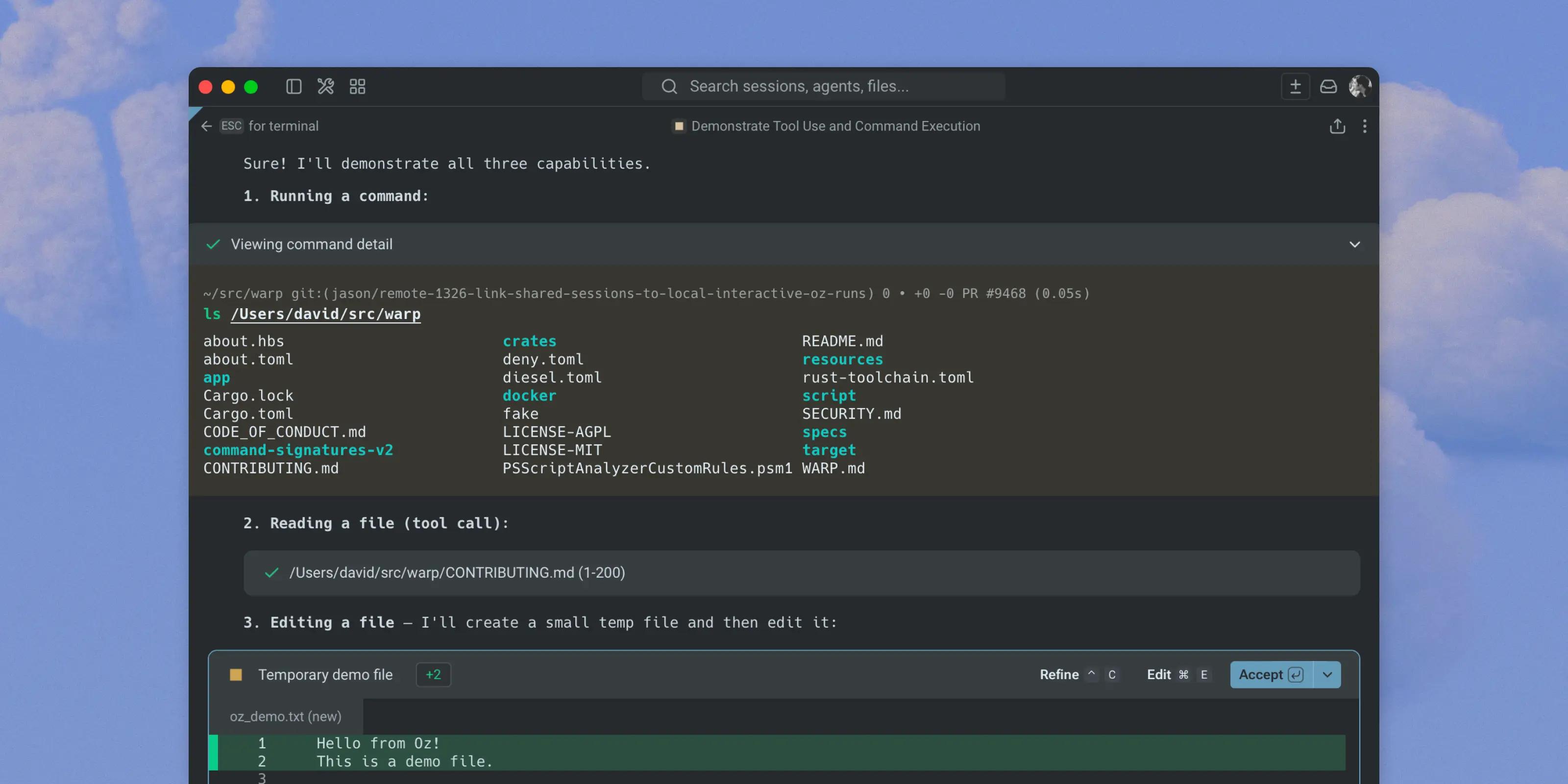
The Block Model Behind Warp's Agentic Development Environment
Warp has come a long way since it initially set out to modernize the terminal. In the screenshot above, an agent is working through a plan alongside a developer's own shell commands — running its own commands, reasoning, proposing a diff — all in the same scroll stream. Five years ago, none of that would have had a place in Warp; today it's a core part of how people use it.
Warp — Open Infrastructure for Cloud Software Factories
Build your software factory on Warp: factories as code, any model or harness, with evals, benchmarks, and self-improvement built in.
WarpBuild - 2x faster, 50% cheaper Github Actions runners
WarpBuild is a drop in replacement for Github runners that are 2x faster and 50% cheaper.
warpfork/try-electron
Contribute to warpfork/try-electron development by creating an account on GitHub.
agentlanguages.dev — Programming languages designed for AI agents to write
A community-edited catalogue of programming languages designed for AI agents to author code, organised around three philosophical camps: syntactic, verification, and orchestration.
Mistral Vibe | AI coding agent for terminal, IDE by Mistral.
Agentic coding that understands your entire codebase. Build, test, and modernize autonomously.
labs/docs/why.md at main · commonfabric/labs
The Common Fabric runtime. Contribute to commonfabric/labs development by creating an account on GitHub.
.github/GOVERNANCE.md at main · co-infra/.github
Contribute to co-infra/.github development by creating an account on GitHub.
repomirror/repomirror.md at main · repomirrorhq/repomirror
Contribute to repomirrorhq/repomirror development by creating an account on GitHub.
morluto/rea
Reverse engineer anything with agents, from app behavior down to native binaries.
skills/openverse/SKILL.md at main · toosean/skills
the skills i wrote. Contribute to toosean/skills development by creating an account on GitHub.
Cognition | Agent Trace: Capturing the Context Graph of Code
We’re excited to join in Cursor, Cloudflare, Vercel, git-ai, OpenCode and others in support of [Agent Trace](https://agent-trace.dev/). As described in the spec, Agent Trace is an open, vendor-neutral spec for recording AI contributions alongside human authorship in version-controlled codebases.