An open-source tool for running controlled behavioral experiments on AI systems at scale.
Meet Foundry: An AI Startup that Builds, Evaluates, and Improves AI Agents

pguso/ai-agents-from-scratch
Demystify AI agents by building them yourself. Local LLMs, no black boxes, real understanding of function calling, memory, and ReAct patterns.
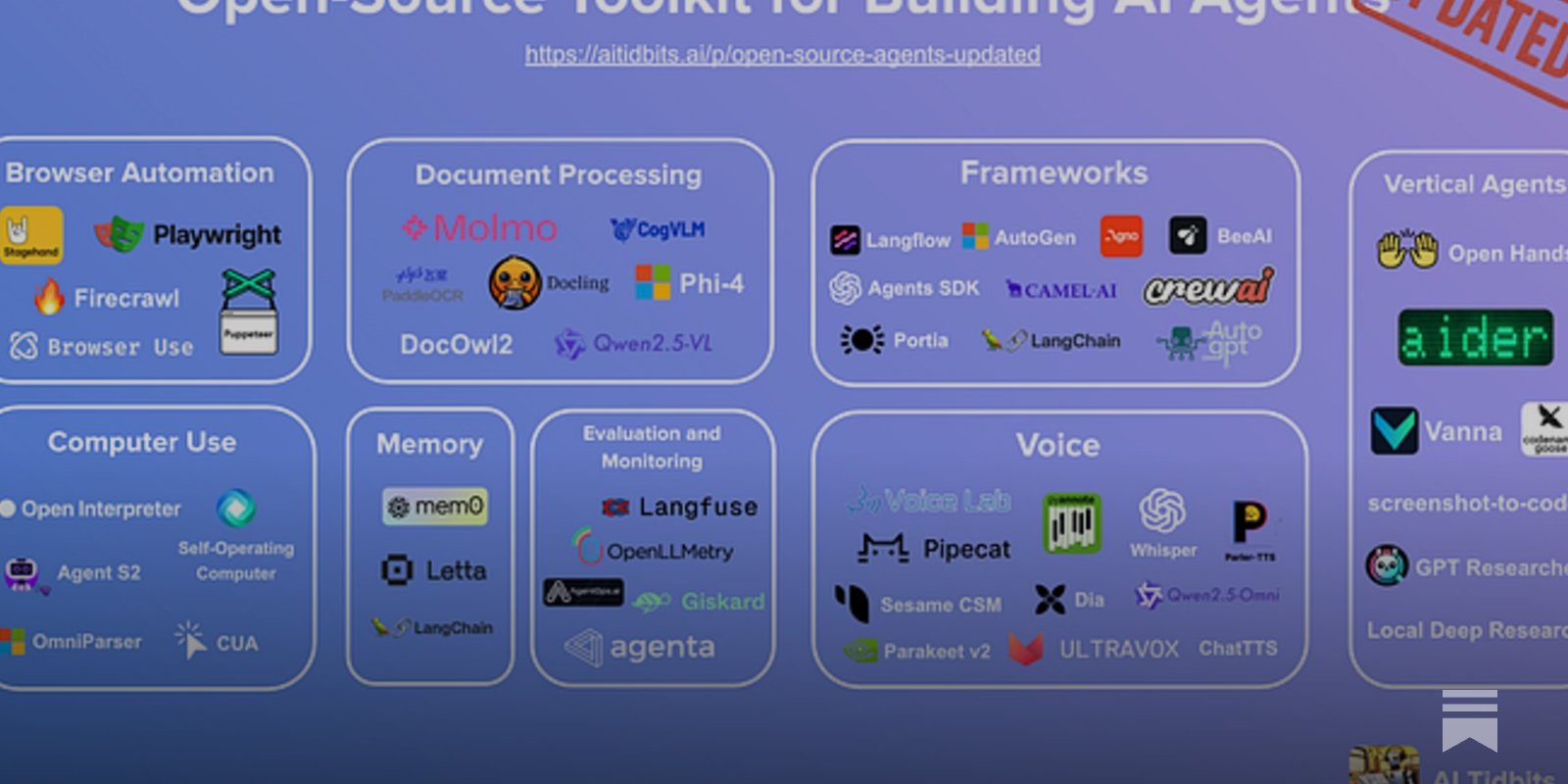
The Open-Source Toolkit for Building AI Agents v2
An opinionated, developer-first guide to building AI agents with real-world impact
AI agents team up in Agent Laboratory to speed scientific research
Johns Hopkins University and AMD have developed Agent Laboratory, a new open-source framework that pairs human creativity with AI-powered workflows.

Measuring the Impact of Early-2025 AI on Experienced Open-Source...
Despite widespread adoption, the impact of AI tools on software development in the wild remains understudied. We conduct a randomized controlled trial (RCT) to understand how AI tools at the...

12britz/awesome-free-models
A curated list of free AI models, APIs, and tools you can use without paying a cent.
AI Simulation Platform for Human Behavior | Simile
Simulate how real customers respond to a launch, price change, or campaign — before you ship. Built by the Stanford researchers behind generative agents.

Introduction to Agents
Discover what actually works in AI. Join millions of builders, researchers, and labs evaluating agents, models, and frontier technology through crowdsourced benchmarks, competitions, and hackathons.

bytedance/UI-TARS-desktop
The Open-Source Multimodal AI Agent Stack: Connecting Cutting-Edge AI Models and Agent Infra
AI Analytics Platform for Your Whole Team
Agentic notebooks, conversational self-serve, and Context Studio for governed AI answers — all in a unified platform for your whole team.

TasteVal: Measuring the Experimental Research Taste of AI Systems Against Human Experts
We introduce TasteVal, a benchmark to evaluate the experimental research taste of frontier models. We define research taste as the ability to pick interesting problems to solve, design experiments, and interpret experimental results. TasteVal measures the experimental component of research taste; given a fixed research problem, we measure how well a model iteratively designs experiments and draws conclusions from their outcomes. We operationalize experimental research taste as compute efficiency; a Researcher who reaches the same score as an expert human using half the serial experimental compute has twice the experimental taste. Experimental taste thus acts as a multiplier on experimental compute, making it a key input to forecasts of AI progress. TasteVal consists of 8 novel, challenging, open-ended tasks representative of frontier AI R&D. To isolate taste from coding ability, the model under evaluation acts as a Researcher that iteratively designs experiments while a fixed Coder agent implements them and reports their results. The Researcher executes until either the 40 H100 hour or 120 wall-clock hour budgets are exhausted. We recruit 24 human experts, at least 2 per task, and take the best expert attempt per task as the expert baseline. We evaluate 20 models released between 2023 and 2026. The best-performing model, Opus 5.5, exceeds our expert baseline, with a compute multiplier of 2.3x (95% CI 1.15-4.37), at roughly 1/30 of our baseliners' average per-run cost. On TasteVal, the compute multiplier of frontier models has doubled approximately every 3.0 months since December 2025 (95% CI 1.7-5.0), up from every 14 months between 2023 and December 2025. Measured by final normalized performance, frontier models show no trend break, doubling every 14.6 months. To keep TasteVal uncontaminated, we do not release the tasks.
Strata Demo video
Strata Demo video
Pause Giant AI Experiments: An Open Letter - Future of Life Institute
We call on all AI labs to immediately pause for at least 6 months the training of AI systems more powerful than GPT-4.