

Exploring LLM-powered automation in platform-based software collaboration
'AI' Sucks the Joy Out of Programming
I’ve used spicy auto-complete, as well as agents running in my IDE, in my CLI, or on GitHub’s server-side. I’ve been experimenting enough with LLM/AI-driven programming to have an opinion on it. And it kind of sucks.

Andrej Karpathy: Software Is Changing (Again)
After automation: Software will work for you, not on you
Alex Komoroske, CEO and cofounder, Common Tools — AI promises “infinite software”—endless tools tailored to every need—but funneled through today's app stores, that abundance just means more silos, more trapped data, and more to orchestr...

If an AI agent can’t figure out how your API works, neither can your users
Discover how LLM‑powered agents act as tireless API testers—exposing friction in docs, errors, and design—and learn six essential strategies (consistency, comprehensive docs, rich errors, example‑driven tutorials, simplicity, and feedback loops) to elevate your API’s developer experience for both humans and machines alike.

We build AI that works for humans
Imbue builds AI to help people think, create, and build. We share our tools openly because we believe progress in AI should be collaborative and developer-driven

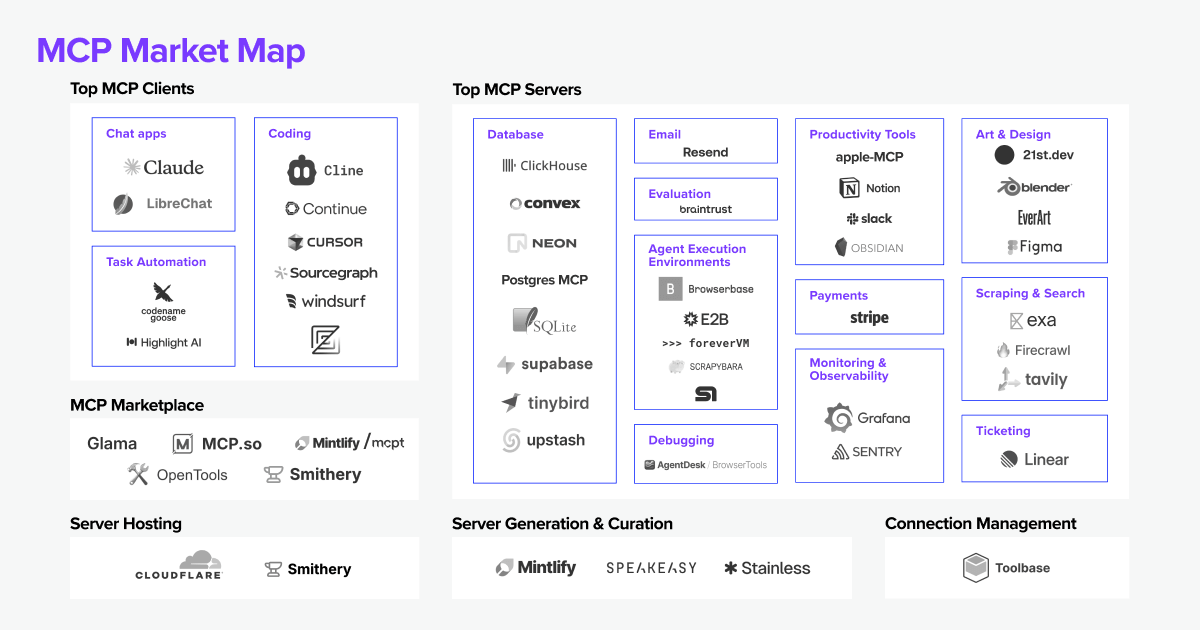
A Deep Dive Into MCP and the Future of AI Tooling | Andreessen Horowitz
We explore what MCP is, how it changes the way AI interacts with tools, what developers are already building, and the challenges that still need solving.
Getting Started with ML and AI in Research Software | Software Sustainability Institute
Getting started with ML in research software means embracing a shift in how results are produced and reproduced. Instead of a fixed execution path, research software teams work with systems whose behaviour emerges from data, configuration, and training dynamics. Reproducibility becomes a matter of capturing the process rather than relying solely on the code. The tools and techniques outlined here can be adopted incrementally into existing projects, and together they provide a practical foundation for reproducible ML research.

Towards End-to-End Automation of AI Research
The automation of science is a long-standing ambition in the field of AI. While the community has made significant progress in automating individual components of the scientific process, a system that autonomously navigates the entire research lifecycle -- from conception to publication -- has remained out of reach. Here, we present the strongest demonstration to date toward automating the entire process end-to-end. We present The AI Scientist, which creates research ideas, writes code, runs experiments, plots and analyzes data, writes the entire scientific manuscript and performs its own peer review. Its ideas, execution, and presentation are of sufficient quality to produce a manuscript generated by an AI system that passes the first round of peer review at a major machine learning conference workshop. The workshop has an acceptance rate of 70 percent. Our system leverages modern foundation models within a complex agentic system. We evaluate The AI Scientist in two settings: a focused mode using human-provided code templates as an initial scaffold to conduct research on a specific topic, and a template-free, open-ended mode that leverages agentic search for wider scientific exploration. Both settings produce diverse ideas and automatically test, report on, and evaluate them. This achievement demonstrates AI's growing capacity for scientific contribution and signifies a potential paradigm shift in how research is conducted. As with any impactful new technology, there could be significant risks, including taxing overwhelmed review systems and adding noise to scientific literature. However, if developed responsibly, such autonomous systems could greatly accelerate scientific discovery.

Optimizing Agentic Workflows using Meta-tools
Agentic AI enables LLM to dynamically reason, plan, and interact with tools to solve complex tasks. However, agentic workflows often require many iterative reasoning steps and tool invocations,...
From OSS to Open Source AI: an Exploratory Study of Collaborative...
AI development is embracing open-source paradigm, but the fundamental distinction between AI models and traditional software artifacts may lead to a divergent open-source development paradigm with...
Agentic Laboratories of the Future: Towards World Models for Scientific Discovery
Scientific discovery is fundamentally a problem-solving process involving distributed intelligence. Human intuition, computational reasoning, and experimental execution are distributed across people, instruments, and software systems, limiting the speed and scale of discovery. Although automation, high-throughput experimentation, foundation models, and cloud infrastructure have accelerated individual stages of the scientific workflow, they have not unified the discovery process. We hypothesize that the next generation of laboratories will be agentic: environments in which scientists, AI systems, and robotic platforms operate as collaborative discovery partners, with humans contributing the parts of discovery that remain hardest to make explicit: asking the right questions and holding provisional mechanistic models of how a system works. The key missing layer is an agentic harnessing layer that continuously integrates hypothesis, literature-derived evidence, experimental data, uncertainty, and experimental state into a shared “laboratory world model”—a dynamic representation of the scientific system and its evolving context. By maintaining and updating this lab world model, the agentic harnessing layer enables coordinated decision-making, adaptive planning, and increasingly autonomous scientific workflows across humans and machines. A central challenge is that much of the scientific research process remains inaccessible to machines, including tacit knowledge, human observations, adaptive decision-making, and evolving experimental context. Advances in multimodal AI and immersive interfaces may help bridge this gap, allowing humans, agents, and robotic systems to collaborate seamlessly in scientific discovery rather than simply automating isolated tasks. Agentic laboratories could provide a new architecture for science, integrating human, artificial, and physical intelligence into a unified discovery system.

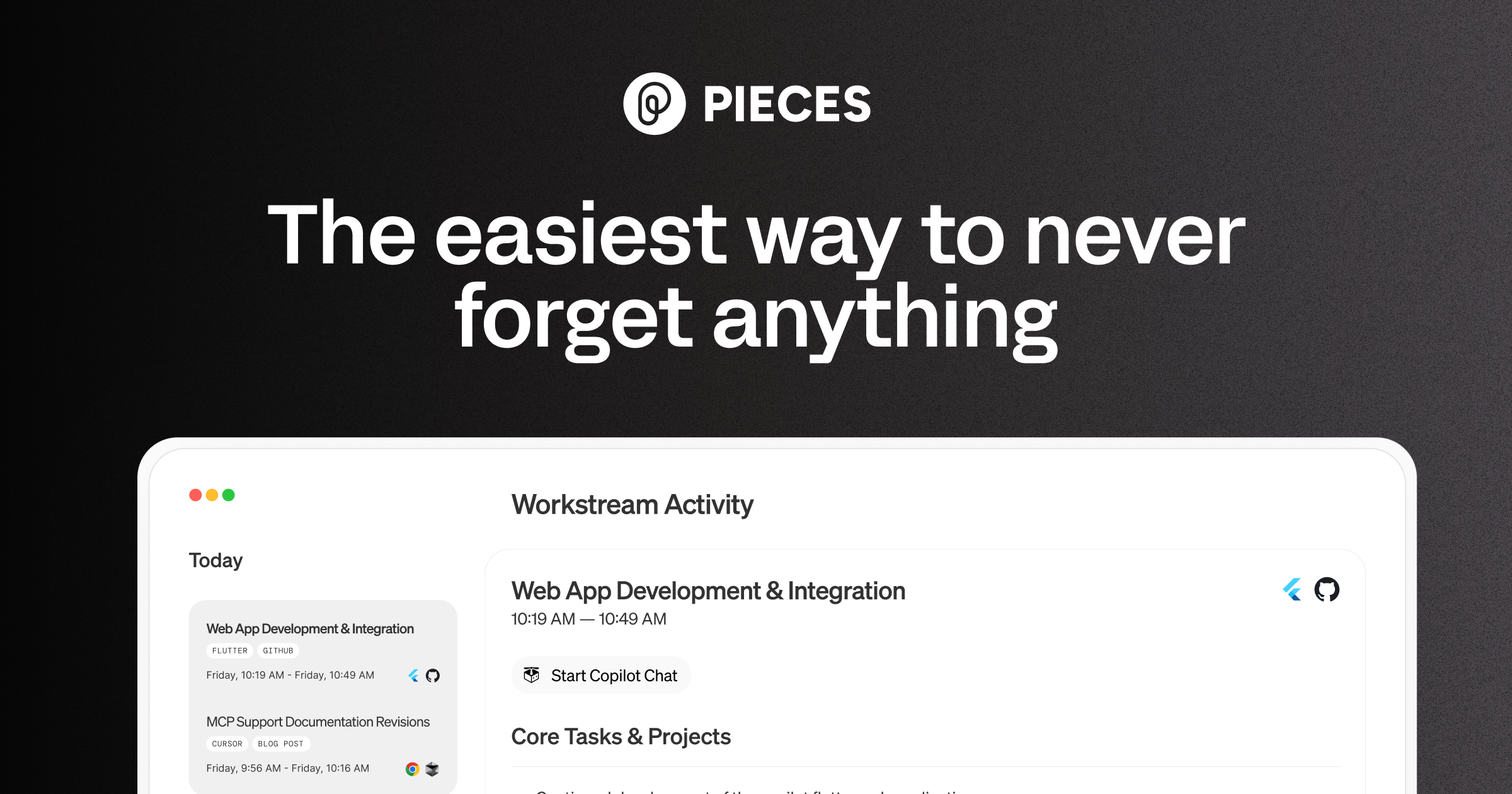
Pieces | Infinite Artificial Memory for your Digital Workers and Agents
Pieces is your AI companion that captures live context from browsers to IDEs and collaboration tools, manages snippets and supports multiple llms - all while processing data locally for maximum control.
Meet Foundry: An AI Startup that Builds, Evaluates, and Improves AI Agents

Collaborative AI Engineering: One Dev, Two Dozen Agents, Zero Alignment — Maggie Appleton, GitHub
Our newest project is taking flight: meet codename goose! 🪶 Today, we launched an open source on-machine AI Agent. It’s modular, works with your preferred LLM, and integrates seamlessly with developer tools and other software via MCP. Developers, check it out! block.github.io/goose/blog/2025/01/28/introdu…

Introducing codename goose
block.github.io