


It's not just distant recollections that can fool you.
False Memories Can Form Within Seconds, Study Finds - Slashdot
In a new study, scientists found that it's possible for people to form false memories of an event within seconds of it occurring. This almost-immediate misremembering seems to be shaped by our expectations of what should happen, the team says. Gizmodo reports: "This study is unique in two ways, in ...

Is the Memory Shortage Intentional? | Contrary Research
A deep dive from Contrary Research.
“Infantile amnesia” occurs despite babies showing memory activity
It looks like humans actively suppress our earliest memories.

When Bad Things Happen in Slow Motion - Nautilus
Is there more to our experience of time than the foibles of memory?

To Remember, the Brain Must Actively Forget | Quanta Magazine
Researchers find evidence that neural systems actively remove memories, suggesting that forgetting may be the default mode of the brain.

Our Brains Keep Us 15 Seconds 'in The Past' to Help Us See a Stable World, Says Study
The past is present.
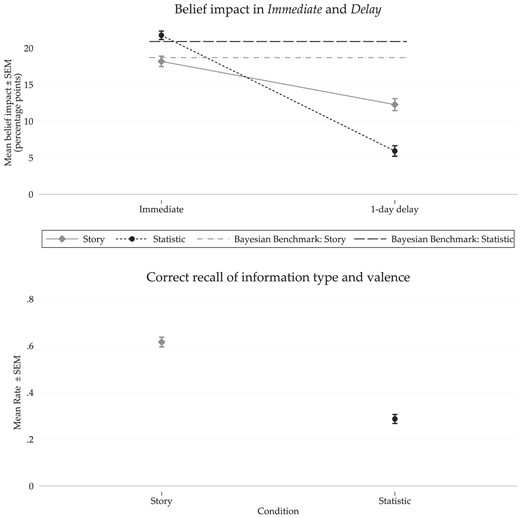
Stories, Statistics, and Memory
Abstract For many decisions, we encounter relevant information over the course of days, months, or years. We consume such information in various forms, including stories (qualitative content about individual instances) and statistics (quantitative data about collections of observations). This article proposes that information type—story versus statistic—shapes selective memory. In controlled experiments, we document a pronounced story-statistic gap in memory: the average impact of statistics on beliefs fades by 73% over the course of a day, but the impact of a story fades by only 32%. Guided by a model of selective memory, we disentangle different mechanisms and document that similarity relationships drive this gap. Recall of a story increases when its qualitative content is more similar to a memory prompt. Irrelevant information in memory that is similar to the prompt, on the other hand, competes for retrieval with relevant information, impeding successful recall.
We’re underestimating the mind-warping potential of fake video
Doctored photos can easily create false memories. What happens when there’s fake video?

Walking backwards can boost your short-term memory | New Scientist
Moving backwards - or simply imagining doing it - can be enough to improve scores on memory tests, but we don't know why

Brain Study Suggests Traumatic Memories Are Processed as Present Experience (Published 2023)
Traumatic memories had their own neural mechanism, brain scans showed, which may help explain their vivid and intrusive nature.

Study illuminates the structural features of memory formation at cellular and subcellular levels
NIH-funded study uses cutting-edge imaging techniques to reconstruct features underlying learning and memory in the mouse brain.

To Make Sense of the Present, Brains May Predict the Future | Quanta Magazine
A controversial theory suggests that perception, motor control, memory and other brain functions all depend on comparisons between ongoing actual experiences and the brain’s modeled expectations.

The Cognitive Debt of Digging Through Preprints
Your Brain on MIT Media Lab

A Successful Artificial Memory Has Been Created
The growing science of memory manipulation raises social and ethical questions

I don't understand this. 52 years later, why try and replicate the original? It's obviously not going to be the same study. The world has changed; cars, traffic, and people have changed. If one is interested in false memory, why not design the best study you can? What can you conclude meaningfully?
Andrew Gelman et al.
A plan to replicate the Loftus and Palmer (1974) experiment on false memories statmodeling.stat.columbia.edu/2026/10/04/a-plan-to-replicat…
