


Among the (many) mysteries surrounding the gigantic black holes that live at the center of galaxies is just how they managed to get so big, so fast.
Galaxy
A galaxy is a system of stars, stellar remnants, interstellar gas, dust, and dark matter bound together by gravity. The word is derived from the Greek galaxias (γαλαξίας), literally 'milky', a reference to the Milky Way galaxy that contains the Solar System. Galaxies, averaging an estimated 100 million stars, range in size from dwarfs with less than a thousand stars, to the largest galaxies known – supergiants with one hundred trillion stars, each orbiting its galaxy's centre of mass. Most of the mass in a typical galaxy is in the form of dark matter, with only a few percent of that mass visible in the form of stars and nebulae. Supermassive black holes are a common feature at the centres of galaxies.

Scientists Discover Massive 'Pipeline' in the Cosmic Web Connecting the Universe
A new study reveals “by far the best evidence” for the elusive cosmic filaments that supercharge ancient galaxies with cold gas.

The Illustris simulation: the evolving population of black holes across cosmic time
We study the properties of black holes and their host galaxies across cosmic time in the Illustris simulation. Illustris is a large scale cosmological hydrodynamical simulation which resolves a (106.5 Mpc)^3 volume with more than 12 billion resolution elements and includes state-of-the-art physical models relevant for galaxy formation. We find that the black hole mass density for redshifts z = 0 - 5 and the black hole mass function at z = 0 predicted by Illustris are in very good agreement with the most recent observational constraints. We show that the bolometric and hard X-ray luminosity functions of AGN at z = 0 and 1 reproduce observational data very well over the full dynamic range probed. Unless the bolometric corrections are largely underestimated, this requires radiative efficiencies to be on average low, epsilon_r <= 0.1, noting however that in our model radiative efficiencies are degenerate with black hole feedback efficiencies. Cosmic downsizing of the AGN population is in broad agreement with the findings from X-ray surveys, but we predict a larger number density of faint AGN at high redshifts than currently inferred. We also study black hole -- host galaxy scaling relations as a function of galaxy morphology, colour and specific star formation rate. We find that black holes and galaxies co-evolve at the massive end, but for low mass, blue and star-forming galaxies there is no tight relation with either their central black hole masses or the nuclear AGN activity.

Dark matter
In astronomy and cosmology, dark matter is an invisible and hypothetical form of matter that does not interact with light or other electromagnetic radiation. Dark matter is implied by gravitational effects that cannot be explained by general relativity unless more matter is present than can be observed. Such effects occur in the context of formation and evolution of galaxies, gravitational lensing, the observable universe's current structure, mass position in galactic collisions, the motion of galaxies within galaxy clusters, and cosmic microwave background anisotropies. Dark matter is thought to serve as gravitational scaffolding for cosmic structures. After the Big Bang, dark matter clumped into blobs along narrow filaments with superclusters of galaxies forming a cosmic web at scales on which entire galaxies appear like tiny particles.

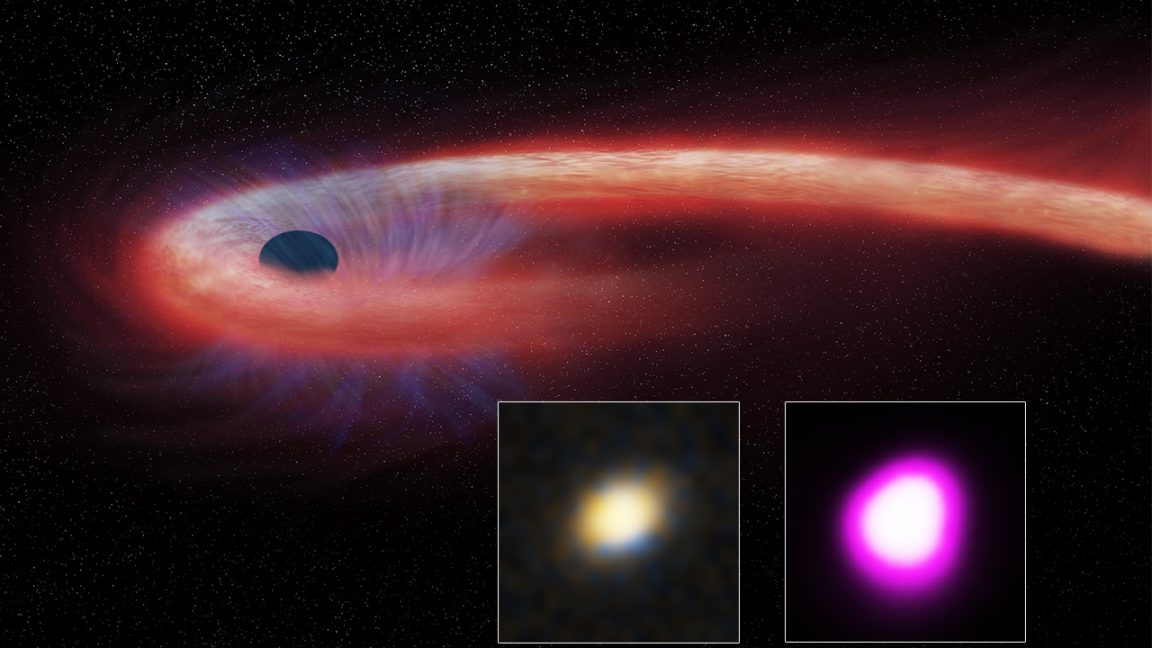
Explaining why a black hole produces light when ripping apart a star
New model tracks the remains of a star looping around a black hole.
The Year in Physics
Physicists saw a black hole for the first time, debated the expansion rate of the universe, pondered the origin of time and modeled the end of clouds.

You have to see this stellar VFX breakdown for Gravity
Hey, remember how Gravity blew your mind? Well, how they made Gravity is pretty much exactly as incredible.

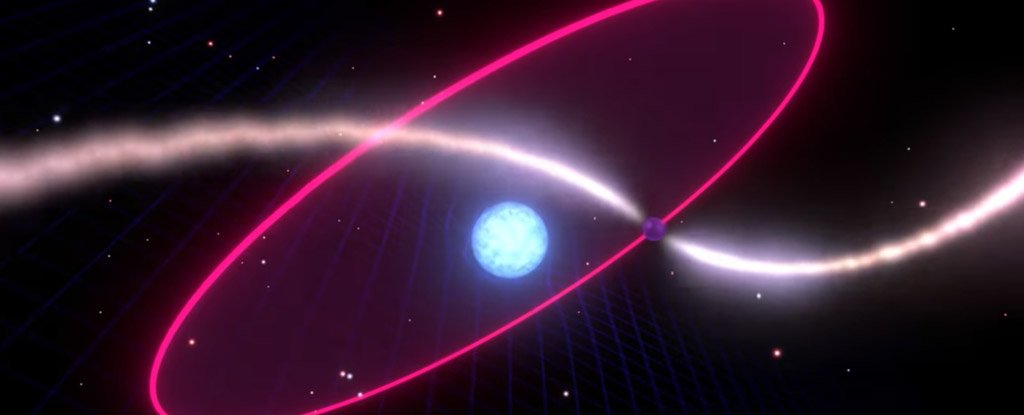
Astronomers Have Caught a Star Literally Dragging Space-Time Around With It
Einstein predicted this!
The Engine of Scientific Discovery: How New Methods and Tools Spark Major Breakthroughs
Abstract. How do we spark new scientific discoveries? Why do some breakthroughs seem even accidental? And most importantly, how can we accelerate them and
Holy Shit! Scientists Have Confirmed the Existence of Gravitational Waves
Since Albert Einstein first predicted their existence a century ago, physicists have been on the hunt for gravitational waves, ripples in the fabric of

The era of precision cosmology with voids
Cosmic voids, the large underdense regions of our Universe, have emerged over the past decade as powerful cosmological laboratories: their simple dynamics, sensitivity to local gravitational...
Science e-Books - NASA Science
From the planets to black holes in distant galaxies, explore NASA science, imagery, and missions through our library of free, downloadable e-books.
How the First Gravitational Waves Were Found
After decades of speculation and searching, a signal came through. It promises to change our understanding of the universe.

NASA's Got a Plan For a 'Galactic Positioning System' To Save Astronauts Lost in Space - Slashdot
From a report: Outer space glows with a bright fog of X-ray light, coming from everywhere at once. But peer carefully into that fog, and faint, regular blips become visible. These are millisecond pulsars, city-sized neutron stars rotating incredibly quickly, and firing X-rays into the universe with ...

Black hole
A black hole is an astronomical body so compact that its gravity prevents anything, including light, from escaping. Albert Einstein's theory of general relativity, which describes gravitation as the curvature of spacetime, predicts that any sufficiently compact mass will form a black hole. The boundary of no escape is called the event horizon. In general relativity, crossing a black hole's event horizon traps an object inside but produces no locally detectable change. General relativity also predicts that every black hole should have a central singularity, where the curvature of spacetime is infinite.
