


Countries with big carbon footprints are giving money to defense contractors as opposed to fulfilling their climate aid promises, a new report finds.
Vast fossil fuel and farming subsidies causing ‘environmental havoc’
World Bank says subsidies costing as much as $23m a minute must be repurposed to fight climate crisis
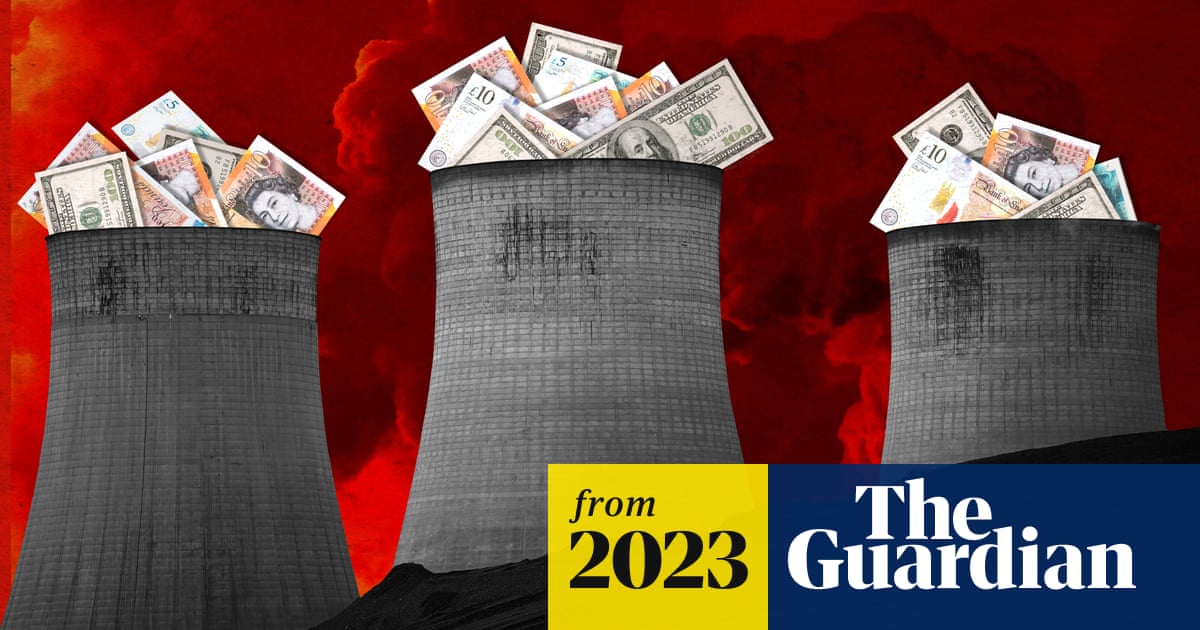
20 meat and dairy firms emit more greenhouse gas than Germany, Britain or France
Livestock companies with large emissions receive billions of dollars in funding, campaigners say

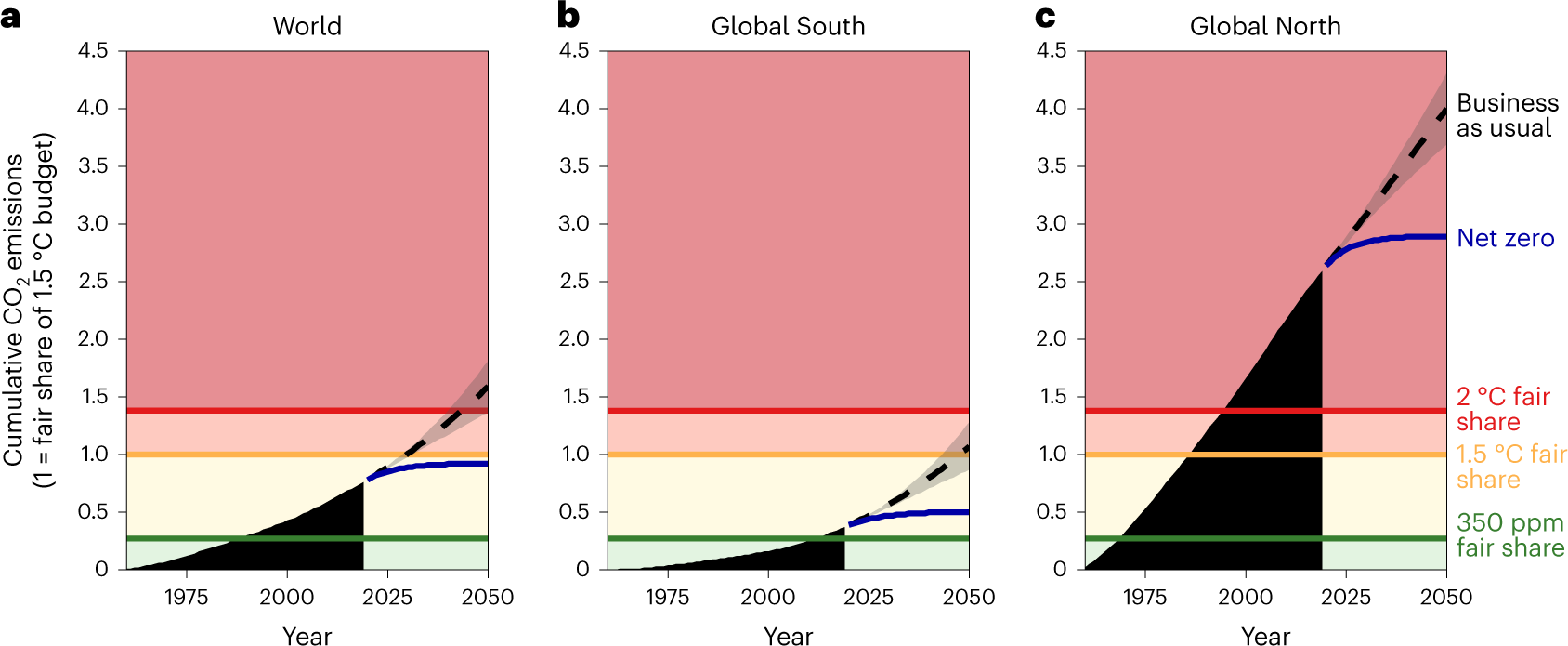
Compensation for atmospheric appropriation
Research on carbon inequalities shows that some countries are overshooting their fair share of the remaining carbon budget and hold disproportionate responsibility for climate breakdown. Scholars argue that overshooting countries owe compensation or reparations to undershooting countries for atmospheric appropriation and climate-related damages. Here we develop a procedure to quantify the level of compensation owed in a ‘net zero’ scenario where all countries decarbonize by 2050, using carbon prices from IPCC scenarios that limit global warming to 1.5 °C and tracking cumulative emissions from 1960 across 168 countries. We find that even in this ambitious scenario, the global North would overshoot its collective equality-based share of the 1.5 °C carbon budget by a factor of three, appropriating half of the global South’s share in the process. We calculate that compensation of US$192 trillion would be owed to the undershooting countries of the global South for the appropriation of their atmospheric fair shares by 2050, with an average disbursement to those countries of US$940 per capita per year. We also examine countries’ overshoot of equality-based shares of 350 ppm and 2 °C carbon budgets and quantify the level of compensation owed using earlier and later starting years (1850 and 1992) for comparison.
Pentagon Fears Confirmed: Climate Change Leads to War, Refugees
The most comprehensive study done to assess the link between climate change, war and migration has confirmed that the warming planet is fueling conflicts that lead to more refugees.

Super-rich get ‘double dividend’ from causes and costs of climate crisis, report finds
Oxfam says investing by rich in disaster recovery widens inequality and gives incentive to delay climate action

The Climate Solution Actually Adding Millions of Tons of CO2 Into the Atmosphere — ProPublica
New research shows that California’s climate policy created up to 39 million carbon credits that aren’t achieving real carbon savings. But companies can buy these forest offsets to justify polluting more anyway.

Militaries and conflict: critical gaps in climate action - CEOBS
Analysing how governments address military emissions and conflict impacts in their UNFCCC Nationally Determined Contribution climate plans.
In Deep
The numbers are simply mind-blowing: up to £264 billion for a climate “solution” that will increase emissions. Has the government lost its mind?

As the Planet Warms, Canada Faces an Influx of Climate Refugees
Advocates want the government to allow more climate-related immigration and to consider those migrants “protected persons.”
Climate change: The rich are to blame, international study finds
The Leeds University study looked at 86 countries and came to broadly the same conclusions about the rich.

The world’s perilous Ebola complacency
Global leaders must fund the Africa-led regional response today, or risk paying a higher price in human lives and economic devastation tomorrow.

Austerity and climate (in)action
In the wake of the 2008 global financial crisis, many governments implemented austerity policies aimed at reducing budget deficits through public spending cuts. This column examines the rollout of programme awarding grants for home energy efficiency upgrades in the UK examine the extent to which cuts to local government finances may have impacted efforts to promote climate action. The findings suggest that austerity, combined with poor digital skills, undermined local authorities’ efforts to effectively carry out a climate action policy that was centrally planned but locally administered.

RETRACTED ARTICLE: The economic commitment of climate change
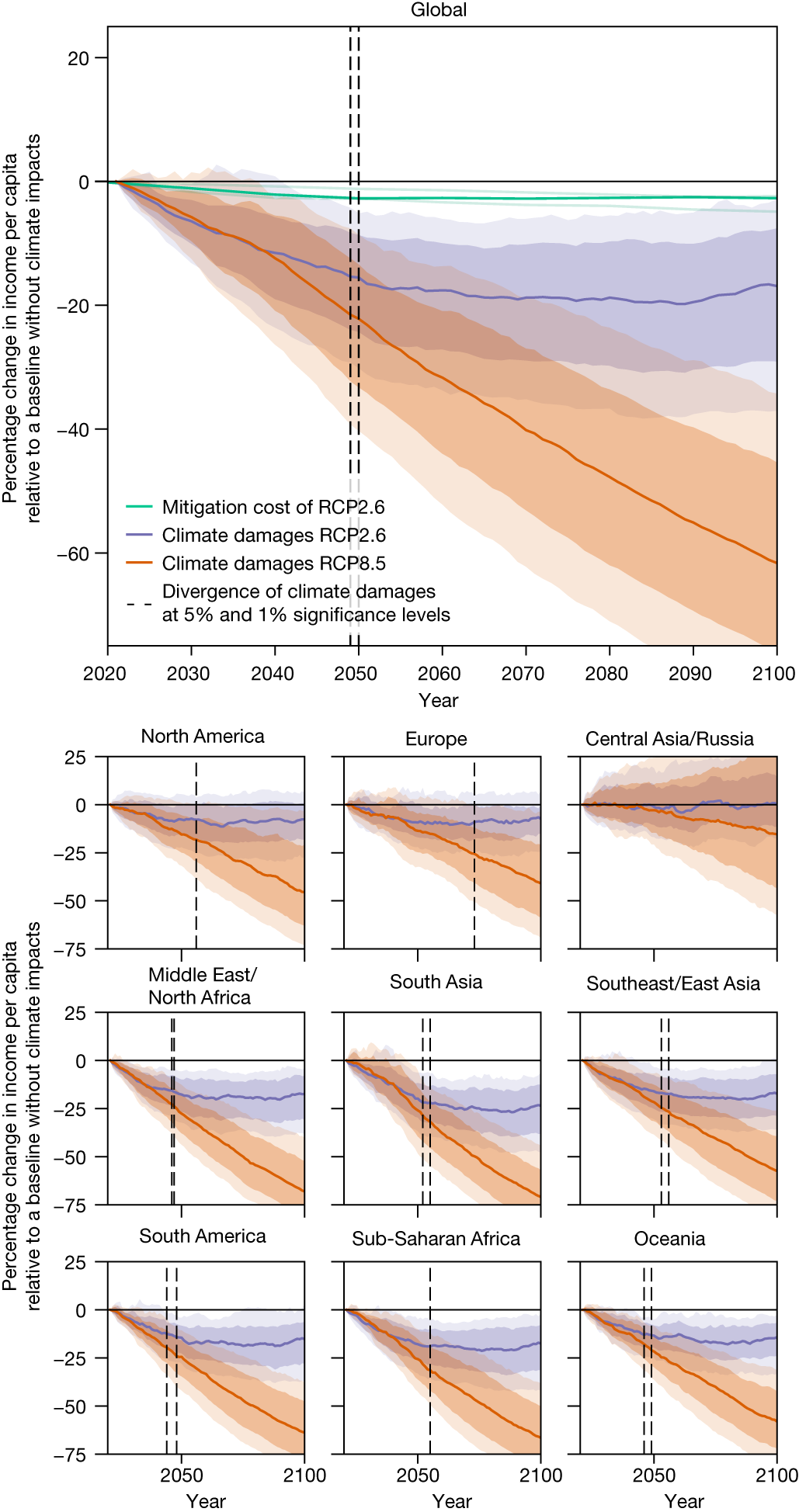
Global projections of macroeconomic climate-change damages typically consider impacts from average annual and national temperatures over long time horizons1–6. Here we use recent empirical findings from more than 1,600 regions worldwide over the past 40 years to project sub-national damages from temperature and precipitation, including daily variability and extremes7,8. Using an empirical approach that provides a robust lower bound on the persistence of impacts on economic growth, we find that the world economy is committed to an income reduction of 19% within the next 26 years independent of future emission choices (relative to a baseline without climate impacts, likely range of 11–29% accounting for physical climate and empirical uncertainty). These damages already outweigh the mitigation costs required to limit global warming to 2 °C by sixfold over this near-term time frame and thereafter diverge strongly dependent on emission choices. Committed damages arise predominantly through changes in average temperature, but accounting for further climatic components raises estimates by approximately 50% and leads to stronger regional heterogeneity. Committed losses are projected for all regions except those at very high latitudes, at which reductions in temperature variability bring benefits. The largest losses are committed at lower latitudes in regions with lower cumulative historical emissions and lower present-day income.
France’s big climate problem: The budget crunch
Historic heat is forcing the French government to rethink its spending plans.

Imperialist appropriation in the world economy: Drain from the global South through unequal exchange, 1990–2015
Unequal exchange theory posits that economic growth in the “advanced economies” of the global North relies on a large net appropriation of resources and labour from the global South, extracted through price differentials in international trade. Past attempts to estimate the scale and value of this drain have faced a number of conceptual and empirical limitations, and have been unable to capture the upstream resources and labour embodied in traded goods. Here we use environmental input-output data and footprint analysis to quantify the physical scale of net appropriation from the South in terms of embodied resources and labour over the period 1990 to 2015. We then represent the value of appropriated resources in terms of prevailing market prices. Our results show that in 2015 the North net appropriated from the South 12 billion tons of embodied raw material equivalents, 822 million hectares of embodied land, 21 exajoules of embodied energy, and 188 million person-years of embodied labour, worth $10.8 trillion in Northern prices – enough to end extreme poverty 70 times over. Over the whole period, drain from the South totalled $242 trillion (constant 2010 USD). This drain represents a significant windfall for the global North, equivalent to a quarter of Northern GDP. For comparison, we also report drain in global average prices. Using this method, we find that the South’s losses due to unequal exchange outstrip their total aid receipts over the period by a factor of 30. Our analysis confirms that unequal exchange is a significant driver of global inequality, uneven development, and ecological breakdown.
