


The oldest human to have ever lived died at the age of 122—and that was nearly 20 years ago. A recent analysis of global demographic data suggests this
The Quest for Longevity Is Already Over
Studying people who live well beyond the age of 100 could reveal the secret to living longer, healthier lives. But the statistics tell another story.
Scientists find humans age dramatically in two bursts – at 44, then 60
US findings suggesting ageing is not a slow and steady process could explain spikes in health issues at certain ages
Ageing Accelerates at Around Age 50 - Some Organs Faster Than Others - Slashdot
A new analysis of protein changes across human tissues has identified an aging acceleration point around age 50, with blood vessels showing the most dramatic deterioration. Researchers examined tissue samples from eight body systems in 76 people of Chinese ancestry aged 14 to 68 who died from accide...

The Math That Shows Humans Could Live Ten Times Longer
A new model shows that evolution has programmed us to die—and that reprogramming isn’t off the table.

Human bodies begin breaking down at two very precise ages, but scientists aren’t yet sure why
It's no revelation that the human body undergoes natural wear and tear as we age. But you might be surprised to discover that this process isn't as gradual as we'd presumed.

Massive biomolecular shifts occur in our 40s and 60s, Stanford Medicine researchers find
Time marches on predictably, but biological aging is anything but constant, according to a new Stanford Medicine study.

Our Bodies Age in Three Distinct Shifts, According to More Than 4,000 Blood Tests
Things change at 34, 60, and 78.

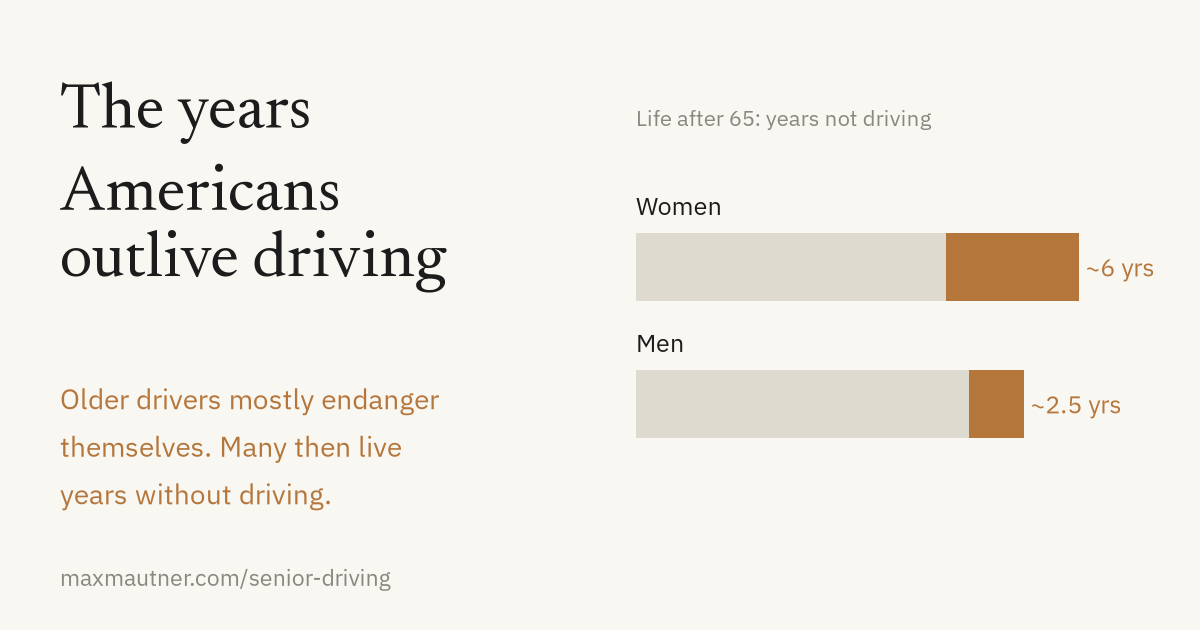
The years Americans outlive driving
Per mile, drivers 75 and older are in fatal crashes as often as drivers under 25, but the people who die are mostly the older drivers themselves. Women can expect ~6 years of life after 65 without driving, men ~2.5.
Estrogen: Women’s Secret Recipe To Longevity
Longevity is becoming increasingly popular to elongate health-span. We turn to estrogen to understand its impact on women's long-term well-being.

The Global Decline in the Mental Health of the Young
One of the major findings in wellbeing research until recently was that happiness was U-shaped by age and unhappiness hump-shaped by age. There was a midlife crisis — a finding reported in well over 600 published papers using data on 145 countries. It was present in both developing and developed countries. And it was persistent over time. The finding of a peak in ill-being in midlife was consistent with Anne Case and Angus Deaton’s work on mortality and the so-called “deaths of despair.”1 In the US in particular and to a lesser extent in other countries, White prime-aged individuals without a college degree had high death rates from suicide, drug overdoses, and cirrhosis of the liver. Drug overdose deaths in the US, for example, peaked at midlife ages. In 2023, the Centers for Disease Control and Prevention (CDC) reported that overdose death rates per 100,000 by age rose from 13.5 for 15-to-24-year-olds to 45.6 for 25-to-34-year-olds and 60.8 for 35-to-44-year-olds, and then declined to 53.3 for 45-to-54-year-olds, 49.2 for 55-to-64-year-olds, and 14.7 for those over the age of 65.2 The morbidity data matched the mortality data.

Scientists Discover 4 Distinct Patterns of Aging
Scientists have come closer to understanding why people seem to age at different rates.

Genetics play less of a role in lifespan than we thought
Large historical analysis points to marriage choices skewing the stats.

Safeguarding human health in the Anthropocene epoch: report of The Rockefeller Foundation–Lancet Commission on planetary health
Far-reaching changes to the structure and function of the Earth's natural systems represent a growing threat to human health. And yet, global health has mainly improved as these changes have gathered pace. What is the explanation? As a Commission, we are deeply concerned that the explanation is straightforward and sobering: we have been mortgaging the health of future generations to realise economic and development gains in the present. By unsustainably exploiting nature's resources, human civilisation has flourished but now risks substantial health effects from the degradation of nature's life support systems in the future.

Research finds that renting ages you faster than smoking, obesity
Millions of Aussies are losing years to accelerated ageing because of one absolute living essential, an alarming new study has revealed.

Human Race Just 0.01% of All Life But Has Destroyed 83% of Wild Mammals, Study Finds - Slashdot
An assessment of all life on Earth has revealed humanity's surprisingly tiny part in it as well as our disproportionate impact. From a report: The world's 7.6 billion people represent just 0.01% of all living things, according to the study. Yet since the dawn of civilisation, humanity has caused the...

The extraordinary life and death of the world’s oldest known spider
This is the story of a 43-year-old spider and the people who knew her.
