


A new study released by the Metropolitan Community of Montreal (MMC) finds the economic benefits of public transit are far greater than personal automobiles.
The cost of driving versus using a bike and transit (or: how to save over $7,000 a year)
I thought it would be fun to find out: how much money did I save in 2025 by cycling and using transit compared to using a car as my primary way of getting around?

Cycling Toward a Cooler Toronto | The Power of Bike Lanes
A Modest Proposal for Funding Transit Instead of AI
In the ’60s, the Bay Area almost got a high-speed train from Marin to San Jose. What could happen if we dreamed big again?

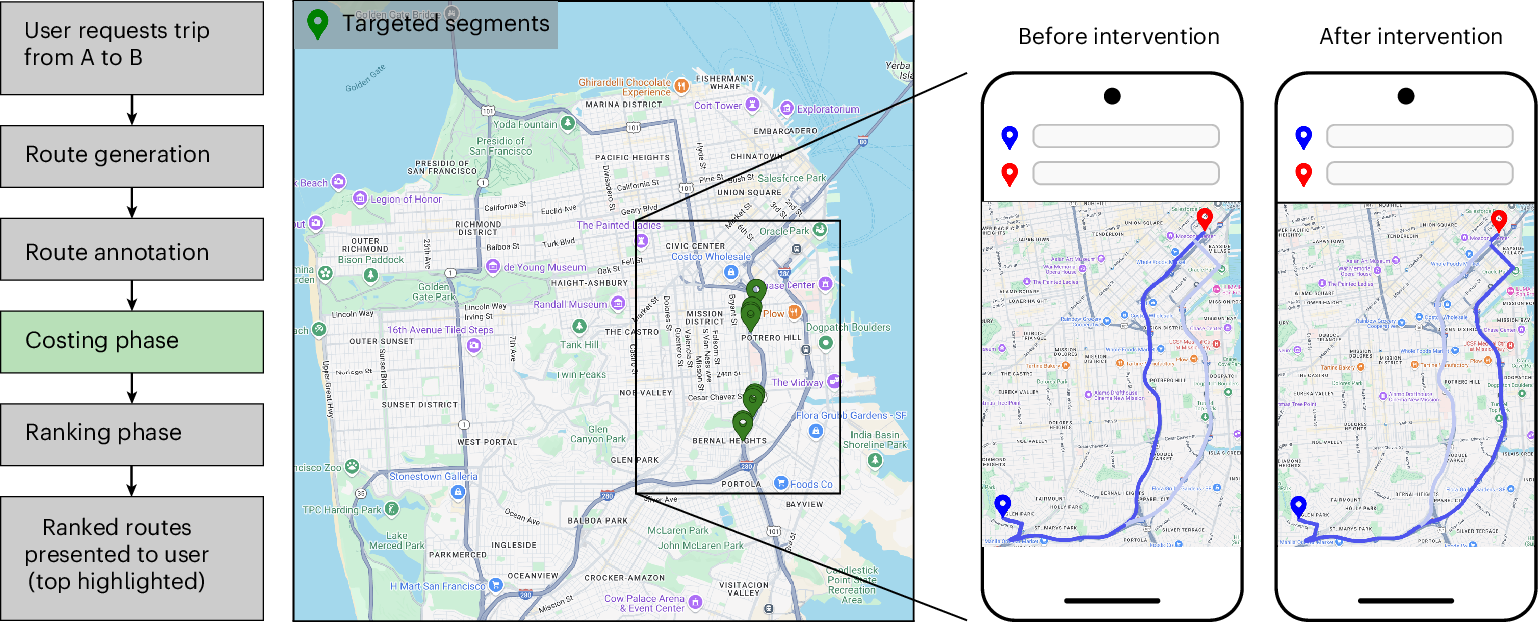
Urban congestion relief experiments through routing-app interventions
Traffic congestion remains a persistent challenge for urban mobility, increasing travel delays and elevating CO2 emissions. The widespread use of smartphones and GPS navigation creates new opportunities to mitigate congestion through routing optimizations in apps, yet real-world evidence for the effectiveness of such interventions is limited. Here we report large-scale empirical experiments evaluating routing-based traffic interventions on ~100 highly congested road segments across 10 major US cities. By rerouting a small share of Google Maps trips from targeted congested highway and arterial segments to less congested alternatives of equivalent road-classes with comparable travel times, we observe a city-average 2% increase in vehicle speeds on the intervened segments, along with improved travel times 0.7% and potential annual reductions exceeding 1,000 tons of CO2-equivalent emissions per city in the majority of studied locations. These findings provide evidence that marginal routing interventions involving a small proportion of vehicles can measurably enhance overall road network efficiency, offering a practical pathway to easing congestion and advancing urban sustainability.
Second Street | How Government Policies Affect Canadians
We investigate the real-world impact of government policy through groundbreaking research and the personal stories of everyday Canadians.

What Is the Economic Impact of Data Centers? It’s a Secret. - Inside Climate News
N.C. Gov. Josh Stein wants state lawmakers to rethink tax breaks for data centers. The industry’s opacity makes it difficult to evaluate costs and benefits.

Ode to the Shanghai Metro - Phoebe Lemon
Wayfinding has many applications, and arguably the most important one is public transportation systems. Granted, there are many different ways to design such a system, and the politics and culture of the environment in which it will be integrated certainly plays a large role. Interestingly, often when we discuss transportation systems on the global scale, individuals are so quick to praise New York or London’s metro systems, Europe’s “high speed” rail system, or how “Uber is the most original new technology cities have seen”. All of these statements are subjective, but somehow they’ve become accepted fact, especially in the West, and I argue that anyone who gives European/American public transport that much praise is blissfully living in a bubble. As an international student who grew up in America and has visited most of its major cities, lived in China for two years, and is now studying in the Middle East, I’ve had the opportunity to use almost every public transportation system to exist. Old fashion taxis, the Maglev, high speed trains, shared bikes, shared mopeds, carpools, the bus, the metro, I have used them all, but nothing quite compares to the way China does public transport.

Designing a wayfinding concept for Vancouver's Skytrain system.
I wasn’t always a big fan of public transport.

Chicago's Bike Lanes Don't Hurt Businesses, City Report Finds
As protected bike lanes face opposition in some neighborhoods, city-backed case studies found lanes in a half-dozen corridors have not contributed to a negative impact on economic activity.

Move fast and break kings
There is another policy response to tariffs, one that will substantially lower prices for Canadians, while incubating profitable, export-oriented Canadian tech firms, whose products can be sold by community-based small and medium enterprises, to the benefit of the Canadian news and culture industry, Canadian software firms, and Canadian consumers.

Community Wealth Building — Urban Affairs Review
Scholars of urban politics have long debated the issue of what cities can and should do to promote the economic well-being of their residents. As the of election Zohran Mamdani illustrates, urban residents are increasingly demanding that city governments do more to address the increasingly exorbitant costs of housing, childcare, and transportation. One obvious solution is to raise taxes on the private holders of wealth. By the same token, his election has prompted handwringing on the right about the “inevitable” flight of capital out of New York City. Scholarship that runs the gamut from the public choice school associated with the “city limits” perspective (Peterson 1981) through to Marxian accounts (Logan and Molotch 1987) all recognize that the private ownership of wealth and the mobility of capital puts cities in a bind, especially in a context of highly circumscribed levels of federal urban spending. Though several scholars (Logan and Swanstrom 1990; Kantor and Savitch 1993; Schragger 2016) have demonstrated that cities have greater latitude to promote egalitarian public policies than these perspective allow, few would argue that the deep structural problems of economic and social inequality can be fully resolved by tax-and-spend liberalism (Imbroscio 2010).
U.S. and Canada fall deeper into a trade war with new tariffs as talks collapse and blame is spread
President Donald Trump’s import taxes will hit about 5% of what Canada ships to the United States every year, including products ranging from hockey sticks to tongue depressors.

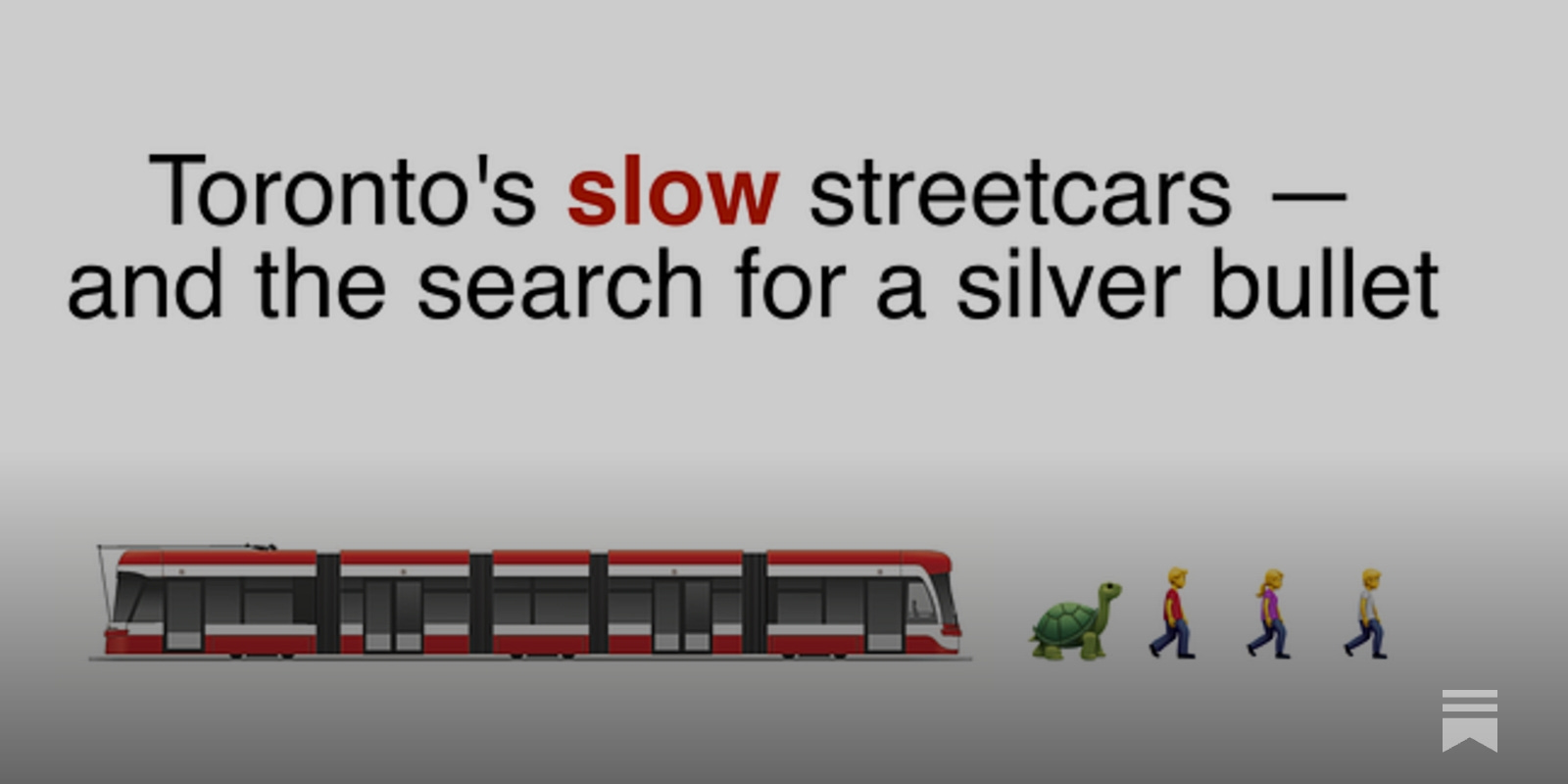
Toronto's slow streetcars — and the search for silver bullets
City Hall Watcher #393: Damien Moule returns with a look at Toronto's seriously slow streetcars, plus notes on budgets, Bike Share and basketball
Have Data Centers Raised Your Electric Bill? Causal Evidence from the United States
We estimate that data centers caused average retail electricity rates to fall modestly in the United States from 2015 to 2024 using an instrumental variables approach. Despite prevailing sentiment, the finding is consistent with economic reasoning: existing large power system fixed costs, economies of scale in transmission and distribution, and declining unit costs for generation imply that durable demand growth lowers average prices. We find patterns of economies of scale for transmission, distribution, and generation costs as well as within and across retail customer classes. We caution that future supply constraints could reverse the effect.

Have Data Centers Raised Your Electric Bill? Causal Evidence from the United States
We estimate that data centers caused average retail electricity rates to fall modestly in the United States from 2015 to 2024 using an instrumental variables approach. Despite prevailing sentiment, the finding is consistent with economic reasoning: existing large power system fixed costs, economies of scale in transmission and distribution, and declining unit costs for generation imply that durable demand growth lowers average prices. We find patterns of economies of scale for transmission, distribution, and generation costs as well as within and across retail customer classes. We caution that future supply constraints could reverse the effect.
