

Google’s Engineering Practices documentation
Better tools made Copilot code review worse. Here's how we actually improved it.
How migrating Copilot code review to shared Unix-style code exploration tools reduced review cost by reshaping agent workflows around pull request evidence.

21 Lessons From 14 Years at Google
Lessons learned from 14 years of engineering at Google, focusing on what truly matters beyond just writing great code.

Review the reviews
When I was actively contributing to the Go project, my primary feed was the code review email firehose. Issues, mailing lists, and Slack had low SNR. The finished commit history was better: it was finely polished work with some of the best written commit messages I have ever encountered. But it didn’t hold a candle to code reviews for operational learning. The commit history could tell you what got done and why, in impressive technical detail.
crawshaw - 2026-05-07
The industry-established code review process, review-then-commit, was a straightforward mechanism that allowed a relatively low-trust group of engineers to collaborate. It appears to have been initially developed for the Apache server OSS project in the 90s, corporatized by Google in the early 2000s, and popularized throughout the industry by several means, most notable of which was the GitHub PR.
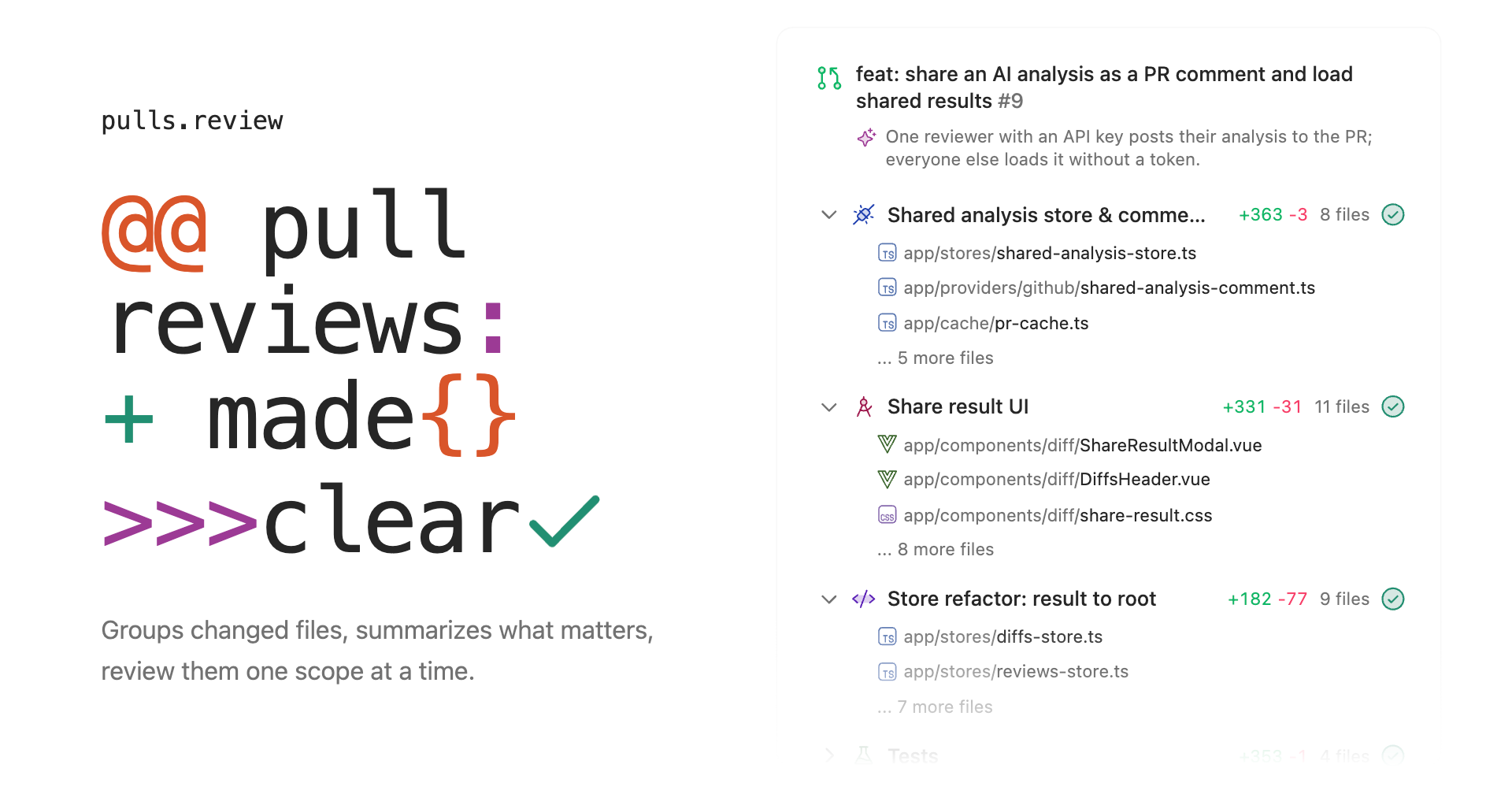
pulls.review
A better way to review a GitHub pull request’s diff: grouped, summarized, and fast.
ReviewBench: An Extensible Framework for Benchmarking Human and AI Manuscript Review
The volume of scientific manuscripts is rising faster than the available pool of expert reviewers, and AI tools are emerging as a possible response, ranging from frontier large language models applied directly to peer review to purpose-built multi-agent systems. Scalable, standardized benchmarks are needed to regularly evaluate how these tools compare to one another and to human reviewers. We present ReviewBench, an open-source, venue-agnostic framework that compares human and AI reviews across structure, alignment with a paper’s major claims, impact, and critique category. We apply ReviewBench to 145,021 review comments from human reviewers, frontier large language models (GPT-5.2, and Gemini 3 Pro), and Reviewer3.com (R3), a multi-agent peer review system. The dataset spans papers in computer science (ICLR 2025, n = 1,000), social science (Nature Human Behaviour, n = 142), and life science (eLife, n = 1,000). Across disciplines, AI reviews are more structured and engage more directly with a paper’s major claims, with R3 more often surfacing consequential comments, defined as comments capable of undermining those claims. When restricting to critical comments, however, human reviewers rank first on consequential rate on more individual papers than any AI source, despite a lower average. We identify a bimodal reviewer distribution with peaks near 0% and 100%, indicating that many reviewers outperform AI on this metric, but a substantial fraction of reviewers near 0% brings the average down. Critique typing demonstrates systematic differences, where humans emphasize contribution and clarity, while AI emphasizes validity, sufficiency, and transparency. Together, these findings argue against framing AI as a replacement for human review and instead support a complementary model in which AI scales technical verification of major claims while human judgment remains essential for evaluating contribution and shaping editorial decisions.

Documentation is more than you think
Everything that is involved in making great documentation everywhere and all at once.
Making Documentation Simpler and Practical: Our Docs-as-Code Journey — Squarespace Engineering Blog
In the fast-paced world of software development, documentation often gets a bad rap. It's perceived as a chore, a necessary evil, and sometimes, unfortunately, an afterthought. But what if writing documentation could be as dynamic and collaborative as writing the code itself? What if it could be si

Docs as Code: The Best Guide for Technical Writers
Recently, my work has involved writing a lot of documentation and. Doing this has introduced me to...

Study finds AI tools made open source software developers 19 percent slower
Coders spent more time prompting and reviewing AI generations than they saved on coding.

Gerrit Code Review | Gerrit Code Review
The open source, patchset based, code review platform for Git-based development
Software Engineering Productivity Research - Home
How Documentation Affects API Quality
If quality depends on consumers' perception, how can API documentation influence it?

Things That Don't Seem Like Documentation
When developers think of documentation, we often tend to think of walls of texts or verbose reference guides. However, the purpose of documentation is to be the UI layer for an API or code library: when you’re learning something new, documentation is the frontend that you spend most of your time interacting with.
ReadMe · Developer-friendly API documentation
ReadMe helps you create beautiful, interactive API documentation that developers love.