Learning to build living software
Workshop on Live Programming (LIVE)
The 12th Workshop on Live Programming (LIVE 2026) will take place online. LIVE invites submissions of ideas for improving the immediacy, usability, and learnability of programming.

The Year of the Software Factory
We are building LifeBuild, a personal operating system for your life where AI agents help you draft projects, prioritize your commitments, and stay on top of what matters—from health to relationships to finances and beyond. This Lab Notebook chronicles our explorations.

Learning To Write Software… Is Hard - Zicklag's Leaflets
But it's also good — Musings about the last year of Roomy development, and more.
Live Coding: A User's Manual
Live Coding: A User's Manual, published by MIT Press

Software Bonkers
I’m software bonkers: I can’t stop thinking about software. And I can’t stop building software.
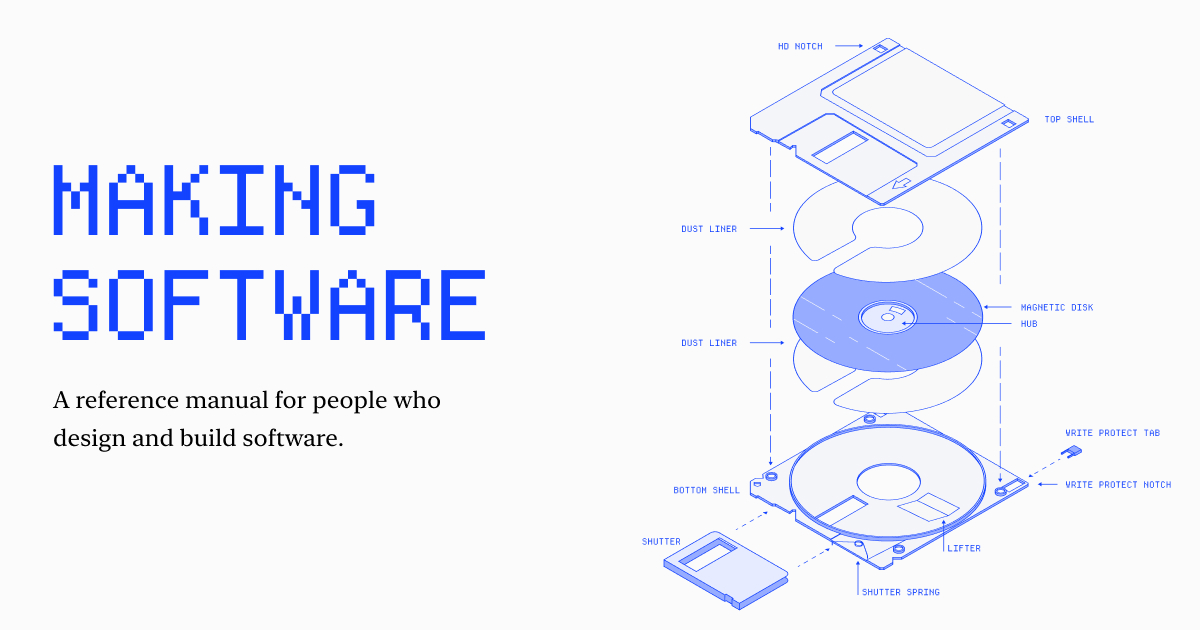
progression.fyi
A collection of open source frameworks for helping designers and engineers to grow at work

Building personal tools by programming

Prioritize learning / seth.computer
The personal website of Seth Etter, a Wichita, KS based software engineer.
A Framework for Finding A Design Partner | Andreessen Horowitz
Design partners, or the first few users of a company's software, are often a key part of the early software development process.

The Motivation Blueprint | Learning Development Accelerator | Professional L&D Community
You can buy an ebook from us directly or wherever ebooks are sold (Apple Books, Amazon, B&N, etc..

Graham Fleming | Software & Hardware Engineer
The Human Co-Pilot for Early-Stage Founders. Expert software & hardware engineer specializing in Next.js, AI integration, scaling infrastructure, and fixing tech debt.
values based software talks
Talk #3 Files, algorithms, media, software as lived practice, and personal software
Exploratory and Live, Programming and Coding: A Literature Study Comparing Perspectives on Liveness
Various programming tools, languages, and environments give programmers the impression of changing a program while it is running. This experience of liveness has been discussed for over two decades and a broad spectrum of research on this topic exists. Amongst others, this work has been carried out in the communities around three major ideas which incorporate liveness as an important aspect: live programming, exploratory programming, and live coding. While there have been publications on the focus of each particular community, the overall spectrum of liveness across these three communities has not been investigated yet. Thus, we want to delineate the variety of research on liveness. At the same time, we want to investigate overlaps and differences in the values and contributions between the three communities. Therefore, we conducted a literature study with a sample of 212 publications on the terms retrieved from three major indexing services. On this sample, we conducted a thematic analysis regarding the following aspects: motivation for liveness, application domains, intended outcomes of running a system, and types of contributions. We also gathered bibliographic information such as related keywords and prominent publications. Besides other characteristics the results show that the field of exploratory programming is mostly about technical designs and empirical studies on tools for general-purpose programming. In contrast, publications on live coding have the most variety in their motivations and methodologies with a majority being empirical studies with users. As expected, most publications on live coding are applied to performance art. Finally, research on live programming is mostly motivated by making programming more accessible and easier to understand, evaluating their tool designs through empirical studies with users. In delineating the spectrum of work on liveness, we hope to make the individual communities more aware of the work of the others. Further, by giving an overview of the values and methods of the individual communities, we hope to provide researchers new to the field of liveness with an initial overview.