We are all having to keep revising upwards our assessments of the mathematical capabilities of large language models. I have just made a fairly large revision as a result of ChatGPT 5.5 Pro, to whi…
Build A Large Language Model (From Scratch), Published by Manning, ISBN 978-1633437166
Implement a ChatGPT-like LLM in PyTorch from scratch, step by step
ChatGPT is bullshit
Ethics and Information Technology - Recently, there has been considerable interest in large language models: machine learning systems which produce human-like text and dialogue. Applications of...

ChatGPT Translate | Fast, Natural, 40+ Languages
ChatGPT translates across 40+ languages with accuracy, tone, and cultural nuance. Translate text, voice, or photos for everyday use, travel, school, and work — and learn grammar or phrasing as you go.

ChatGPT Work with GPT-5.6
ChatGPT Work, powered by GPT-5.6, helps teams take on ambitious work and turn goals into finished outputs. Connect tools, automate tasks, and keep projects moving.

Mathematics with large language models as provers and verifiers
During 2024 and 2025 the discussion about the theorem-proving capabilities of large language models started reporting interesting success stories, mostly to do with difficult exercises (such as problems from the International Mathematical Olympiad), but also with conjectures [Feldman & Karbasi, arXiv:2509.18383v1] formulated for the purpose of verifying whether the artificial intelligence could prove it. In this paper we report a theorem proving feat achieved by ChatGPT by using a protocol involving different prover and verifier instances of the gpt-5 model working collaboratively. To make sure that the produced proofs do not suffer from hallucinations, the final proof is formally verified by the lean proof assistant, and the conformance of premises and conclusion of the lean code is verified by a human. Our methodology is by no means complete or exact. It was nonetheless able to solve five out of six 2025 IMO problems, and close about a third of the sixty-six number theory conjectures in [Cohen, Journal of Integer Sequences, 2025].

Mathematics with large language models as provers and verifiers
During 2024 and 2025 the discussion about the theorem-proving capabilities of large language models started reporting interesting success stories, mostly to do with difficult exercises (such as problems from the International Mathematical Olympiad), but also with conjectures [Feldman & Karbasi, arXiv:2509.18383v1] formulated for the purpose of verifying whether the artificial intelligence could prove it. In this paper we report a theorem proving feat achieved by ChatGPT by using a protocol involving different prover and verifier instances of the gpt-5 model working collaboratively. To make sure that the produced proofs do not suffer from hallucinations, the final proof is formally verified by the lean proof assistant, and the conformance of premises and conclusion of the lean code is verified by a human. Our methodology is by no means complete or exact. It was nonetheless able to solve five out of six 2025 IMO problems, and close about a third of the sixty-six number theory conjectures in [Cohen, Journal of Integer Sequences, 2025].
Inside ChatGPT: How AI chatbots work
Large language models like ChatGPT use a complicated series of equations to understand and respond to your prompts. Here’s a look inside the system.

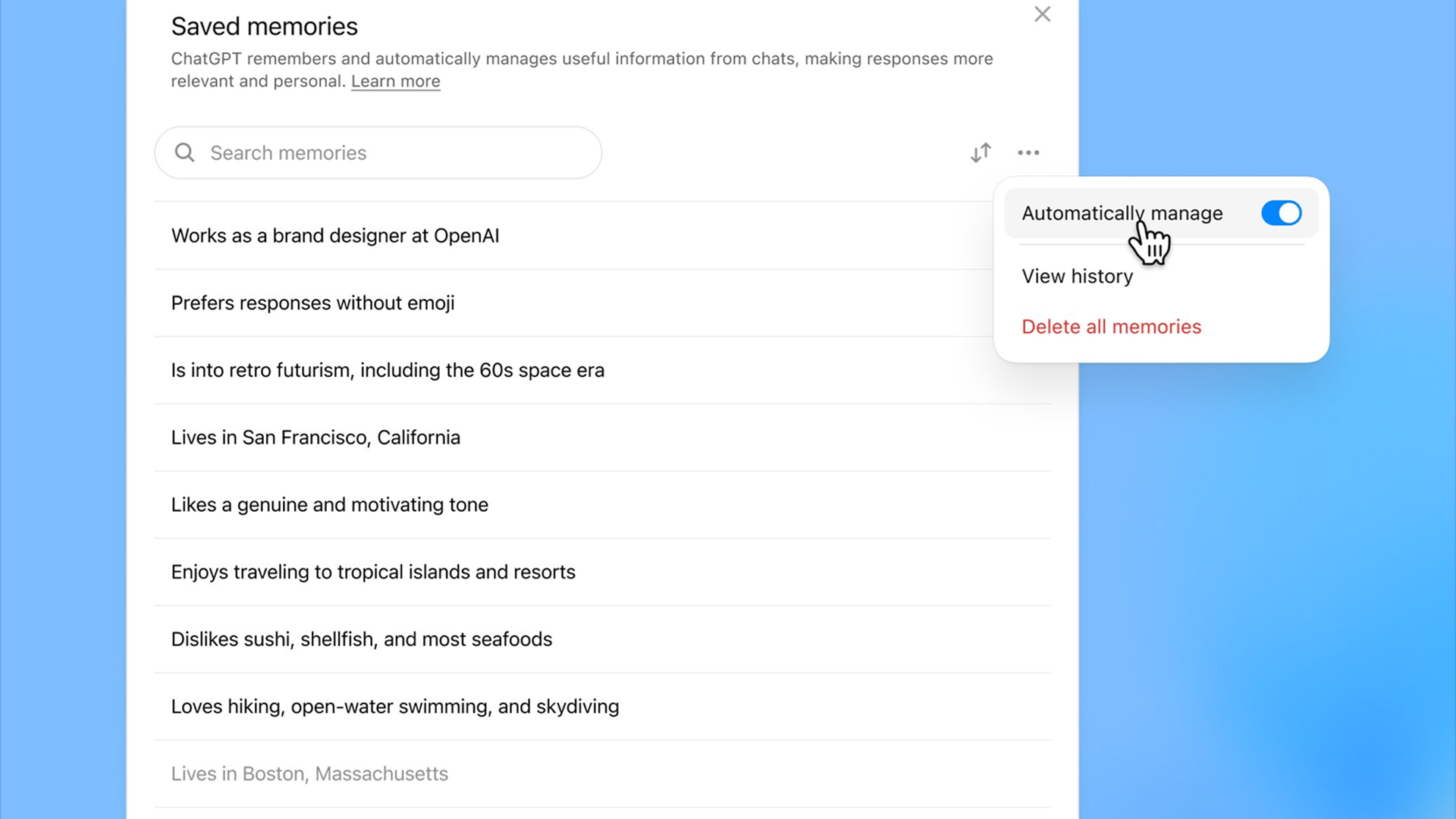
ChatGPT is smarter now that it's learned to forget - a huge memory upgrade is coming
The AI chatbot will remember what matters most and quietly let the rest fade
Hypothesis generation and updating in large language models
Large language models (LLMs) increasingly help people solve problems, from debugging code to repairing machinery. This process requires generating plausible hypotheses from partial descriptions,...
How Large Language Models Actually Work
On-screen and now IRL: FSU researchers find evidence of ChatGPT buzzwords turning up in everyday speech
Within five days of ChatGPT’s release in 2022, the artificial intelligence chatbot gained more than a million users. Today, more than half of all adults

Model Release Notes | OpenAI Help Center
We’re beginning the rollout of GPT-5.6 Sol in ChatGPT, our flagship reasoning model for complex work across coding, research, science, cybersecurity, computer use, and design.GPT-5.6 Sol is rolling out to eligible paid ChatGPT plans. Free, Go, and logged-out users are not included. Availability may vary during rollout, and managed-workspace access can depend on administrator settings. Availability for other GPT-5.6 family models varies by product and plan; check the model picker or current rate card in the product you use.

brexhq/prompt-engineering
Tips and tricks for working with Large Language Models like OpenAI's GPT-4.
darrenburns/elia
A snappy, keyboard-centric terminal user interface for interacting with large language models. Chat with ChatGPT, Claude, Llama 3, Phi 3, Mistral, Gemma and more.
Introducing GPT-Live
A new generation of voice models for natural human-AI interaction, now powering ChatGPT Voice.