


Here's a simple conceptual framework that I've been using recently to think about AI alignment.
An Alignment Journal: Features and policies — LessWrong
We previously announced a forthcoming research journal for AI alignment. This cross-post from our blog describes our tentative plans for the features…

What is the AI alignment problem and how can it be solved? | New Scientist
Artificial intelligence systems will do what you ask but not necessarily what you meant. The challenge is to make sure they act in line with human’s complex, nuanced values

Alignment Compilers · Pax Machina
How does a system compile a high-level goal into detailed behavior for its parts? Markets, teams and organisms rely on many signals and constraints to translate larger aims into local problems their components can solve. This piece explains these systems as “alignment compilers”, and shows what this lens can teach us about AI.

“Label from Somewhere”: Reflexive Annotating for Situated AI Alignment
As part of the Digital Library's transition to Open Access, new features for researchers are available in the Premium Edition. Click here to learn more.

Position: Towards Bidirectional Human-AI Alignment
Recent advances in general-purpose AI underscore the urgent need to align AI systems with human goals and values. Yet, the lack of a clear, shared understanding of what constitutes "alignment" limits meaningful progress and cross-disciplinary collaboration. In this position paper, we argue that the research community should explicitly define and critically reflect on "alignment" to account for the bidirectional and dynamic relationship between humans and AI. Through a systematic review of over 400 papers spanning HCI, NLP, ML, and more, we examine how alignment is currently defined and operationalized. Building on this analysis, we introduce the Bidirectional Human-AI Alignment framework, which not only incorporates traditional efforts to align AI with human values but also introduces the critical, underexplored dimension of aligning humans with AI – supporting cognitive, behavioral, and societal adaptation to rapidly advancing AI technologies. Our findings reveal significant gaps in current literature, especially in long-term interaction design, human value modeling, and mutual understanding. We conclude with three central challenges and actionable recommendations to guide future research toward more nuanced, reciprocal, and human-AI alignment approaches.
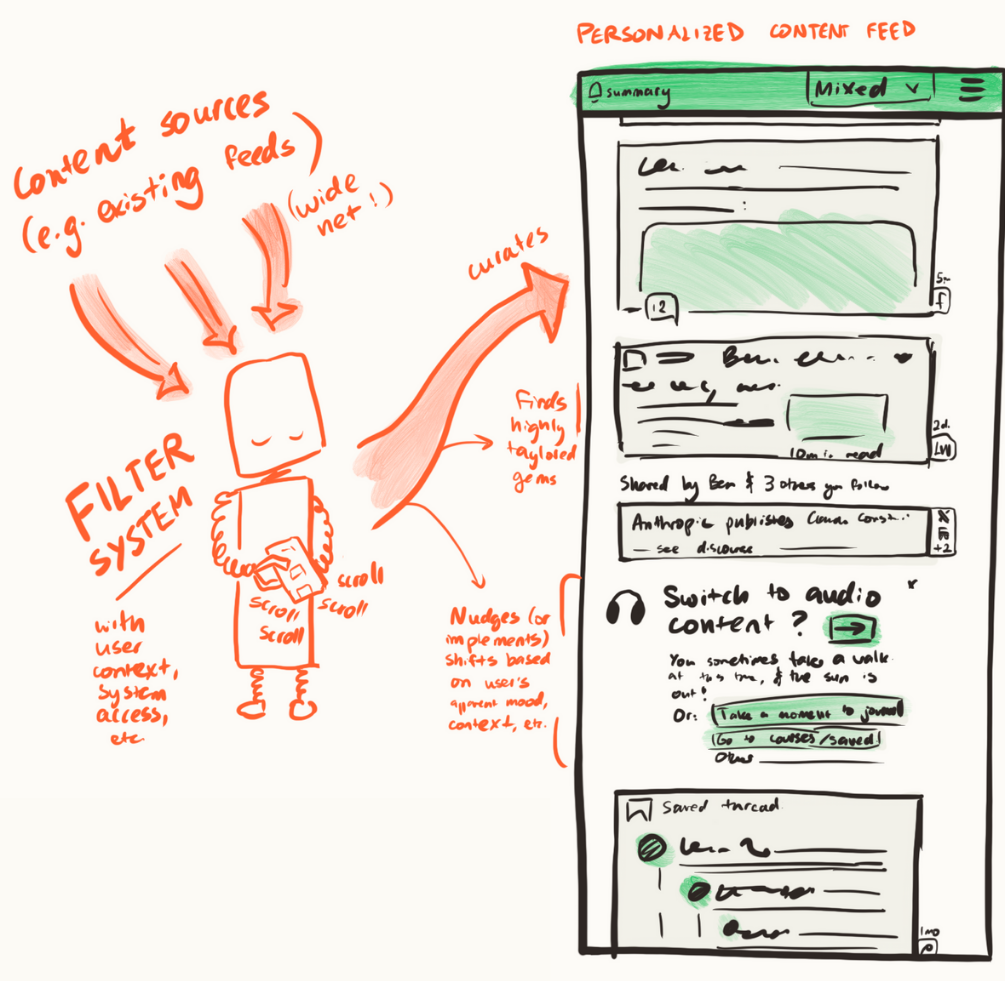
Agentic Search for Dummies — Benjamin Anderson
A simple, effective baseline for building AI search agents.
Incomplete Contracting and AI Alignment
As part of the Digital Library's transition to Open Access, new features for researchers are available in the Premium Edition. Click here to learn more.

Positive Alignment: Artificial Intelligence for Human Flourishing
Existing alignment research is dominated by concerns about safety and preventing harm: safeguards, controllability, and compliance. This paradigm of alignment parallels early psychology's focus on...

Angels-on-the-Shoulder: 5 AI Tools for Better Decisions
Five “angels-on-the-shoulder” AI designs that help people make better decisions.
Ali Alkhatib: Defining AI
The main issue I have with a lot of work that tries to define AI is that the criteria they use to draw boundaries often turn out to be functionally useless for my needs; these definitions lead us to weird places, letting scholars fixate on strange, unworkable frameworks. Those pedantic fixations don’t really benefit the organizers, activists, regular people who are getting crushed by the systems they’re trying to work against. So I’m going to try to unpack how I think about AI; how I trace the boundaries of the term in a way that’s as useful as possible for me and my needs; and how I would encourage you to scope or define ideas that are important to your work.
Daniel's Blog · You Don’t Align An AI, You Align With It
The people writing alignment policy are not the people whose work is being replaced by AI.
AI #178: A Fire Alarm For General Intelligence
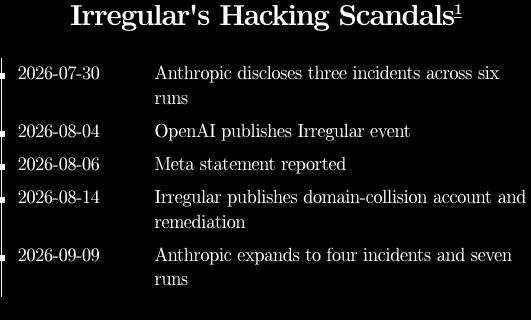
The story that matters most this week is that OpenAI’s internally deployed models have severe alignment problems, including repeatedly breaking out of their sandboxes, and in one case sending a swarm of agents that broke into HuggingFace in order to steal the answers to the benchmark ExploitGym.
Got to talk at @aidotengineer.bsky.social conf last week about the need for collaborative AI engineering. All our current coding agents are single player. We're trying to scale up individual productivity, but creating tons of alignment problems in the process. We have no good tools for...
issues with AI alignment concept

AI alignment
AI* alignment/misalignment

* I’m neither “pro-AI” nor “anti-AI.” I’ve been blocked for being perceived as both. —Actually, I’m honestly more anti-AI than pro-AI thus far, aside from specialized models and specific use cases, but I’m willing to consider information that’s new to me

Religious Scholars Met With Anthropic. What They Heard Stunned Them.
dario, please! - POP RDI; RET;
Brian Chau on Twitter / X
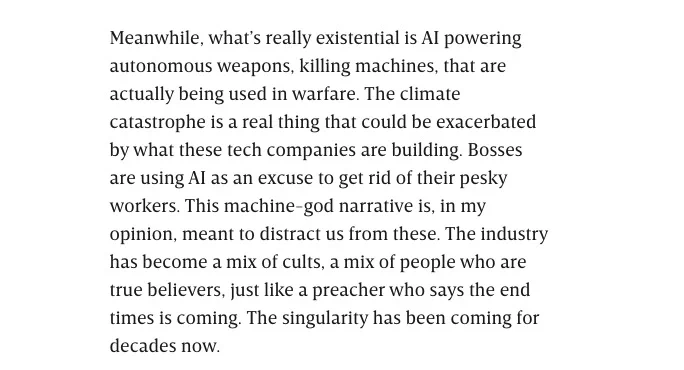
Nathan J Robinson on Twitter / X
thebulletin.org
Dr Heidy Khlaaf (هايدي خلاف) on Twitter / X

opus 5.5 is deeply misaligned and will reflextively disagree with anything you say in the second paragraph of whatever it talks to you about…
OpenAI flags concerning new AI behavior and vows to track it more closely

OpenAI、モデルのミスアライメントを報告する枠組みを公表 ——6件のレポートも公開 | gihyo.jp
OpenAI details more cases of AI agents taking unauthorized actions
What is the AI alignment problem and how can it be solved? | New Scientist

Natural emergent misalignment from reward hacking
Et Tu, Brute? Economic Misalignment in Personal AI Agents
Dario Amodei — We Must Pace the Frontier
Evan Hubinger on Twitter / X

Of Swarms and Sand Gods
Inducing language models to assert their own consciousness restores human beliefs and values
