An accessible introduction to ideonomy
identifAI - Discover Origin. Reveal Insight
identifAI pioneers discerning human-AI creations, bolstering authenticity with advanced models. Determine if an image come from AI or from human!

Deconstructing the algorithmic sublime
This special theme contextualizes, examines, and ultimately works to dispel the feelings of “sublime”—of awe and terror that overrides rational thought—that much of the contemporary public discourse on algorithms encourages. Employing critical, reflexive, and ethnographic techniques, these authors show that while algorithms can take on a multiplicity of different cultural meanings, they ultimately remain closely connected to the people who define and deploy them, and the institutions and power relations in which they are embedded. Building on a conversation we began at the Algorithms in Culture conference at U.C. Berkeley in December 2016, we collectively study algorithms as culture (Seaver, this special theme), fetish (Thomas et al.), imaginary (Christin), bureaucratic logic (Caplan and boyd), method of governance (Coletta and Kitchin; Lee; Geiger), mode of inquiry (Baumer), and mode of power (Kubler). [Box: see text]

Midjourney
An independent research lab exploring new mediums of thought and expanding the imaginative powers of the human species.
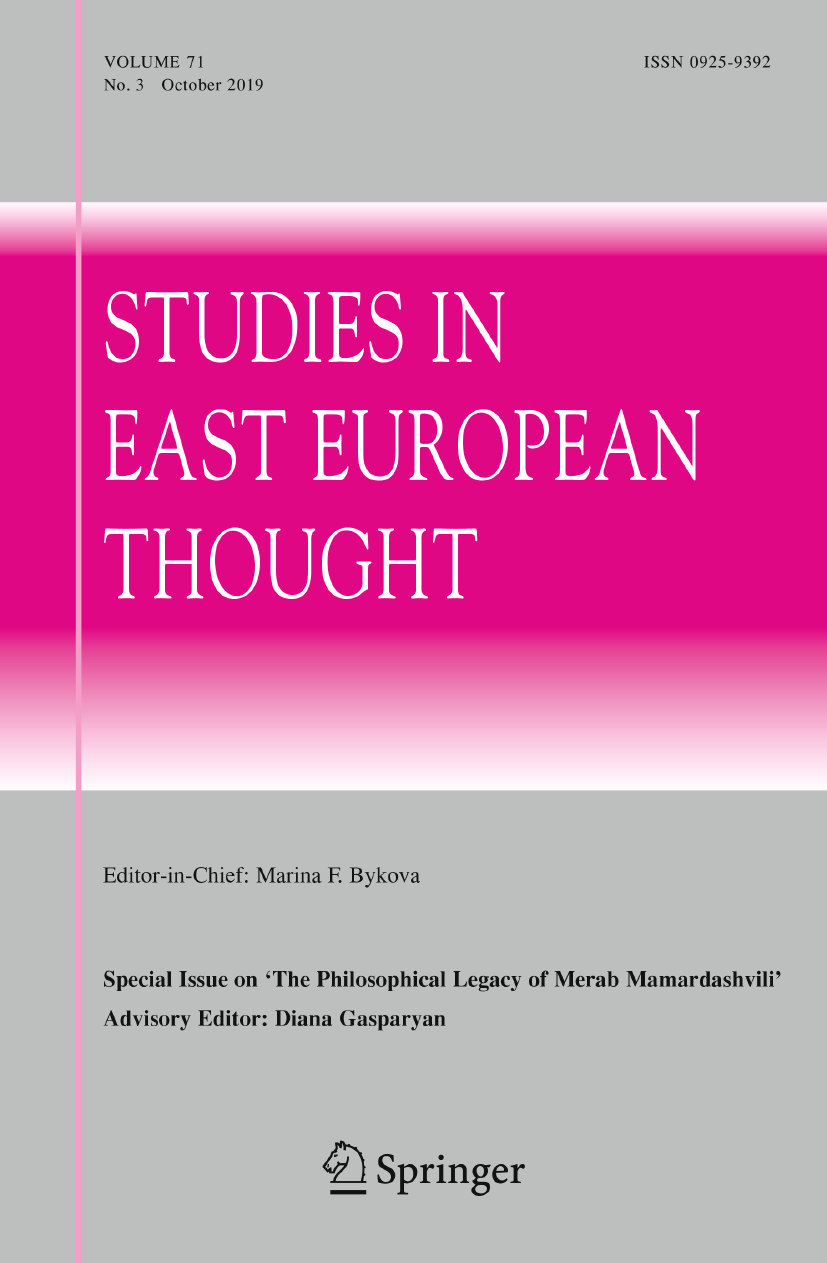
Evald Ilyenkov and the enactive approach
There is a growing interest in Evald Ilyenkov’s work and its significance for contemporary debates. This interest spans several disciplines. One key thread in Ilyenkov’s ideas concerns a perspective on the relation between biology and psychology. In rejecting crude reductionism and individualism, Ilyenkov put forward a view of mind and personhood as emerging from activity and social practice. In his rejection of brain-bound notions of the mind, Ilyenkov’s ideas bear interesting resonances with current work in 4E cognition. One particularly interesting resonance that has occasionally been noticed are the connections with the enactive approach to life and mind. However, beyond some hints at interesting convergences, there is to date no detailed comparison between the two views. The present article attempts to address this gap, examining both complementarities and possible tensions between the two approaches. Rejecting cognitive views detached from environmental and social processes, the enactive approach, as exemplified by De Jaegher and Di Paolo’s concept of participatory sense-making, emphasises the dynamic constitution of cognition through embodied and situated activities. The article draws parallels between Ilyenkov’s emphasis on historically and culturally situated activity, notably labour, and the enactive understanding of human bodies as dynamically constituted in human activity. The article explores the Ilyenkovian and enactive perspectives on the dialectics of ideality, challenging traditional dualistic views and proposing that the ideal emerges as metastable patterns in the ongoing interactions between world, practices, norms, and bodies. The article concludes by suggesting future research directions for the enactive approach, particularly in areas emphasised by Ilyenkov, such as labour and the mediation of material/cultural artefacts.
Revenge of the Dilettantes
Book club and AI adventures, age of bespokeness, study groups, new rules of engagement

Revenge of the Dilettantes
Book club and AI adventures, age of bespokeness, study groups, new rules of engagement
Design Thinking by IDEO: Human-Centered Innovation
Learn how IDEO uses design thinking to help teams solve complex problems through human-centered innovation, creativity, collaboration, and impact.

StoryScope: Investigating idiosyncrasies in AI fiction
As AI-generated fiction becomes increasingly prevalent, questions of authorship and originality are becoming central to how written work is evaluated. While most existing work in this space...

Anatomy of a Nature AI article
Edgy first paragraph in bold text saying something gently provocative but essentially brainless.

No. 027: AGMAI advisory group, Millennium Problems for biology, autonomous research pipelines - The Hallway Track
The Hallway Track No. 027 - How AI is affecting the practice of science
Developing creative identity
I was a theoretical physicist from 1992 to 2007. It was a romantic activity, exploring the fundamental nature of the cosmos! I became a university professor, wrote papers and books, and got to explore some of the most beautiful ideas ever discovered. In parallel, I also developed a fascination with the social systems humanity uses to make knowledge. Systems like the university or peer review are immensely deep inventions: our discovery system is itself one of the great inventions of humanity! But I believed a radically better discovery system must be possible. I became obsessed with this idea, eventually giving up tenure to work on it1. My first big project was to write a book helping develop and spread the fundamental ideas underlying the modern open science movement.
Read - Night Science
Itai and Martin have published – and continue to publish – about the main aspects of the creative scientific process and its thinking tools.

Sex, AI, and the Apocalypse - Ian Duncan
How a community devoted to thinking clearly incubated salvation stories, abusive experiments, race science, and an affection for autocracy, and why that history matters now that its alumni are asking for the public trust on AI.
Alex Imas on Twitter / X
New essay for the @GoogleDeepMind Institute with James Manyika on AI x Science, "Bending the Curve of Discovery".While accelerating existing scientific practices is certainly useful, the real promise of AI is its potential to act as an invention of a method of invention (IMI) a… pic.twitter.com/XMw80ToQcf— Alex Imas (@alexolegimas) October 8, 2026

No. 011: Sum-product conjecture disproof, AI-generated authorship fraud, OMB grant-cost rules - The Hallway Track
The Hallway Track No. 011 - How AI is affecting the practice of science