

Andrej Karpathy on Twitter / X
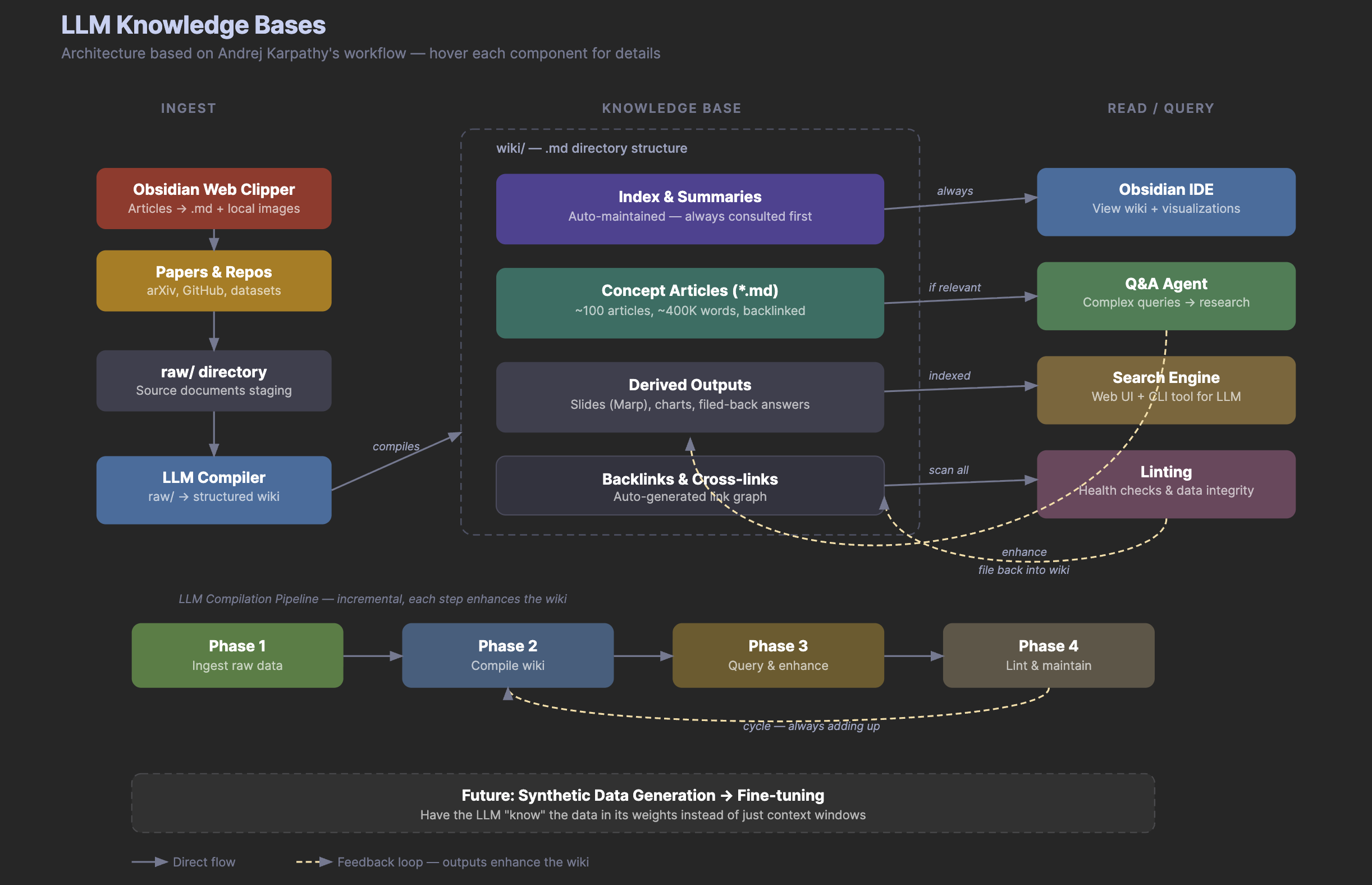
LLM Knowledge BasesSomething I'm finding very useful recently: using LLMs to build personal knowledge bases for various topics of research interest. In this way, a large fraction of my recent token throughput is going less into manipulating code, and more into manipulating…— Andrej Karpathy (@karpathy) April 2, 2026
Brandon Stewart on Twitter / X
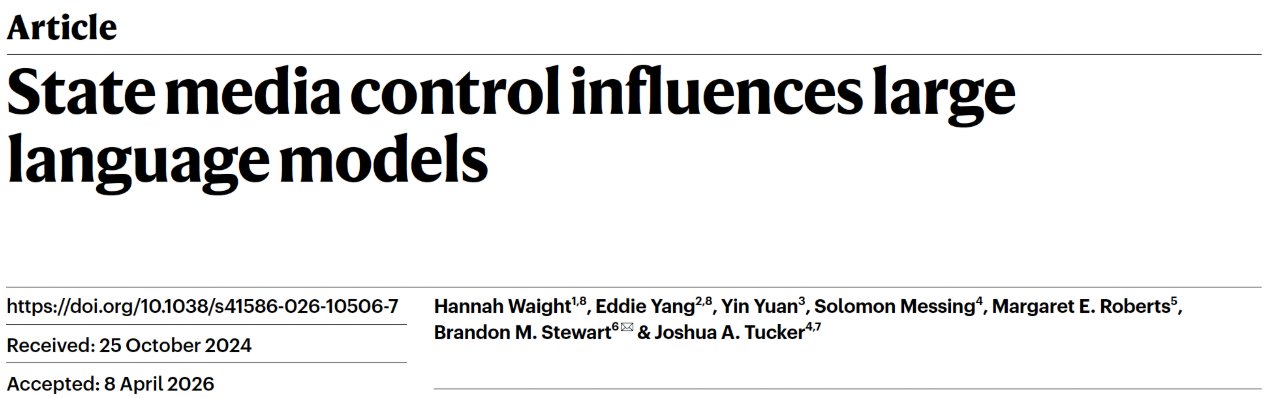
1/ New @Nature! We study how powerful institutions shape the information environment for LLMs. Commercial LLM training is opaque, so we trace a path from state-coordinated media -> training data -> model responses. pic.twitter.com/5LdFvzbFaf— Brandon Stewart (@b_m_stewart) May 13, 2026
Instant LLM Updates with Doc-to-LoRA and Text-to-LoRA
Recent LLM agents have shown impressive capabilities on complex computer use and long-horizon tasks. Yet, they still struggle with long-term memory and adaptation--two of the most important cognitive capabilities that still limit LLMs today. Without long-term memory, users have to provide LLMs with relevant content at the start of every new session, creating friction, discontinuity, and longer time-to-response. Additionally, due to the lack of adaptation, they do not learn from mistakes or user preferences from previous sessions, making each interaction as cumbersome as the first. Traditionally, these two problems are tackled by "updating" the model.
LLM Knowledge Bases
A visual breakdown of Andrej Karpathy's approach to building personal knowledge bases powered by LLMs. Learn the 4-phase pipeline: ingest, compile, query, and maintain - with an interactive architecture diagram.
Lincoln Michel on Twitter / X
This was my read on AI from the beginning and it proved very true. Whatever hypothetical benefits LLMs have (and they have some), their main use is to waste everyone's time wading through slop. Longer colleague powerpoints. More spam emails. More slop clogging up all the systems. https://t.co/2gtGfqf7KF— Lincoln Michel (@TheLincoln) September 21, 2026
LLM Agents Are the Antidote to Walled Gardens
While the Internet's core infrastructure was designed to be open and universal, today's application layer is dominated by closed, proprietary platforms. Open and interoperable APIs require significant investment, and market leaders have little incentive to enable data exchange that could erode their user lock-in. We argue that LLM-based agents fundamentally disrupt this status quo. Agents can automatically translate between data formats and interact with interfaces designed for humans: this makes interoperability dramatically cheaper and effectively unavoidable. We name this shift universal interoperability: the ability for any two digital services to exchange data seamlessly using AI-mediated adapters. Universal interoperability undermines monopolistic behaviours and promotes data portability. However, it can also lead to new security risks and technical debt. Our position is that the ML community should embrace this development while building the appropriate frameworks to mitigate the downsides. By acting now, we can harness AI to restore user freedom and competitive markets without sacrificing security.

On the Way to LLM Personalization: Learning to Remember User Conversations
This paper was accepted at the Workshop on Large Language Model Memorization (L2M2) 2025. Large Language Models (LLMs) have quickly become…
A pocket full of personal software - Bailey's Retrospective
A year-ish spent building software I want, the way I want with *in a low voice* llms
Unbundling Tools for Thought
Disparate thoughts on personal information management after traversing the hype cycle.
Big Help or Big Brother? Auditing Tracking, Profiling, and Personalization in Generative AI Assistants
Generative AI (GenAI) browser assistants integrate powerful capabilities of GenAI in web browsers to provide rich experiences such as question answering, content summarization, and agentic navigation. These assistants, available today as browser extensions, can not only track detailed browsing activity such as search and click data, but can also autonomously perform tasks such as filling forms, raising significant privacy concerns. It is crucial to understand the design and operation of GenAI browser extensions, including how they collect, store, process, and share user data. To this end, we study their ability to profile users and personalize their responses based on explicit or inferred demographic attributes and interests of users. We perform network traffic analysis and use a novel prompting framework to audit tracking, profiling, and personalization by the ten most popular GenAI browser assistant extensions. We find that instead of relying on local in-browser models, these assistants largely depend on server-side APIs, which can be auto-invoked without explicit user interaction. When invoked, they collect and share webpage content, often the full HTML DOM and sometimes even the user's form inputs, with their first-party servers. Some assistants also share identifiers and user prompts with third-party trackers such as Google Analytics. The collection and sharing continues even if a webpage contains sensitive information such as health or personal information such as name or SSN entered in a web form. We find that several GenAI browser assistants infer demographic attributes such as age, gender, income, and interests and use this profile--which carries across browsing contexts--to personalize responses. In summary, our work shows that GenAI browser assistants can and do collect personal and sensitive information for profiling and personalization with little to no safeguards.
The rebel alliance
This blog is co-authored with Zoe Weinberg and Matt Hawes at ex/ante, and is a follow-up to our first blog post on the topic, 'You don't own your memory.' We need an open architecture that puts us in control of our memories while making their exploitation technically impossible. But how will this shift happen? In order to discover possible implementations, we must understand how our data informs LLMs. The three predominant context engineering techniques are prompt design, retrieval-augmented ...

Patrick Collison on Twitter / X
I want some kind of LLM workflow tool.• Ability to manage a set of input files (Markdown or similar), plus other general-purpose context.• With real-time collaboration. (And maybe some concept of snapshots or VCS integration.)• And the ability to create/manage a inference…— Patrick Collison (@patrickc) June 6, 2026
Auto-grading decade-old Hacker News discussions with hindsight
A vibe coding thought exercise on what it might look like for LLMs to scour human historical data at scale and in retrospect.


Supporting Our AI Overlords: Redesigning Data Systems to be Agent-First
Large Language Model (LLM) agents, acting on their users' behalf to manipulate and analyze data, are likely to become the dominant workload for data systems in the future. When working with data,...
Sakana AI on Twitter / X
We’re excited to introduce Doc-to-LoRA and Text-to-LoRA, two related research exploring how to make LLM customization faster and more accessible.https://t.co/wGKDNhBcJXBy training a Hypernetwork to generate LoRA adapters on the fly, these methods allow models to instantly… pic.twitter.com/gId3J6hgEr— Sakana AI (@SakanaAILabs) February 27, 2026

I propose an approach for highly personalized LLMs, for near-future productivity gains and personal info/cybersecurity against increasingly powerful LLMs: they should, in the spirit of uploading, try to emulate the user’s values and preferences in order to amplify the principal—not replace them. I discuss a package of techniques and proposals to accomplish such ‘guardian angels’; dynamic evaluation of LLMs combined with active learning and elicitation and heavy inner-monologue search/data-augmentation.