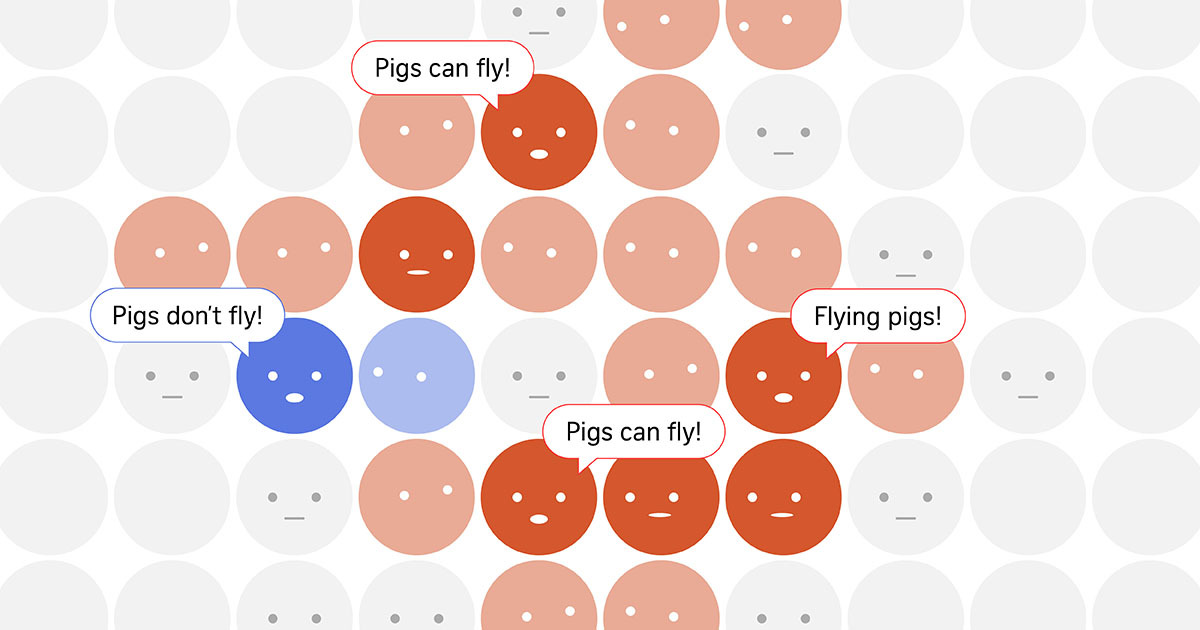
Selection effects in media become increasingly strong as populations and media increase, meaning that rare datapoints driven by unusual processes such as the mentally ill or hoaxers are increasingly unreliable as evidence of anything at all and must be ignored. At scale, anything that can happen will happen a small but nonzero times.
Media Bias/Fact Check News
We are the most comprehensive media bias resource on the internet. There are currently 3900+ media sources listed in our database and growing every day.
Americans' Trust in Mass Media Sinks to New Low
Americans' trust in the mass media has dropped sharply since last year to its lowest point since 1972. Republicans' lack of faith in the media is chiefly behind this decline.

Facts and Myths about Misperceptions
Misperceptions threaten to warp mass opinion and public policy on controversial issues in politics, science, and health. What explains the prevalence and persistence of these false and unsupported beliefs, which seem to be genuinely held by many people? Though limits on cognitive resources and attention play an important role, many of the most destructive misperceptions arise in domains where individuals have weak incentives to hold accurate beliefs and strong directional motivations to endorse beliefs that are consistent with a group identity such as partisanship. These tendencies are often exploited by elites who frequently create and amplify misperceptions to influence elections and public policy. Though evidence is lacking for claims of a “post-truth” era, changes in the speed with which false information travels and the extent to which it can find receptive audiences require new approaches to counter misinformation. Reducing the propagation and influence of false claims will require further efforts to inoculate people in advance of exposure (for example, media literacy), debunk false claims that are already salient or widespread (for example, fact-checking), reduce the prevalence of low-quality information (for example, changing social media algorithms), and discourage elites from promoting false information (for example, strengthening reputational sanctions).
Media Won’t Stop Psychologizing Long Covid
Media outlets that trumpet their journalistic integrity have used their prestige to launder an unproven, anti-science conspiracy theory about Long Covid.

How People Weave Online Information Into Pseudoknowledge
Misinformation has found a new natural habitat in the digital age. Thousands of forums, blogs, and alternative news sources amplify fake news and inaccurate information to such a degree that it impacts our collective intelligence. Researchers and policy makers are troubled by misinformation because it is presumed to energize or even carry false narratives that can motivate poor decision-making and dangerous behaviors. Yet, while a growing body of research has focused on how viral misinformation spreads, little work has examined how false narratives are in fact constructed. In this study, we move beyond contagion inspired approaches to examine how people construct a false narrative. We apply prior work in cognitive science on narrative understanding to illustrate how the narrative changes over time and in response to social dynamics, and examine how forum participants draw upon a diverse set of online sources to substantiate the narrative. We find that the narrative is based primarily on reinterpretations of conventional and scholarly sources, and then used to provide an alternate account of unfolding events. We conclude that the link between misinformation, conventional knowledge, and false narratives is more complex than is often presumed, and advocate for a more direct study of this relationship.

AI summaries cause ‘devastating’ drop in audiences, online news media told
Exclusive: Study claims sites previously ranked first can lose 79% of traffic if results appear below Google Overview
The spreading of misinformation online
Significance The wide availability of user-provided content in online social media facilitates the aggregation of people around common interests, worldviews, and narratives. However, the World Wide Web is a fruitful environment for the massive diffusion of unverified rumors. In this work, using a massive quantitative analysis of Facebook, we show that information related to distinct narratives––conspiracy theories and scientific news––generates homogeneous and polarized communities (i.e., echo chambers) having similar information consumption patterns. Then, we derive a data-driven percolation model of rumor spreading that demonstrates that homogeneity and polarization are the main determinants for predicting cascades’ size. , The wide availability of user-provided content in online social media facilitates the aggregation of people around common interests, worldviews, and narratives. However, the World Wide Web (WWW) also allows for the rapid dissemination of unsubstantiated rumors and conspiracy theories that often elicit rapid, large, but naive social responses such as the recent case of Jade Helm 15––where a simple military exercise turned out to be perceived as the beginning of a new civil war in the United States. In this work, we address the determinants governing misinformation spreading through a thorough quantitative analysis. In particular, we focus on how Facebook users consume information related to two distinct narratives: scientific and conspiracy news. We find that, although consumers of scientific and conspiracy stories present similar consumption patterns with respect to content, cascade dynamics differ. Selective exposure to content is the primary driver of content diffusion and generates the formation of homogeneous clusters, i.e., “echo chambers.” Indeed, homogeneity appears to be the primary driver for the diffusion of contents and each echo chamber has its own cascade dynamics. Finally, we introduce a data-driven percolation model mimicking rumor spreading and we show that homogeneity and polarization are the main determinants for predicting cascades’ size.

Media Ownership Monitor
Mass media influences how facts are viewed and debated in a society, contributing to crafting its public opinion. Independence and pluralism...

A Failure, But Not Of Prediction
I. Vox asks What Went Wrong With The Media’s Coronavirus Coverage? They conclude that the media needs to be better at “not just saying what we do know, but what we don’t know”. This rai…

How Social Media Rewards Misinformation
A majority of false stories are spread by a small number of frequent users, suggests a new study co-authored by Yale SOM’s Gizem Ceylan. But they can be taught to change their ways.

Fakebook: Using Data Science to Spot Fake News
The Fate of the News in the Age of the Coronavirus
Can a fragile media ecosystem survive the pandemic?

A Statistical Interrogation of “The Case for Causality, Part 1” by Rausch and Haidt – Matthew B. Jané
I don’t know anything about the literature on social media and mental health so my focus on this post is to interrogate the statistical approach taken by the article written by Zach Rausch and Jonathon Haidt (link here) and to some extent the original meta-analysis by Ferguson.

Home - Black Press Media
Truth MattersClarity MattersCommunity MattersPowered by more than 200 Journalists Any Time. Any Place. Any Device. We are dedicated to serving more than 80 communities across Canada and North America with credible and hyperlocal journalism, brought to our readers by passionate journalists who live where they work. Black Press Media is a catalyst for informed engagement […]

Ground News
The biggest source for breaking news around the world. Compare headlines across the political spectrum using media bias ratings driven by data.

Fake news spreads like an epidemic. Here’s how to stop it.
Researchers study fake news the same way they study the spread of disease. When misinformation “goes viral”, it is not just a metaphor. It is what’s actually happening. via @straits_times str.sg/viz-misinformation