

Lenses, Folds and Traversals

Limits and Colimits in a Category of Lenses
Lenses are an important tool in applied category theory. While individual lenses have been widely used in applications, many of the mathematical properties of the corresponding categories of lenses have remained unknown. In this paper, we study the category of small categories and asymmetric delta lenses, and prove that it has several good exactness properties. These properties include the existence of certain limits and colimits, as well as so-called imported limits, such as imported products and imported pullbacks, which have arisen previously in applications. The category is also shown to be extensive, and it has an image factorisation system.

Symmetric lenses | Proceedings of the 38th annual ACM SIGPLAN-SIGACT symposium on Principles of programming languages
A lens is a bidirectional transformation between a pair of connected data structures, capable of translating an edit on one structure into an appropriate edit on the other. Many varieties of lenses have been studied, but none, to date, has offered a ...

Quotient lenses | Proceedings of the 13th ACM SIGPLAN international conference on Functional programming
Bidirectional programming languages are a practical approach to the view update problem. Programs in these languages, called lenses, define both a view and an update policy - i.e., every program can be read as a function mapping sources to views as well ...

Generalized Lens Categories via functors $\mathcal{C}^{\rm op}\to\mathsf{Cat}$
Lenses have a rich history and have recently received a great deal of attention from applied category theorists. We generalize the notion of lens by defining a category $\mathsf{Lens}_F$ for any category $\mathcal{C}$ and functor $F\colon \mathcal{C}^{\rm op}\to\mathsf{Cat}$, using a variant of the Grothendieck construction. All of the mathematics in this note is straightforward; the purpose is simply to see lenses in a broader context where some closely-related examples, such as ringed spaces and open continuous dynamical systems, can be included.
Three Lenses on Coordination
Three Sets of Specs (for Staying in Spec) In the last post I talked about how systems formalisms are like sculpting with a chisel: we remove behaviors we don’t…
Dependent Optics
A wide variety of bidirectional data accessors, ranging from mixed optics to functor lenses, can be formalized within a unique framework-dependent optics. Starting from two indexed categories, which encode what maps are allowed in the forward and backward directions, we define the category of dependent optics and establish under what assumptions it has coproducts. Different choices of indexed categories correspond to different families of optics: we discuss dependent lenses and prisms, as well as closed dependent optics. We introduce the notion of Tambara representation and use it to classify contravariant functors from the category of optics, thus generalizing the profunctor encoding of optics to the dependent case.
Project Cambria: Translate your data with lenses
Changing schemas in distributed software is hard. Could adopting bidirectional lenses help?

Calculating with lenses | Proceedings of the 20th ACM SIGPLAN workshop on Partial evaluation and program manipulation
Functional programs are particularly well suited to formal manipulation by equational reasoning. In particular, it is straightforward to use calculational methods for program transformation. Well-known transformation techniques, like tupling or the ...

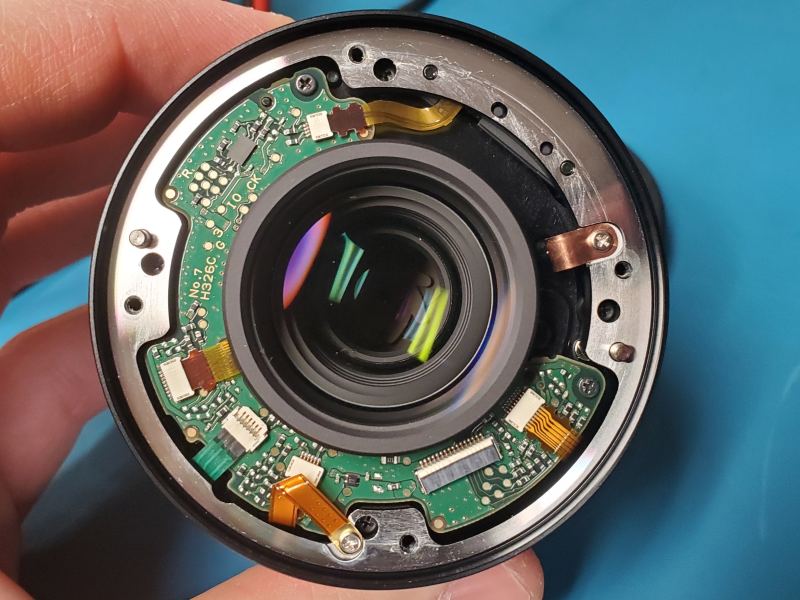
Sigma 45mm f/2.8 Lens Repair & Analysis | Salvaged Circuitry
I stumbled across a broken Sigma 45mm f/2.8 Art lens for a very cool $58.65 USD that I simply could not resist. I've been eyeing an AF lens in the 50mm range for my recent endeavors with L-mount cameras and this looked like the perfect fit. This lens is commonly found as a kit with the very excellent full-frame Sigma FP camera series. Here is my comprehensive guide to bringing the lens back into service. I delve into the nitty-gritty details of lens PCB repair and lens disassembly techniques.
Profunctor Optics, a Categorical Update
Optics are bidirectional data accessors that capture data transformation patterns such as accessing subfields or iterating over containers. Profunctor optics are a particular choice of representation supporting modularity, meaning that we can construct accessors for complex structures by combining simpler ones. Profunctor optics have previously been studied only in an unenriched and non-mixed setting, in which both directions of access are modelled in the same category. However, functional programming languages are arguably better described by enriched categories; and we have found that some structures in the literature are actually mixed optics, with access directions modelled in different categories. Our work generalizes a classic result by Pastro and Street on Tambara theory and uses it to describe mixed V-enriched profunctor optics and to endow them with V-category structure. We provide some original families of optics and derivations, including an elementary one for traversals. Finally, we discuss a Haskell implementation.

The Plane of Focus — a lens, opened up
Everyone knows when a photo is blurry. Almost nobody has seen the exact plane where it turns sharp. Open a lens, turn the focus ring and watch that plane sweep through a tiny world.

Categories of Optics
Bidirectional data accessors such as lenses, prisms and traversals are all instances of the same general 'optic' construction. We give a careful account of this construction and show that it extends to a functor from the category of symmetric monoidal categories to itself. We also show that this construction enjoys a universal property: it freely adds counit morphisms to a symmetric monoidal category. Missing in the folklore is a general definition of 'lawfulness' that applies directly to any optic category. We provide such a definition and show that it is equivalent to the folklore profunctor optic laws.
Delta Lenses over Inductive Types
Existing bidirectional languages are either state-based or operation-based, depending on whether they represent updates as mere states or as sequences of edit operations.In-between both worlds are delta-based frameworks, where updates are represented using alignment relationships between states.In this paper, we formalize delta lenses over inductive types using dependent type theory and develop a point-free delta lens language with an explicit separation of shape and data.In contrast with the already known issue of data alignment, we identify the new problem of shape alignment and solve it by lifting standard recursion patterns such as folds and unfolds to delta lenses that use alignment to infer meaningful shape updates.
AI-powered smart glasses

Meta AI Glasses, etc.

Norway plans temporary ban on smart glasses in some public places

Newsom vetoes measure that would have penalized the use of smart glasses to secretly record people

Dutch retailers suspend Meta smart glasses sales amid privacy concerns | Digital Watch Observatory

Amazon’s delivery driver smart glasses will reportedly take photos ‘almost constantly’

Meta glasses captured and shared intimate images without users' consent, lawsuit claims
A Review of the Ray-ban Meta AI Glasses for People With Low Vision