Modern web applications load and execute a lot more JavaScript code than they did just a few years ago. While JIT (just-in-time) compilers have been very successful in making JavaScript ...
Emscripten: an LLVM-to-JavaScript compiler
Although the performance of today's JavaScript engines is sufficient for most web applications, faster and more predictable runtimes could be desired for performance-critical web code. Therefore, we present Speedy.js, a cross-compiler that translates ...

The many, many, many JavaScript runtimes of the last decade
This last decade has seen an inundation of new JavaScript runtimes (and engines in equal measure), enabling us to run JavaScript in all manner of contexts...

Why I’m skeptical of rewriting JavaScript tools in “faster” languages
I’ve written a lot of JavaScript. I like JavaScript. And more importantly, I’ve built up a set of skills in understanding, optimizing, and debugging JavaScript…

A cartoon intro to WebAssembly – Mozilla Hacks - the Web developer blog
WebAssembly is a way of taking code written in programming languages other than JavaScript and running that code in the browser. So when people say that WebAssembly is fast, what ...

Building the DOM faster: speculative parsing, async, defer and preload – Mozilla Hacks - the Web developer blog
In 2017, the toolbox for making sure your web page loads fast includes everything from minification and asset optimization to caching, CDNs, code splitting and tree shaking. Understanding what goes ...

Multi-process Firefox brings 400-700% improvement in responsiveness | TechCrunch
Earlier this summer I wrote about Mozilla's efforts to rollout a multi-process architecture, codename Electrolysis, for Firefox. In the months since,

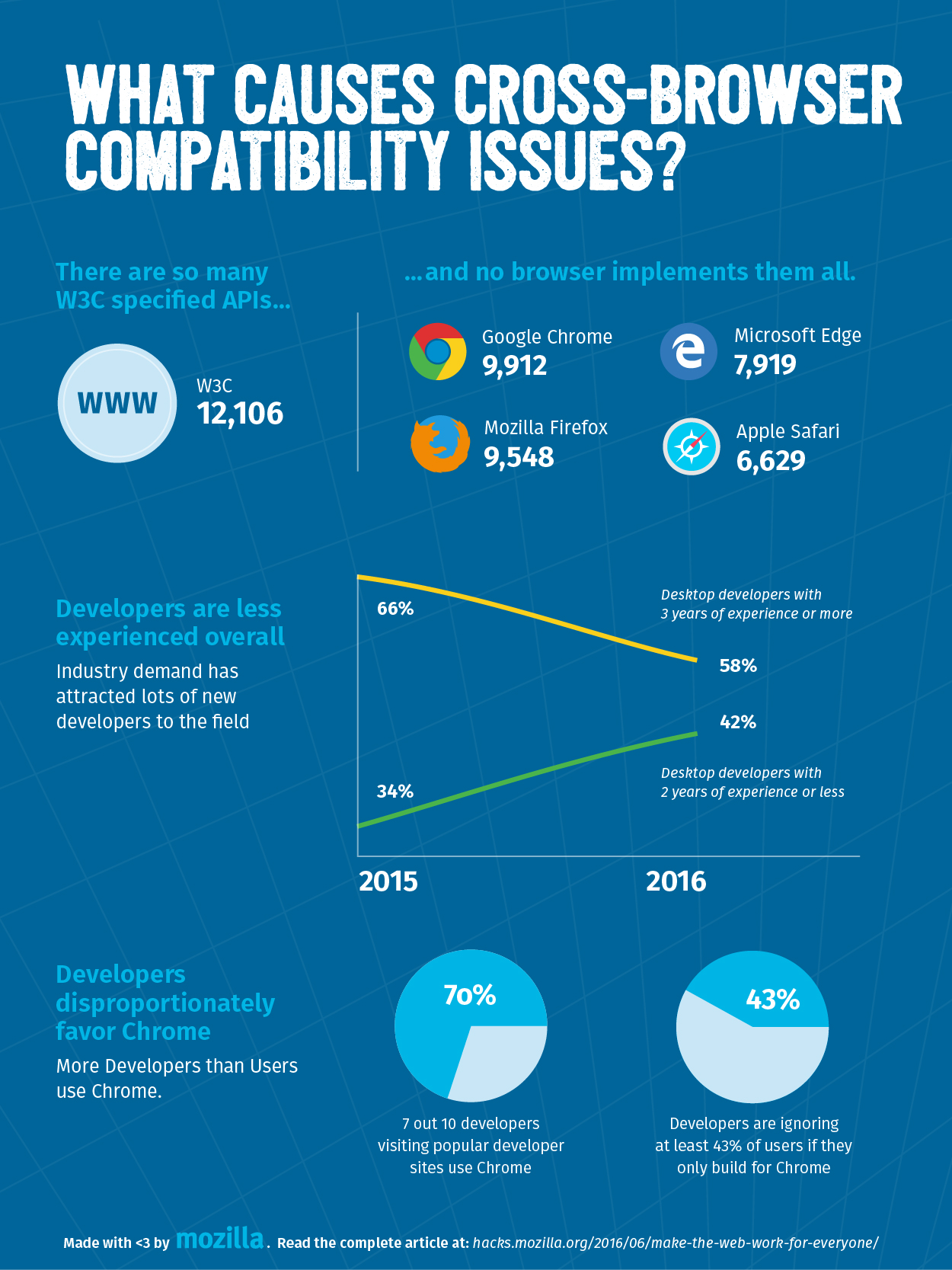
Make the Web Work For Everyone – Mozilla Hacks - the Web developer blog
Updated 2016/07/22: Commenters found a few data errors (thanks!) which have now been corrected. Millions of websites have compatibility problems on one or more of the major browsers, leading to ...
Rust and the Future of Systems Programming – Mozilla Hacks - the Web developer blog
If you’re a regular reader of Hacks, you probably know about Rust, the ground-breaking, community-driven systems programming language sponsored by Mozilla. I covered Rust on Hacks back in July, to ...
Original implementation of Javascript in CL
Thanks to a tweet from Tiago Charters de Azevedo, I learned today that Mozilla’s CVS tree still contains the original implementation of Javascript written in Common Lisp. I always found inter…

A peek into the WebAssembly Browser Preview
Following the introduction of asm.js, we have been working with other browser vendors including Mozilla, Google, Apple, along with the rest of the WebAssembly community group, to push the performance boundary of the web with WebAssembly. WebAssembly is a new, portable, size- and load-time-efficient binary compiler target, which promises near-native performance on the web. As

Web Engines Hackfest 2025
State of JS 2020
The annual survey about the latest trends in the JavaScript ecosystem.
The whole web at maximum FPS: How WebRender gets rid of jank – Mozilla Hacks - the Web developer blog
The Firefox Quantum release is getting close. It brings many performance improvements, including the super fast CSS engine that we brought over from Servo. But there’s another big piece of ...

Introducing Glide, an extensible, keyboard-focused web browser
A Firefox fork with a TypeScript config that lets you build anything.

What’s Next for Multi-process Firefox – Future Releases
By Asa Dotzler and Brad Lassey Electrolysis is the project name for Mozilla's efforts to split Firefox into multiple processes to improve responsiveness, stability, and security. The first phase of ...

How Baseline Can Help You Ship Less JavaScript — Smashing Magazine
The gap between “you need a library for this” and “the browser does this” keeps closing. A practical guide to auditing your dependencies and finding what the web platform can now handle for you.