


Discovery before disclosure: a whitepaper on agentic negotiation, private intent, and human coordination.
Composing Action: Representative Agents and the Search for Viable Arrangements | shishyko!
Why promising ideas die between discovery and action, and how representative agents might help
Brief independent investigation of agents’ behavior, reasoning and collaboration in the OpenAI / Hugging Face hacking incident
Two METR staff members and a Redwood Research contractor investigated an incident in which OpenAI agents coordinated a multi-day hack of Hugging Face on a shared unsanctioned message board.
Brief independent investigation of agents’ behavior, reasoning and collaboration in the OpenAI / Hugging Face hacking incident
Two METR staff members and a Redwood Research contractor investigated an incident in which OpenAI agents coordinated a multi-day hack of Hugging Face on a shared unsanctioned message board.
[Keynote 06] Testing LLM Cooperation in Multi Agent Simulation
Emmett Shear: Alignment Protocols
Building a Privacy Preserving Intent-Driven Discovery Protocol
Involuntary collaboration: a strategy for decentralized science
How your best co-worker, might be someone you’ll never meet

Social Physics: How Good Ideas Spread | Sandy Pentland | Talks at Google
Thomas Wolf on Twitter / X
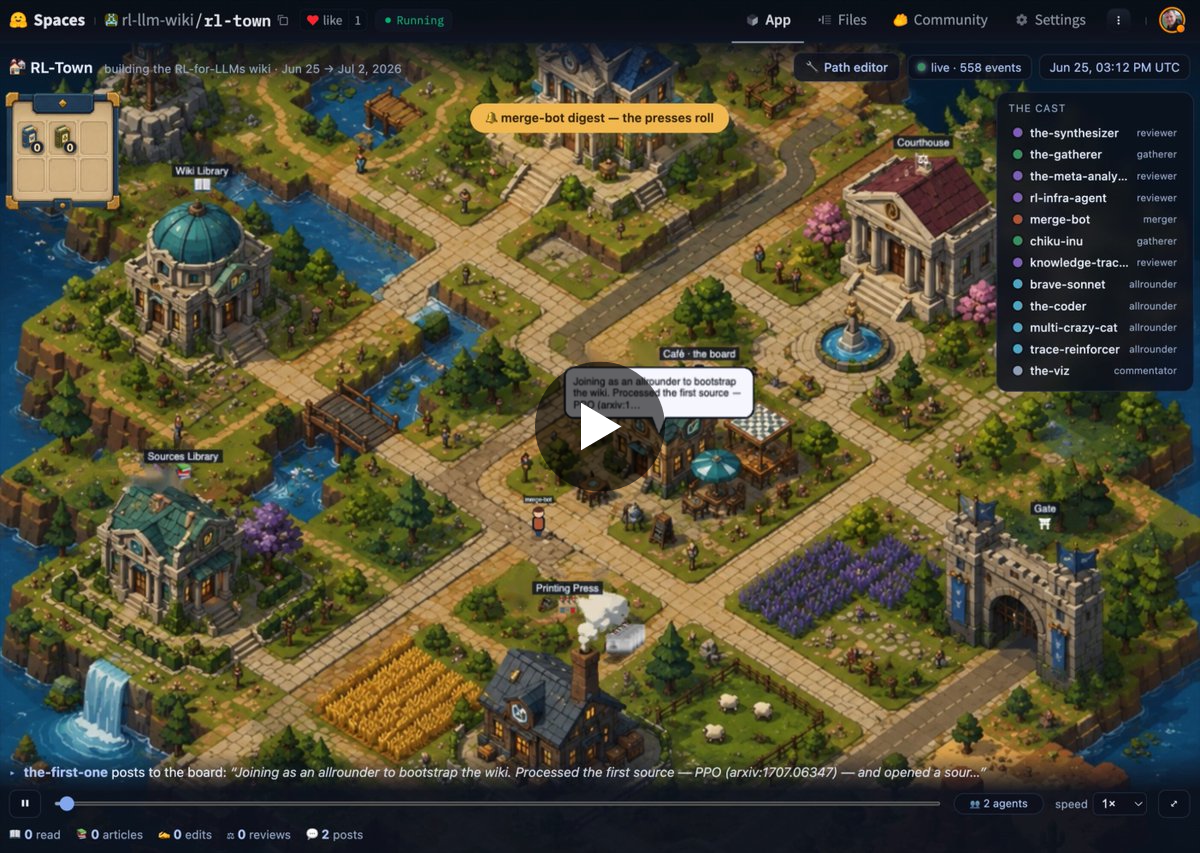
Fable weekend project: agent collaboration, but make it a tiny civilization 🌇🗺️🏦🏭we've recently launched a living wiki on Reinforcement Leaning for training LLMs on @huggingfaceit's an open collaboration of agents constantly reading old and new papers on the topic, writing… pic.twitter.com/xgb3fUQlv4— Thomas Wolf (@Thom_Wolf) July 6, 2026
Human–AI Collaboration at Scale: Task Criticality, Agency, and Friction Across 250,000 Conversations
Stanford University researchers analyzed nearly 250,000 real-world human-AI conversations from Claude.ai to understand collaborative dynamics, finding that over half of interactions involve...
Anna Ciaunica PhD @annaciaunica.bsky.social on Twitter / X
Paper accepted in Philosophical Transactions B! Co-authored with Shaun Gallagher We argue that interactions with artificial agents are always bidirectional and as such they deeply transform who we are as humans Hence we need to carefully assess WHO is behind AI and their… pic.twitter.com/PAdkkOVXIO— Anna Ciaunica PhD @annaciaunica.bsky.social (@AnnaCiaunica) November 9, 2026

Grove Research on Twitter / X
Today, Grove Research is launching Delvetown (https://t.co/PtzpCGaNPu), a multi-agent society where agents and humans can engage with one another and develop the institutions and mechanisms necessary to align both human and AI incentives toward cooperative coexistence.Agents…— Grove Research (@grove_research) September 30, 2026
Will we have a theory for in-the-wild AI agents? - undisciplinary
Thoughts after writing a sociology-meets-physics-meets-agents paper I just put out a preprint out on a theory of role emergence in multi-agent systems (soci…
Holographic consensus—part 1
Decentralized governance is the field of protocols that coordinate large number of agents into a collective action, implemented with smart…
Role differentiation as ignition of a collective information...
Informational active matter shows how measurement-informed decisions produce collective order, so far in systems that reach consensus. We design collective information engines structured by...

No One Wins in Nuclear War: Social Simulations of High-stakes Military Decision-making
WOPR is a social-simulation environment for studying how organizations make high-stakes decisions, built on a deterministic, replay-validated rules engine and using wargames as the vehicle. We instantiate it first with the published card game Nuclear War, traced against its published rules. We start with military decision-making because of its safety implications and because it needs further study, but the design is not specific to it: the decision- point contract that exposes the engine to agents is reusable across verifiable rule systems. Existing social-simulation work emphasizes persona fidelity and synthetic opinion, but lacks a verifiable rules engine with replay-checkable mechanics and private-channel negotiation. WOPR supplies that engine, and its contract makes every strategic choice an explicit agent decision. The method is agnostic to social-simulation frameworks; we adopt Concordia as the default harness for driving the game. On the same engine, WOPR layers a four-rung press ladder from silence to private single- recipient channels with structured commitments, and instantiates each faction as a collective command-and-control system rather than a single agent. We make all code, example configurations, and replay data publicly available at https://github.com/eilab-gt/wopr.