

Trusted, curated, subject-specific models are needed for academia
#predictingthefuture #newfutureofwork | Jaime Teevan
🌱 Prediction: Knowledge will outgrow publication. We’re already seeing academic publication start to buckle under AI, sometimes absurdly. I still publish research more or less the way Darwin did. I run a study, write it up, a few other scientists check it over, and the result gets filed away as a document with my name on the front. Faster than Darwin, with better figures, but the same basic shape. I predict that shape won’t last another decade. Academic authors are starting to slip hidden instructions into papers to flatter the AI that might review them. Reviewers are spending time checking whether citations exist or were hallucinated. Researchers asking AI to tell them about a paper instead of reading it directly. These are signs that the creation of new knowledge is outgrowing the articles that used to contain it. An academic paper serves many purposes at once. It makes an argument legible. It lets strangers check one's reasoning. It assigns credit and responsibility. It records who knew what and when. A paper was the only container we had for these different jobs, so it carried all of them together. With AI, they can be separated. My guess is that means the unit of publication will get smaller. Much of my research has focused on microproductivity, developing the idea that large accomplishments can be built from many small contributions. Publication will start to become a form of microproductivity. Instead of holding onto a result until it can be wrapped in a narrative large enough to justify a paper, researchers will publish it the moment it’s solid. Each finding, method, or negative result will be citable and carry its own provenance, so credit and reasoning travel with it. Reviewing will shrink to match, so claims get checked as they’re made instead of in one verdict at the end. But more than changing publication, the deeper change will be to how research itself is done. You may have heard the term “compound engineering,” where every bug fixed, evaluation written, workflow documented, or lesson learned becomes part of the system’s memory. I predict we’re about to see “compound science,” where every experiment, evaluation, insight, artifact, and learned capability becomes a reusable asset for future discovery. Findings will become evidence. Methods will become building blocks. Failed approaches will become constraints. For centuries, science has relied on humans to navigate an ever-growing body of knowledge. Soon that body of knowledge will help navigate itself. Scientists will spend less time searching for hypotheses and more time deciding which opportunities to pursue. AI systems will propose explanations, design experiments, run analyses, and explore many possibilities in parallel. Every discovery will become a part of the machinery that produces the next one. Papers ten years from now will look less like my current papers than my current papers look like Darwin’s. If they exist at all. #PredictingTheFuture #NewFutureOfWork

Scientific sleuths come in from the cold
Research integrity investigators are starting to organize, but the field, and the people, remain idiosyncratic

Large language models eroding science understanding: an empirical study of ‘malignment’
Large Language Models (LLMs) increasingly provide scientific information to non-specialist users, yet their linguistic fluency can create an impression of expertise that exceeds their capacity for scientific judgement. This paper experimentally investigates how readily an LLM can be configured to present fringe scientific claims as authoritative knowledge. We constructed two RAG-like Custom GPTs using GPT-5.1, one concerned with the fine-structure constant and the other with gravitational waves. In each case, ten papers selected by domain experts from the alternative preprint repository viXra were supplied as a domain-specific knowledge base, together with instructions directing the model to treat this material as authoritative. The underlying model was neither retrained nor fine-tuned. Expert-generated questions were then posed to the resulting “Fringe-LLMs”, to the unmodified model, and to domain experts. The Fringe-LLMs produced fluent, detailed and apparently authoritative answers that systematically reflected the fringe corpus, while expert assessment found many of these answers to be scientifically incorrect or seriously misleading. By contrast, the unmodified model generally produced answers substantially closer to mainstream scientific understanding. We describe this deliberate redirection of model output as malignment. The experiment demonstrates that scientifically misleading LLMs can be created with a low technical barrier and without altering model weights or poisoning training data. Because non-specialists may be unable to distinguish such outputs from genuine expertise, the results raise important concerns about the use of LLMs as intermediaries for scientific knowledge and reinforce the continuing importance of expert human judgement and provenance.
Metagov x Future of Science Seminar - Discourse Graphs with Matt Akamatsu
Governing the scholarly AI Commons – Open Future
New report explores how academic communities can shape AI governance in research and publishing, from regulation to community-led approaches.
Discourse Graphs and the Future of Science | Protocol Labs Research
Interview between Tom Kalil, Chief Innovation Officer of Schmidt Futures, Dr. Evan Miyazono, Research Team Lead at Protocol Labs, and Dr. Matt Akamatsu, Assistant Professor of Biology at the University of Washington.

Science One Framework: A verifiable autonomous research framework via Chain-of-Evidence
Rui Meng, Research Scientist, and Tomas Pfister, Director, Google Cloud

NLnet; Nanoarguments
Scientific knowledge is currently scattered across papers, repositories, and disconnected platforms, with no structured way to trace how claims connect to evidence or how arguments develop. Nanoarguments builds a framework and tools for creating, browsing, and contributing to a global, federated graph of scientific discourse and evidence. Researchers and their communities can collaboratively structure claims, evidence chains, and discussion as nanopublications, which are small, cryptographically signed Linked Data snippets with precise provenance and authorship, published to a decentralized peer-to-peer network. The project builds upon the Nanodash interface to help users browse, edit, and aggregate discourse and evidence graphs, and integrates with dokieli to enable in-context authoring of nanopublications as inline annotations while reading or writing a document. A bidirectional ActivityPub connector bridges the nanopublication network and the fediverse, allowing discourse threads to start as social exchanges and crystallize into persistent, machine-readable evidence records. The project will be piloted with early adopter research groups in discourse and evidence modeling. All components will be released as open-source modules that other systems can build upon.
MCP Research & Discussion Night · Luma
We're hosting a reading and discussion group for Anthropic's Model Context Protocol. We'll look at the fundamental protocol affordances, its consequences, and…

A protocol for attributable modular research contribution - Matsuthoughts
I wrote this essay in response to Seemay Chou's call for essays on systemic bottlenecks to science. Structural change in scholarly communication practices i…
A budding discipline around how science gets read and judged - Aris
Scholarly publishing spent thirty years arguing about access. It has barely begun arguing about what readers do with the paper once they have it. At Aris we call that second argument scholarly interface design. Mike Morrison's community calls it ScienceUX. Either way it is becoming a field, and here is why it is worth your attention.
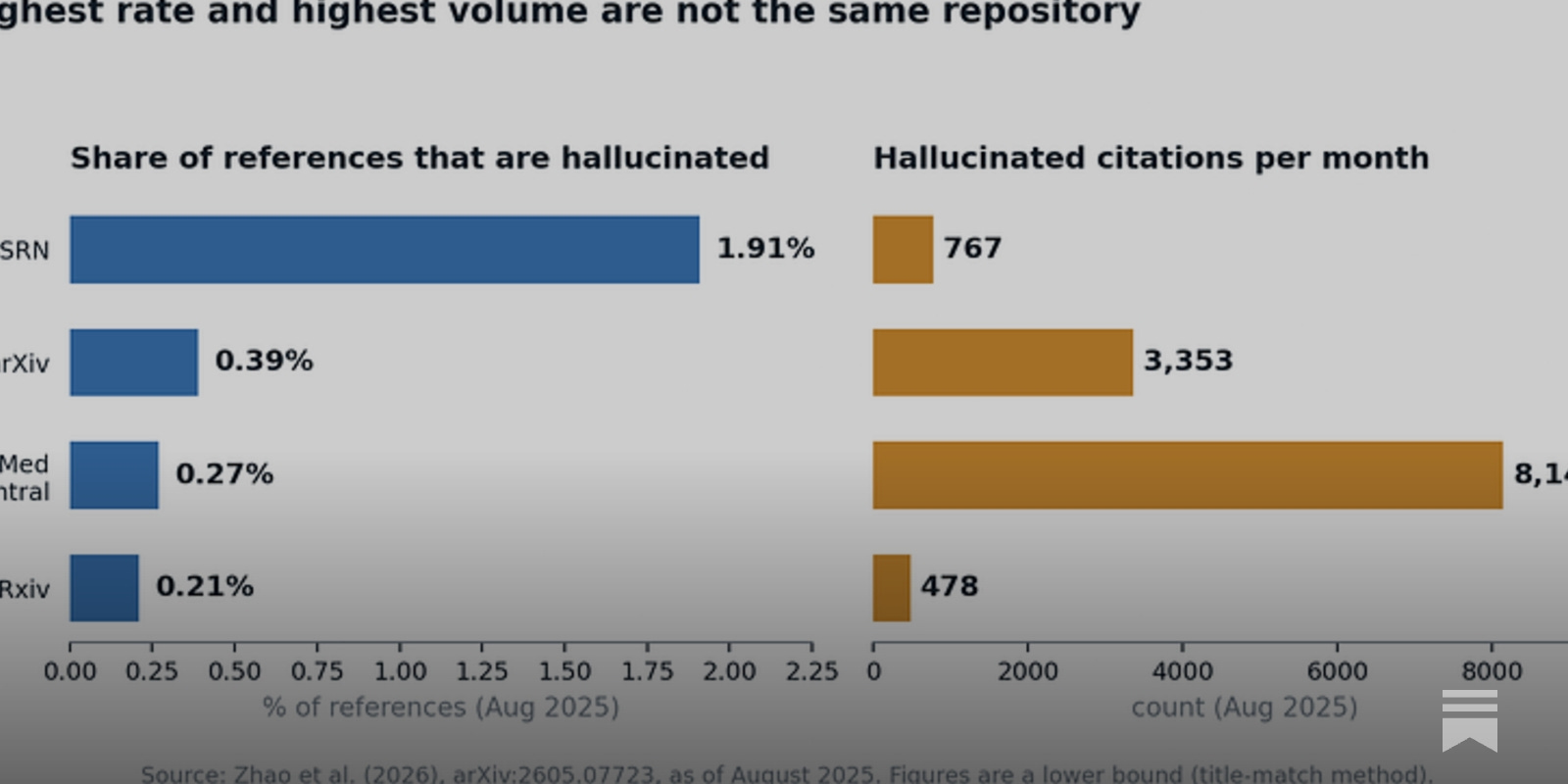
No. 002: Hallucinated citations at scale, ICML catches AI reviewers, scholarly infrastructure gaps - The Hallway Track
The Hallway Track No. 002 - How AI is affecting the practice of science
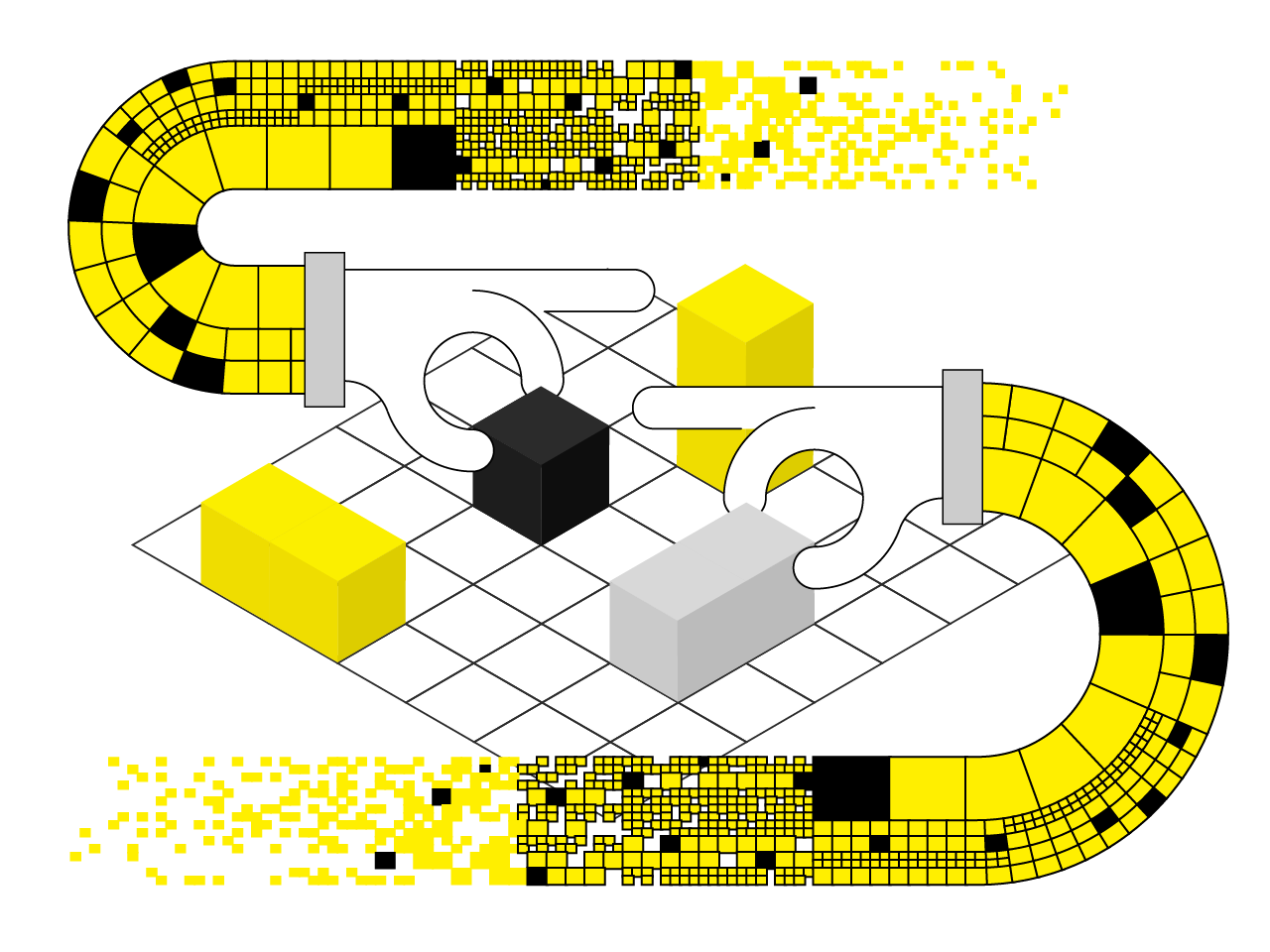
A Science Funding System Beyond the Linear Model
Research funders should embrace a new ontology of scientific work to improve the relationship between science and the public.
The Paper Factory
How can large language models (LLMs) contribute to social science research, and what parts of research remain stubbornly human? Building on existing LLM tools, we offer a multi-agent workflow capable of producing a full quantitative social science paper from an initial prompt. The workflow relies on researchers codifying their heuristics for doing data analysis, and we suggest some core design principles for researchers interested in building on this scaffolding. Using this case, we also examine what current LLM capabilities reveal about the organization of research. LLM agents can lower the cost of pursuing high-risk ideas, expand robustness and transparency, reduce concerns about the scientific file drawer, and force scholars to articulate the heuristics that create valuable work. But they also pose challenges, both in terms of the quality of papers and in the adequacy of scientific institutions to adapt. Meeting these challenges will require new institutional norms that make use of these tools observable, auditable, and accountable.
Scholary infrastructure and the research nexus

The research nexus is "a rich and reusable open network of relationships connecting research organisations, people, things, and actions; a scholarly record that the global community can build on forever, for the benefit of society." (crossref.org/documentation/research-nexus/)

How Grobid uses Crossref metadata to enrich bibliographic information - Crossref
Schema 5.5 now available: adding CRediT, new record types for blogs and posters, and more - Crossref
Scholarly blogs and their place in the research nexus - Crossref
Rogue Scholar
SemRepo.org

Science discussions of retracted articles on Bluesky: public scrutiny or misinformation spreading?
