

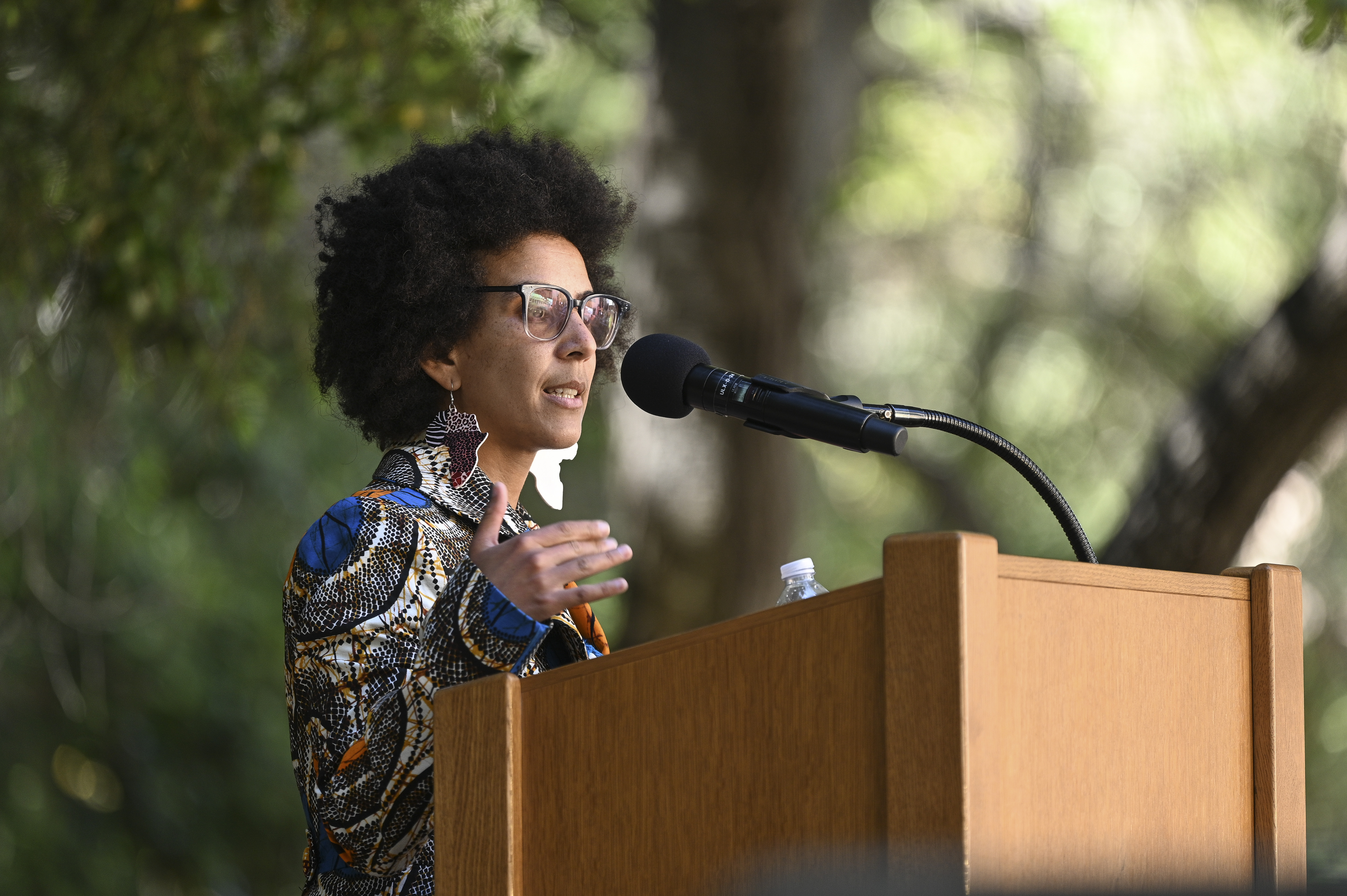
The computer scientist discusses breaking down the power structures that use AI to exploit communities.
The Real Existential Risk Is AI CEOs Avoiding Oversight: “Alternative Nobel” Winner Timnit Gebru
We speak to the prominent AI researcher and leading critic of the AI industry, Timnit Gebru, who was recently awarded a 2026 Right Livelihood Award for her work investigating the harms and hype behind the global buildup of artificial intelligence. “Instead of discussing faulty, unreliable systems,” Gebru says tech leaders like SpaceXAI’s Elon Musk, OpenAI’s Sam Altman and Anthropic’s Dario Amodei are “marketing their systems as all-knowing, superpowerful, superintelligent,” and lobbying for “self-policing and self-regulation” to avoid being held “liable through existing laws.” Gebru expresses skepticism over increasingly widespread claims that AI algorithms pose an existential risk to humanity, warning that such claims are overblown and that “what is actually happening is regulatory capture.”

The tech industry hijacking of the AI ethics research agenda and why we should reclaim it
This paper reflects on the tech industry’s colonization of the AI ethics research field and addresses conflicts of interest in public policymaking concerning AI. The AI ethics research community faces two intertwined challenges: In the first place, we have a tech industry heavily influencing the AI ethics research agenda. Secondly, cleaning up after the tech industry has implied that we have turned to value-driven design methods to bring ethics to AI design. But by framing research questions relevant to a technical practice, we have facilitated the technological solutionism behind the tech industry’s business model. Therefore, this paper takes the first steps to reshape the AI ethics research agenda by suggesting moving toward an emancipatory framework that brings politics to design while, at the same time, bearing in mind that AI is not to be treated as an inevitability. As a research community, we must focus on the repressive power dynamics exacerbated by AI and address challenges facing the vulnerable groups seldom heard, despite the fact that they are the ones most negatively affected by AI initiatives.

AI, Ethics, and Society — Home
AI & Ethics Workgroup | Lincoln Center for Applied Ethics
Artificial Intelligence (AI) is a term with an array of contingent and shifting meanings, unified only by a general aspiration to use mathematical computation to emulate human cognition, language and problem-solving. Rather than a technical term, “AI” can be thought of as a sociotechnical system and assemblage, consisting of technical objects and social imaginaries, practices and ideologies. How we characterize and conceptualize AI shapes how, why and when we use it and when we may constrain or refuse its use. This paper provides a primer on various technologies that often fall under the rubric of “AI” and outlines the various discursive and cultural meanings carried by the term.
3: Consulting the Record: AI Consistently Fails the Public - AI Now Institute
Amid the excitement over AI’s (speculative, hypothetical) potential, we have lost sight of the sobering reality of its present and recent past. AI is already intermediating critical social infrastructures, materially reshaping our institutions in ways that ratchet up inequality and concentrate power in the hands of the already powerful. It is consistently deployed in ways […]
How AI Destroys Institutions
Civic institutions—the rule of law, universities, and a free press—are the backbone of democratic life. They are the mechanisms through which complex societies encourage cooperation and stability, while also adapting to changing circumstances. The real superpower of institutions is their ability to evolve and adapt within a hierarchy
How AI Destroys Institutions
Civic institutions—like the rule of law, higher education, and a free press—are the backbone of democratic life. They are the mechanisms through which complex s

How Shifting Responsibility for AI Harms Undermines Democratic Accountability | TechPolicy.Press
The moralization of individual AI use deflects responsibility away from powerful actors like corporations and governments, Suvradip Maitra and others write.

Friends with no previous interest in AI ethics have been asking me about it recently, so I want to share several underlying concepts about AI & power that are important to understand. 🧵 1/
Friends with no previous interest in AI ethics have been asking me about it recently, so I want to share several underlying concepts about AI & power that are important to understand. 🧵 1/— Rachel Thomas (@math_rachel) May 16, 2023
Inescapable AI — TechTonic Justice
The use of artificial intelligence, or AI, by governments, landlords, employers, and other powerful private interests restricts the opportunities of low-income people in every basic aspect of life: at home, at work, in school, at government offices, and within families. AI technologies derive from a lineage of automation and algorithms that have been in use for decades with established patterns of harm to low-income communities. As such, now is a critical moment to take stock and correct course before AI of any level of technical sophistication becomes entrenched as a legitimate way to make key decisions about the people society marginalizes.

Timnit Gebru, Former Google AI Ethics Chief, Has Plan to Rethink Big Tech
Timnit Gebru says regulators need to provide whistleblowers working on artificial intelligence with fresh protections backed up by tough enforcement.

AI Slopageddon and the OSS Maintainers
AI slop is ripping up the social contract between maintainers and contributors essential to open source development. Practitioners have been repeatedly assured that AI would supercharge their communities, but so far that hasn’t been the case. Just look at what happened last month. Mitchell Hashimoto’s Ghostty implemented a zero-tolerance policy where submitting bad AI-generated code

AI Ethics Are in Danger. Funding Independent Research Could Help (SSIR)
For technology to truly work in the public interest, we need to invest in building organizations that are free from corporate profit motives and that respect, integrate, and compensate communities with whom they work. We offer a new path forward for AI re <meta property=

Gradual disempowerment | 80,000 Hours
The proliferation of advanced AI systems may lead to the gradual disempowerment of humanity, even if efforts to prevent them from becoming power-seeking or scheming are successful. Humanity may be incentivised to hand over increasing amounts of control to AIs, giving them power over the economy, politics, culture, and more. Over time, humanity's interests may be sidelined and our control over the future undermined, potentially constituting an existential catastrophe. There's disagreement over how serious a problem this is and how it relates to [other concerns about AI alignment](https://80000hours.o

Building a Solidarity Ecosystem for AI (SSIR)
How cooperatives, public institutions, and social movements can come together to intentionally build a practical, community-owned alternative to extractive AI systems. <meta property=
> the central promise of “ai” is that nothing is worth doing and that community doesn’t exist. It’s individual entitlement as software. It’s Thatcherism. post.lurk.org/@emenel/117441848350524047
emenel (@emenel@post.lurk.org)
post.lurk.org