

Scientific web claims are seen as scientific claims as observed on the Web, across social media, online news, and other platforms. The growing prevalence of scientific discussions on the Web has intensified the need to process and assess this specific type of claims. Unlike claims from scientific publications, scientific web claims are expressed in lay terms, are often decontextualized, and typically lack proper citations, which poses unique challenges for their identification, verification, and communication. Nevertheless, the correct processing of scientific web claims is crucial to keeping online science discussions accurate and informed, for instance through fact-checking. This survey provides the first systematic overview dedicated specifically to scientific web claims. We review and compare existing definitions, task formulations, datasets, and methodological approaches across three major perspectives: (1) Scientific fact-checking on the Web, (2) Scientific citations on the Web, and (3) Science communication on the Web. Our interdisciplinary analysis integrates insights from natural language processing, information retrieval, artificial intelligence, social sciences, and science communication. We identify major methodological challenges, including the lack of unified definitions, domain-agnostic corpora, and foundational models tailored to science-related online discourse. We also discuss challenges related to the existing interplay between emotions and distortions of science online. By mapping current research efforts and highlighting open problems, this survey lays the groundwork for developing robust datasets, methods, and evaluation frameworks to advance the automated processing of scientific web claims, a necessary capability for strengthening the reliability of science-related online discourse at scale.
NLnet; Nanoarguments
Scientific knowledge is currently scattered across papers, repositories, and disconnected platforms, with no structured way to trace how claims connect to evidence or how arguments develop. Nanoarguments builds a framework and tools for creating, browsing, and contributing to a global, federated graph of scientific discourse and evidence. Researchers and their communities can collaboratively structure claims, evidence chains, and discussion as nanopublications, which are small, cryptographically signed Linked Data snippets with precise provenance and authorship, published to a decentralized peer-to-peer network. The project builds upon the Nanodash interface to help users browse, edit, and aggregate discourse and evidence graphs, and integrates with dokieli to enable in-context authoring of nanopublications as inline annotations while reading or writing a document. A bidirectional ActivityPub connector bridges the nanopublication network and the fediverse, allowing discourse threads to start as social exchanges and crystallize into persistent, machine-readable evidence records. The project will be piloted with early adopter research groups in discourse and evidence modeling. All components will be released as open-source modules that other systems can build upon.
A New Paradigm for Scientific Publishing, Peer Review, and Impact Assessment
Scientific publishing and peer review have evolved little in three centuries, while the demands placed on them have grown profoundly. The growing role of artificial intelligence has underscored deep, systemic shortcomings of an aging system that has largely evaded innovation, a system whose origins are appallingly closer to the invention of the printing press than to the internet. We can do better – much better. This article is intended as the beginning of a communal experiment: a living document that critically reviews the modern academic publishing and peer-review system and presents a concrete framework to address what bibliometrics experts¹ have characterized as "the pervasive misapplication of indicators to the evaluation of scientific performance". Building on the Leiden Manifesto, DORA, and a body of scholarship spanning many disciplines and decades, we present a community-governed, non-profit platform organized around three trust-weighted impact factors, for articles, authors, and reviewers, with full algorithmic transparency, an open development log, and structural decoupling of credibility scoring from content moderation and from monetization. We invite the community to discuss, critique, and help shape it.
Citing Less Critically: LLMs Reshape the Rhetoric and Reach of Scientific Citation
Scientific citations carry rhetorical intent. Scholars may cite prior work positively (supporting), negatively (contrasting), or neutrally (mentioning). As large language models (LLMs) increasingly assist scientific writing, whether they reproduce citations with the same rhetorical intent as humans remains unclear. We introduce a masked-citation task to compare human and LLM-generated citation behavior. For each citation context, an LLM generates a replacement citation sentence, producing a counterfactual corpus directly comparable to human citation. We analyze what, whom, and how models cite, using an LLM-as-a-judge to classify citation intent and a 20-million-edge coauthorship network to measure social distance between cited authors. Across six popular LLMs and 1,746 top NLP conference papers (63k+ contexts, 132k+ citations), three patterns emerge: (1) Compared with human citation, LLMs cite significantly less critically; (2) LLMs over-cite popular and older papers, a tendency amplified for contrasting citations where human writing more often draws on recent, niche work; (3) Whereas humans often cite within their close social network, especially for supporting citations, LLMs tend to draw on more socially distant authors. Together, these differences are double-edged: LLM citation reaches beyond a scholar's close collaborators while being less critical and amplifying visibility bias, reshaping the rhetoric and reach of scientific citation.

Large Knowledge Model: From Papers to a Scientific Reasoning Landscape
Accumulated scientific knowledge advances inquiry when prior findings help researchers choose new questions, design investigations, and interpret results. Realizing this value at scale requires access to the reasoning that connects research problems, scientific procedures, conclusions, and evidence. We introduce the Large Knowledge Model (LKM), a scientific knowledge infrastructure that transforms the literature into a shared, computationally accessible reasoning resource. LKM represents papers as source-grounded reasoning graphs, couples structural traversal with semantic retrieval over the same objects, and aligns related questions, claims, and reasoning chains across papers. This representation forms a Scientific Reasoning Landscape with three connected views: a Question Landscape that organizes research problems and open directions, a Workflow Landscape that exposes reusable scientific procedures, and an Evidence Landscape that connects conclusions to their support, disagreement, and conditions. The unified substrate supports reasoning-aware scientific search, evidence-grounded question answering, comparative evidence analysis, and research planning. Researchers and agents can retrieve relevant work through its scientific intent, synthesize answers with inspectable supporting arguments, and develop research plans informed by established workflows and unresolved evidence. We describe a corpus-scale system and evaluate scientific retrieval and knowledge-intensive question answering. With the answering model fixed, LKM retrieval improves accuracy by 9.30%, 4.20%, and 14.69% on ChemBench, PubMedQA, and SciBench, respectively. By connecting knowledge access to scientific reasoning and action, LKM provides a common foundation for discovering relevant research, reusing scientific knowledge, and coordinating cumulative inquiry across researchers, agents, and research cycles.
Incorrect Citation Association for Articles in Online-Only Springer Nature Journals
We show that citation metrics of journal articles in many of the online-only Springer Nature journals and associated ones are distorted, going back to articles from 2001. We find that most likely due to an API response error, there are many incorrect references which typically lead to Article Number 1 of a given Volume. Among others, the issue affects journals such as Scientific Reports, Nature Communications, Communications journals, Cell Death & Disease, Light: Science & Applications, as well as many BMC, Discovery and npj journals. Beyond the negative effect of introducing incorrect reference information, this distorts the citation statistics of articles in these journals, with a few articles being massively over-cited compared to their peers, while many lose citations; e.g. both in Scientific Reports and in Nature Communications, 5 of the 10 top cited articles have article numbers of 1. We validate the distorted statistics by assessing data from multiple scientific literature databases: Crossref, OpenCitations, Semantic Scholar, and the journals' websites. The issue primarily arises from the inconsistent transition from page-based referencing of articles to article number-based referencing, as well as the improper handling of the change in the publisher's article metadata API. It seems that the most pressing problem has been present since approximately 2011, which we estimate affects the citation count of millions of authors.
How is science clicked on Twitter? Click metrics for Bitly short links to scientific publications
Abstract To provide some context for the potential engagement behavior of Twitter users around science, this article investigates how Bitly short links to scientific publications embedded in scholarly Twitter mentions are clicked on Twitter. Based on the click metrics of over 1.1 million Bitly short links referring to Web of Science (WoS) publications, our results show that around 49.5% of them were not clicked by Twitter users. For those Bitly short links with clicks from Twitter, the majority of their Twitter clicks accumulated within a short period of time after they were first tweeted. Bitly short links to the publications in the field of Social Sciences and Humanities tend to attract more clicks from Twitter over other subject fields. This article also assesses the extent to which Twitter clicks are correlated with some other impact indicators. Twitter clicks are weakly correlated with scholarly impact indicators (WoS citations and Mendeley readers), but moderately correlated to other Twitter engagement indicators (total retweets and total likes). In light of these results, we highlight the importance of paying more attention to the click metrics of URLs in scholarly Twitter mentions, to improve our understanding about the more effective dissemination and reception of science information on Twitter.

Fakebook: Using Data Science to Spot Fake News

Crossref: The sustainable source of community-owned scholarly metadata
This paper describes the scholarly metadata collected and made available by Crossref, as well as its importance in the scholarly research ecosystem. Containing over 106 million records and expanding at an average rate of 11% a year, Crossref’s metadata has become one of the major sources of scholarly data for publishers, authors, librarians, funders, and researchers. The metadata set consists of 13 content types, including not only traditional types, such as journals and conference papers, but also data sets, reports, preprints, peer reviews, and grants. The metadata is not limited to basic publication metadata, but can also include abstracts and links to full text, funding and license information, citation links, and the information about corrections, updates, retractions, etc. This scale and breadth make Crossref a valuable source for research in scientometrics, including measuring the growth and impact of science and understanding new trends in scholarly communications. The metadata is available through a number of APIs, including REST API and OAI-PMH. In this paper, we describe the kind of metadata that Crossref provides and how it is collected and curated. We also look at Crossref’s role in the research ecosystem and trends in metadata curation over the years, including the evolution of its citation data provision. We summarize the research used in Crossref’s metadata and describe plans that will improve metadata quality and retrieval in the future.

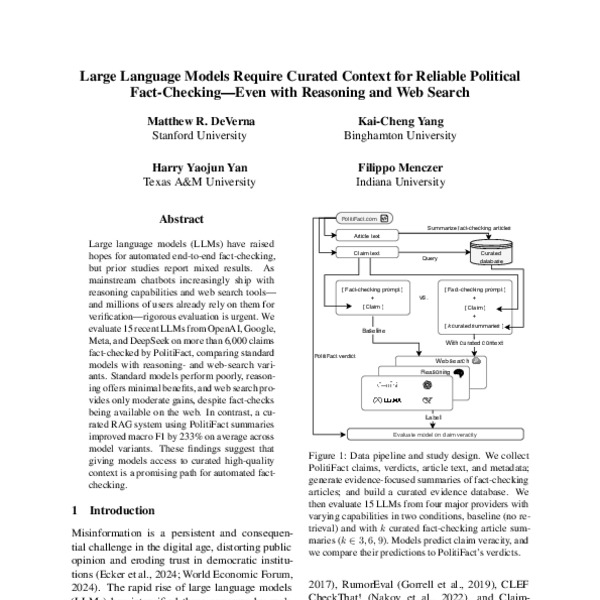
Large Language Models Require Curated Context for Reliable Political Fact-Checking—Even with Reasoning and Web Search
Large language models (LLMs) have raised hopes for automated end-to-end fact-checking, but prior studies report mixed results. As mainstream chatbots increasingly ship with reasoning capabilities and web search tools—and millions of users already rely on them for verification—rigorous evaluation is urgent. We evaluate 15 recent LLMs from OpenAI, Google, Meta, and DeepSeek on more than 6,000 claims fact-checked by PolitiFact, comparing standard models with reasoning- and web-search variants. Standard models perform poorly, reasoning offers minimal benefits, and web search provides only moderate gains, despite fact-checks being available on the web. In contrast, a curated RAG system using PolitiFact summaries improved macro F1 by 233% on average across model variants. These findings suggest that giving models access to curated high-quality context is a promising path for automated fact-checking.
HalluCiteChecker: A Lightweight Toolkit for Hallucinated Citation Detection and Verification in the Era of AI Scientists
We introduce HalluCiteChecker, a toolkit for detecting and verifying hallucinated citations in scientific papers. While AI assistant technologies have transformed the academic writing process, including citation recommendation, they have also led to the emergence of hallucinated citations that do not correspond to any existing work. Such citations not only undermine the credibility of scientific papers but also impose an additional burden on reviewers and authors, who must manually verify their validity during the review process. In this study, we formalize hallucinated citation detection as an NLP task and provide a corresponding toolkit as a practical foundation for addressing this problem. Our package is lightweight and can perform verification in seconds on a standard laptop. It can also be executed entirely offline and runs efficiently using only CPUs. We hope that HalluCiteChecker will help reduce reviewer workload and support organizers by enabling systematic pre-review and publication checks. Our code is released under the Apache 2.0 license on GitHub and is distributed as an installable package via PyPI. A demonstration video is available on YouTube.
Towards Automating Scientific Review with Google's Paper Assistant Tool
Artificial intelligence is driving a revolution in scientific discovery, accelerating everything from hypothesis generation to mathematical theorem proving. However, this rapid acceleration is creating a systemic challenge: traditional human peer review cannot scale to match the influx of AI-assisted science. Ultimately, to resolve this tension, we must also deploy AI to accelerate the verification and review process itself. To frame the discussion around this transition, we propose a taxonomy consisting of four progressive levels of AI-human collaboration in scientific evaluation, and discuss various trade-offs involved with each. As a step toward this future, we introduce the Paper Assistant Tool (PAT), an agentic AI framework built for deep scientific review and verification. PAT ingests full scientific manuscripts and produces a comprehensive evaluation, checking theoretical results, validating experiments, suggesting improvements, and identifying potential flaws. By utilizing inference scaling techniques, PAT is able to identify deeper issues than a single model call alone, achieving a 34% improvement over zero-shot recall on mathematical errors in the SPOT benchmark. Pilot deployments of PAT as a pre-submission tool for authors at two major Computer Science conferences -- STOC and ICML -- demonstrate its ability to identify critical errors and suggest substantive improvements to research papers. By catching errors early, PAT eases the cognitive burden placed on referees, while preserving their control over the outcomes of the review process.
A call for broadening the altmetrics tent to democratize science outreach
Common altmetrics indices are limited and biased in the social media that they cover. In this Perspective, we highlight how and why altmetrics should broaden its scope to provide more reliable metrics for scientific content and communication.
Large language models eroding science understanding: an empirical study of ‘malignment’
Large Language Models (LLMs) increasingly provide scientific information to non-specialist users, yet their linguistic fluency can create an impression of expertise that exceeds their capacity for scientific judgement. This paper experimentally investigates how readily an LLM can be configured to present fringe scientific claims as authoritative knowledge. We constructed two RAG-like Custom GPTs using GPT-5.1, one concerned with the fine-structure constant and the other with gravitational waves. In each case, ten papers selected by domain experts from the alternative preprint repository viXra were supplied as a domain-specific knowledge base, together with instructions directing the model to treat this material as authoritative. The underlying model was neither retrained nor fine-tuned. Expert-generated questions were then posed to the resulting “Fringe-LLMs”, to the unmodified model, and to domain experts. The Fringe-LLMs produced fluent, detailed and apparently authoritative answers that systematically reflected the fringe corpus, while expert assessment found many of these answers to be scientifically incorrect or seriously misleading. By contrast, the unmodified model generally produced answers substantially closer to mainstream scientific understanding. We describe this deliberate redirection of model output as malignment. The experiment demonstrates that scientifically misleading LLMs can be created with a low technical barrier and without altering model weights or poisoning training data. Because non-specialists may be unable to distinguish such outputs from genuine expertise, the results raise important concerns about the use of LLMs as intermediaries for scientific knowledge and reinforce the continuing importance of expert human judgement and provenance.

Attribution, Provenance, Reference, Citation, and AI for Research Applications – Understanding the Differences - The Scholarly Kitchen
Building robust citation and attribution into generative AI systems are foundational to usage, credit and trust. We need to expect more from AI.
