

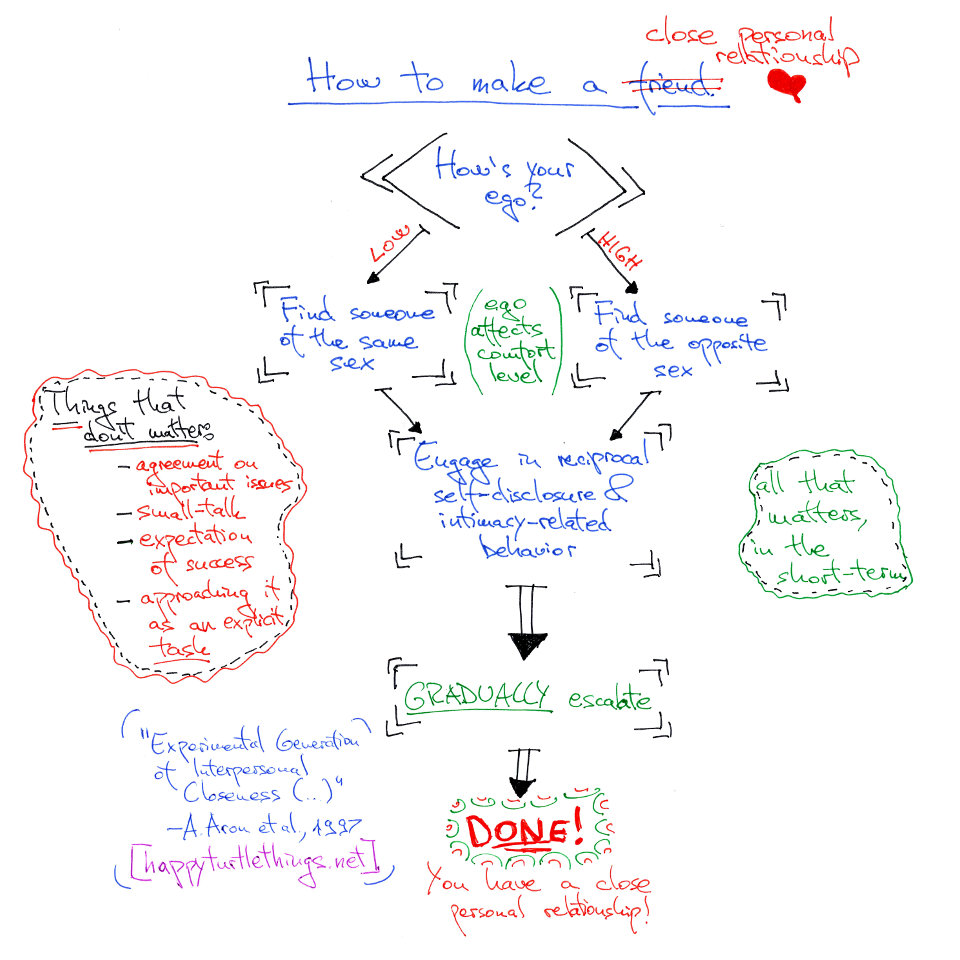
Believe-it-or-not, we actually know exactly how to create friendships in the lab!
The Science of Making Friends
Starting in early adulthood, our number of friends starts to decrease steadily; there are ways to reverse the tide, writes Elizabeth Bernstein.

You have more ways to connect than ever, but deep friendship feels hard to find – here’s how to build better connections
Despite being more connected than any previous generation, many young people report struggling to build friendships that provide a genuine sense of closeness.

Dunbar’s number: why my theory that humans can only maintain 150 friendships has withstood 30 years of scrutiny
The claim that our brain size limits us to 150 meaningful friendships has been challenged by a recent paper.

The Power of Asynchronous Communication
Asynchronous communication allows us to maintain the essential bonds of friendship and dialog with the people that matter to us.

Involuntary collaboration: a strategy for decentralized science
How your best co-worker, might be someone you’ll never meet

#paperclip | James Zou | 46 comments
What if, for any scientific claim, you can search 100M+ papers to find the strongest evidence for and against it ⚡️ in 1 second? That’s now possible with Evidence API! 🚀 https://lnkd.in/dzQ_HT-P Evidence API combines #paperclip with our new Jev-style model trained to extract relevant evidence in lightning speed. Great job by Kevin Wu and GXL For example, does drinking coffee reduce diabetes risk? | 46 comments on LinkedIn
The Power of Positive People (Published 2018)
Are your friendships giving you a boost or bringing you down?

Models for Trust Inference in Social Networks
Interpersonal trust between any two people in social networks is hard to gauge, and even harder to infer, given that these two people are not connected by an immediate social link, such as friendship or acquaintanceship. In order to be able to make accurate inferences for an arbitrary tuple of people in a given social environment, we present an approach, named Appleseed, that is based on mechanics taken from neuropsychology, known as spreading activation models. Compelling in its simplicity, we relate the concept to trust propagation and evaluation in an intuitive fashion. While Appleseed works very well when paths between two arbitrary people in the network can be established, no inference of trust is possible when this is not the case. To this end, we present several algorithms for inferring trust that go beyond network structure and demonstrate their accuracy in real social networks. We also show how these algorithms can be augmented with additional data that may be available in some contexts.

The Social Physics of Conversation: Why Communication Patterns Matter
Discover how communication patterns shape team performance, innovation, and collective intelligence. Learn why idea flow matters more than talent alone.
(PDF) Algorithmically Mediating Communication to Enhance Collective Decision-Making in Online Social Networks
PDF | Many collective decision-making contexts involve communication among group members. Sometimes this communication helps the collective reach an... | Find, read and cite all the research you need on ResearchGate

Creating Scientific Theories with Online Communities using Gut Instinct
People's lived experiences provide intuitions about their health. Can they transform these personal intuitions into scientific theories that inform both science and their lives? My research introduces social computing architectures and system principles for people to brainstorm and test causal scientific theories. These ideas are instantiated in the Gut Instinct system (gutinstinct.ucsd.edu). 344 voluntary online participants from 27 countries created 399 personally-relevant questions about the human microbiome, 75 (19%) of which microbiome experts found potentially scientifically novel. To test their theories, end users design structurally-sound experiments, improve them via community reviews, and run them with other participants. Controlled experiments show that participants create better hypotheses and experimental designs when they have access to procedural training. My research illustrates a novel way to tackle complex, creative tasks online by building expertise in online volunteer communities.

Undersociality: miscalibrated social cognition can inhibit social connection
A person’s well-being depends heavily on forming and maintaining positive relationships, but people can be reluctant to connect in ways that would create or strengthen relationships. Emerging research suggests that miscalibrated social cognition may create psychological barriers to connecting with others more often. Specifically, people may underestimate how positively others will respond to their own sociality across a variety of social actions, including engaging in conversation, expressing appreciation, and performing acts of kindness.

The Difficulty Of Private Contact Discovery
Building a social network is not easy. Social networks have value proportional to their size, so participants aren’t motivated to join new social networks which aren’t already large. It’s a paradox where if people haven’t already joined, people aren’t motivated to join. The trouble is that whi...

being able to sit patiently with other people's thoughts, sit patiently with your own, and make both of those processes legible to someone who is not you is very valuable. if you can find a new way to do this that is fantastic news but I suspect it will at least resemble the model we've inherited

