


The Unbinding was, needless to say, a flop. Few people ever found it on the web, and fewer still bought the printed version that followed (in which the hyperlinks appeared in bold but were functionally moot). Not surprising: it was borderline incoherent. When I started the book, I had a notion that I would use current events to shape the plot. It was a clever idea but not a good one. Fashioning a tale without an ending, a tale that swerved as the headlines changed yet retained its inner logic, was a stunt I simply couldn’t manage. I wrote it in installments, week by week, laying down a railroad track to nowhere. I should have called the project “The Unhinging,” since writing it nearly sent me around the bend.

Everything is In-Between — Douglas Rushkoff
I’ve begun this piece maybe twenty times in the past three weeks. By the time I’ve finished the first paragraph, some new thing happens that obsolesces whatever event I’m writing about. And I’m not even writing about the news, so much as using one shared moment as a “peg” for a piece about some larger phenomenon or strategy.
A heartbreaking work of staggering genius
A book that redefines both family and narrative for the…

Robert Hanks · On Putting Things Off
Job gone, I sat around trying to write, managing bits and pieces, but earning very little. And then my marriage drifted away too, leaving me, in Alan Partridge’s phrase, clinically fed-up boo-hoo. My wife, having said she would leave, took two and a half years to find a way of doing it – there is a small consolation in not being the only procrastinator in the relationship. While this was going on the LRB commissioned me to write about Richard Hughes, who wrote A High Wind in Jamaica. I like Hughes and it seemed like a job I could get on with. I cheerfully settled to the research, reading the novels I hadn’t read, rereading the ones I had. Then I started writing, or that’s what I told myself: some paragraphs, some sentences, a sketch of a plan, then some rewriting, rearranging, scrubbing, more rewriting, more scrubbing, pauses to reconsider. Then I did some more research: the short stories, the children’s stories, the poems and plays, the journalism, Richard Perceval Graves’s biography, then back to the rewriting …
The Great Reckoning - The Ideas Letter
The world feels unsettled, as if history itself were changing tempo. The familiar landmarks of the modern age are blurring, slipping away, and the stories we once told ourselves about…

The Great Reckoning - The Ideas Letter
The world feels unsettled, as if history itself were changing tempo. The familiar landmarks of the modern age are blurring, slipping away, and the stories we once told ourselves about…
The Anatomy of Story
”The Anatomy Of Story is concrete and practical without resorting to simplistic ‘Three Act Structure’ screenwriting clichés. It will be an indispensable guide to writing your first great script.” —Larry Wilson, co-writer /co-producer of Beetljuice and co-writer of The Addams Family THE ANATOMY OF STORY 22 STEPS TO BECOMING A MASTER STORYTELLER Faber & Faber launches John Truby’s The Anatomy of Story: 22 Steps to Becoming a Master Storyteller—a new Bible not just for screenwriters, but for any writer crafting the perfect story. Taking as his examples Jaws, Adventures of Huckleberry Finn, Tootsie, The Great Gatsby, The Godfather, Chinatown, and A Christmas Carol, among many others, Truby illustrates in The Anatomy of Story (Faber & Faber/Farrar, Straus and Giroux) what makes a great story and how to create that story, focusing on plot and premise, theme, characters, moral development, and crafting the kind of ending that brings readers and audiences back again and again. Additionally, Truby offers seven key story structure steps, which are the major stages of a story’s development and of the dramatic code under its surface. The Anatomy of Story is a step-by-step guide to constructing the best story possible—be it a screenplay, short story, or novel. Truby, who has taught his twenty-two-step Great Screenwriting and Genre classes to more than 20,000 students worldwide, is available to discuss: Top 10 mistakes writers make about story. Five best and worst questions about screenwriting. How the 22-step-approach is different from the 3-act structure. Five unique story elements of blockbuster films. Five best techniques of character and plot. John Truby is Hollywood’s premier story consultant and founder of Truby’s Writers Studio. He has worked as a story consultant and script doctor for Disney Studios, Sony Pictures, FOX, and HBO, among others. Booklist “ Hollywood story consultant Truby commits his vast knowledge of screenwriting and storytelling to the page in this handy guide for aspiring writers of all types. Truby delves into the setup, from basic structure to the premise and the depth behind it. From there, he moves into character, emphasizing the importance of not only the hero but also the characters in the story who aid and oppose him. Truby illustrates the importance of setting to the story and how careful plotting is needed to weave the elements of the story together. He cautions that plot is not incidental and requires careful management and timely revelations. Although most of his examples are from movies, such as Tootsie, The Godfather, and Star Wars, Truby also draws from novels and plays, and his advice is applicable not only to the hopeful screenwriter but to the aspiring novelist as well. A comprehensive guide to writing stories of all kinds, Truby’s tome is invaluable to any writer looking to put an idea to paper.” —Kristine Huntley Tweet

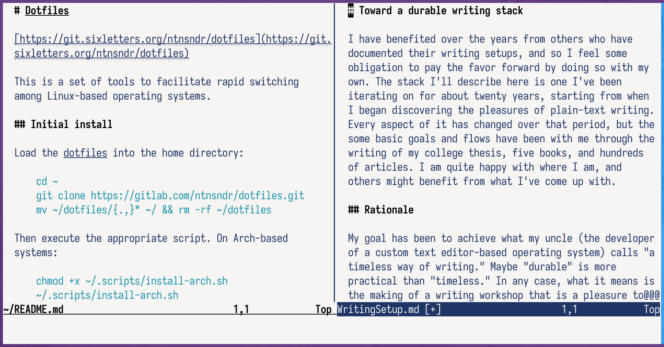
Toward a durable writing stack – Writings and rehearsals by Nathan Schneider
I have benefited over the years from others who have documented their writing setups, and so I feel some obligation to pay the favor forward by doing so with my own. The stack I’ll describe here is one I’ve been iterating on for about twenty years, starting from when I began discovering the pleasures of plain-text writing. Every aspect of it has changed over that period, but the some basic goals and flows have been with me through the writing of my college thesis, five books, and hundreds of articles. I am quite happy with where I am, and others might benefit from what I’ve come up with.
» Huge for the Holidays: Epic Interactive Fiction of the Millennial Period The Digital Antiquarian
After fighting the tendency for decades, I’ve finally learned to accept that I’m a bit of a conservative, if not a downright Luddite, when it comes to my interactive fiction — or my text adventures, as I still persist in calling them. Despite its name, parser-based interactive fiction doesn’t actually strike me as all that good at plot-heavy storytelling. What it does excel at is setting.
Creative Reading: Scaffolding Reading for Transformation
Reading augmentation systems increasingly help readers process text at scale. While these tools address real constraints of time and cognitive load, they often implicitly frame reading as information transmission, or "reading to discard," delegating interpretation and effort to the machine. Yet this delegation changes the outcome of reading. For example, in scholarly reading, deciding what a research text implies and why it matters is central to the work of scholarly production. We propose creative reading as an alternative goal: reading augmentation that supports readers in creating both readings and themselves as readers. By putting literary and narrative theories into conversation with scholarly sensemaking and creativity support, we present a provocation-oriented design space for valuing the process of reading as a way of preserving a plurality of readings and transforming readers over time.
Beating the drums for independent press, publishers, and writers
Whose news? Whose story? Who gets to tell it?

Cory Doctorow: Stories Are a Fuggly Hack - Locus
I've mentioned before, stories are weird. I mean, really, really weird. Nothing that happens in a piece of fiction has any consequence in the real world. Romeo and Juliet did not live, did not die, and the ''tragedy'' they represent is objectively less important than the tragedy of the live yogurt culture I digested at the breakfast table this morning. My theory is that the parts of our brains that …Read More
Things You Lose - The Forge Literary Magazine
Things You Lose, a short fiction by Kelli Dianne Rule

Three Big Things: The Most Important Forces Shaping the World
An irony of studying history is that we often know exactly how a story ends, but have no idea where…