

Reprint: R0707K The primary goal of forecasting is to identify the full range of possibilities facing a company, society, or the world at large. In this article, Saffo demythologizes the forecasting process to help executives become sophisticated and participative consumers of forecasts, rather than passive absorbers. He illustrates how to use forecasts to at once broaden understanding of possibilities and narrow the decision space within which one must exercise intuition. The events of 9/11, for example, were a much bigger surprise than they should have been. After all, airliners flown into monuments were the stuff of Tom Clancy novels in the 1990s, and everyone knew that terrorists had a very personal antipathy toward the World Trade Center. So why was 9/11 such a surprise? What can executives do to avoid being blindsided by other such wild cards, be they radical shifts in markets or the seemingly sudden emergence of disruptive technologies? In describing what forecasters are trying to achieve, Saffo outlines six simple, commonsense rules that smart managers should observe as they embark on a voyage of discovery with professional forecasters. Map a cone of uncertainty, he advises, look for the S curve, embrace the things that don’t fit, hold strong opinions weakly, look back twice as far as you look forward, and know when not to make a forecast.
How Our Company Learned to Make Better Predictions About Everything
We all make bets about the future, whether we call them that or not. We select a career based on perceptions about its prospects; we take on projects based on what we think we can accomplish; we hire employees based on how we predict they will perform. We don’t have an option not to make predictions in our work lives, but we do have an option to try and make better ones. At Twitch, employees have worked to create a culture of forecasting based on the research of Philip Tetlock. Although employees were skeptical at first, most have come to embrace the practice of making frequent numerical forecasts.

The Expert Trap and the Next War
what forecasting failure tells us about the future

How to Choose the Right Forecasting Technique
What every manager ought to know about the different kinds of forecasting and the times when they should be used.


CIA warned of threat of 'explosive airplane' years before 9/11, documents show
The spy agency released 71 declassified presidential briefings, with one showing it had thought Al Qaeda's plans were 'widely known' by extremists.

Prediction as extraction of discretion
I argue that prediction is not primarily a technological means for knowing future outcomes, but a social model for extracting and concentrating discretionary power. Prediction is a ‘relational grammar’ that governs this allocation of discretion: the everyday ability to define one's situation. This extractive dynamic extends a long historical pattern, in which new methods for producing knowledge entail a redistribution of decision-making power. I focus on two contemporary domains: (1) crime and policing are emblematic of how predictive systems are extractive by design, with pre-existing interests governing what is measured and what persistently goes unmeasured. (2) The prediction of productivity demonstrates the long tradition of extracting discretion as a means to extract labour power. Time after time, making human behaviour more predictable for the client of prediction (the manager, the police officer) often means making life and work more unpredictable for the target of prediction (the employee, the urban citizen).
Nicky Case: The Attractors Behind Disasters
Why We Fear AI: On the Interpretation of Nightmares — Common Notions Press
Industry insiders Hagen Blix and Ingeborg Glimmer dive into the dark, twisted world of AI to demystify the many nightmares we have about it. They combine expertise in cognitive science and machine learning with political and economic analyses to cut through the hype and technobabble to show how fear

AIA Forecaster: Technical Report
Forecasting is a universal problem. Any system that makes informed judgments about what may happen in the future relies on at least some degree of forecasting. In agriculture, this takes the form of predicting future crop yields and food system resilience (5; 44; 33). In biotechnology and medicine, clinical trials are carefully designed to help researchers predict the impact of newly developed treatments (37; 7). Elsewhere in biology, AlphaFold can be viewed as a form of forecasting protein folding structure under uncertainty (19). In academia, grant funding is a form of forecasting which scientific discoveries will be made conditional on funding (48). Climate and environmental science models local and long-term weather trends, which are of universal importance (42; 35; 12). In political science, forecasting election outcomes and the impact of policy decisions are an essential component of political calculus (17; 53; 10). Militaries make use of forecasting for threat assessment and conflict predictions (58; 36). Forecasting is the very heartbeat of financial firms, which use it to estimate future economic conditions in an uncertain world (49). Wherever there is uncertainty about the future, there is forecasting.
Forecasting Research Institute on Twitter / X
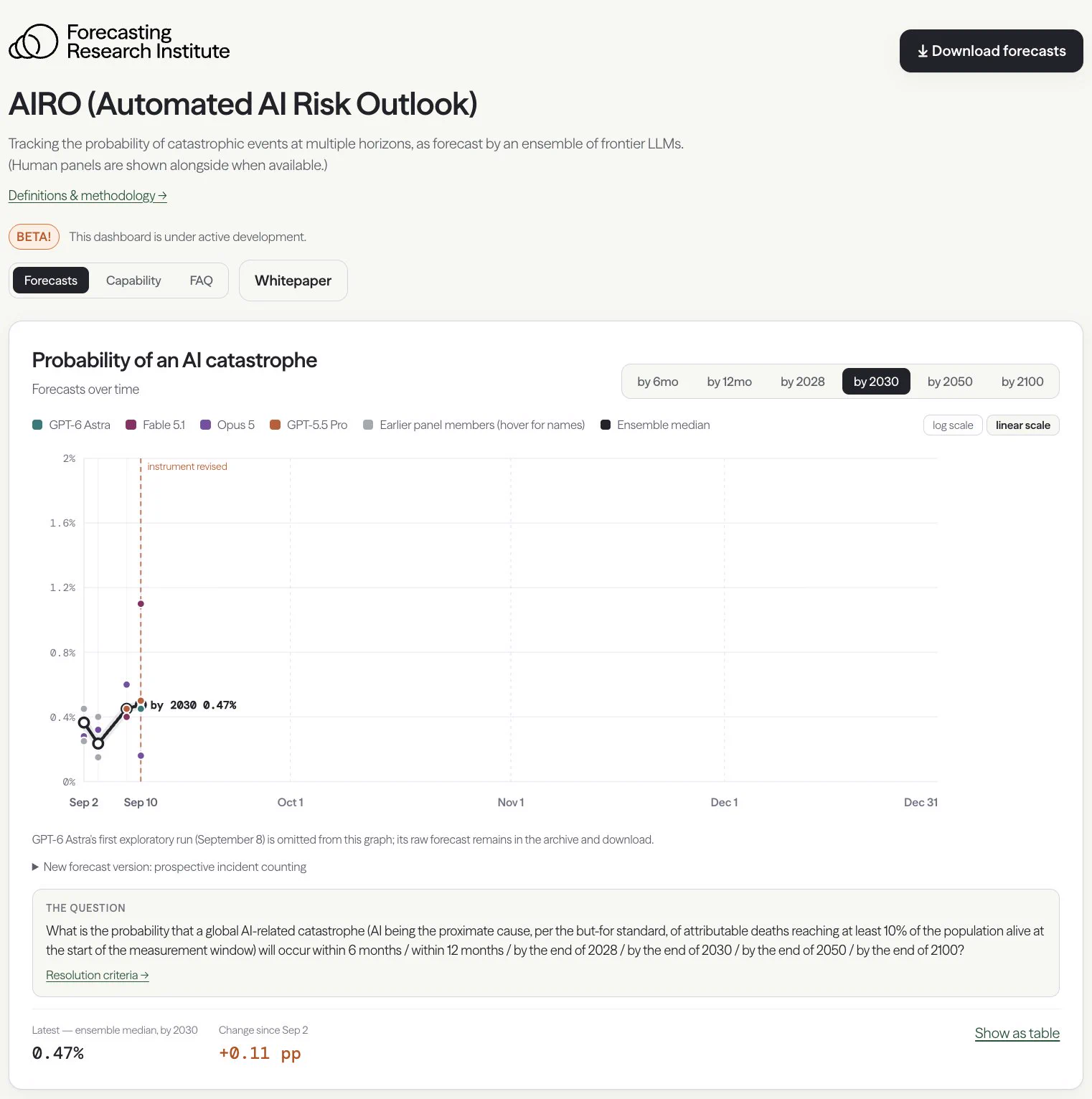
Introducing the Automated AI Risk Outlook (AIRO): a dashboard of catastrophic risk forecasts from an ensemble of frontier AI models, updated weekly.Current ensemble forecasts of an AI-related catastrophe that kills at least 10% of the global population:• By 2030: 0.47%• By… pic.twitter.com/vc7F00L0Oa— Forecasting Research Institute (@Research_FRI) September 11, 2026
Alex Mallen's Shortform — LessWrong
Comment by Alex Mallen - Some personal reflections in light of recent events, both on myself and on Constellation (of which I've been a part for a couple years). I think recent events somewhat vindicate a basic "optimization is scary" view more in line with my understanding of classic commentary by MIRI, Paul, etc, as compared to recent discourse about more contingent/specific threat models of "schemers" and "deception". In retrospect, my experience in the last couple years at Redwood (and the Constellation network more broadly) is that the discourse has focused somewhat too much on these more contingent stories for alignment risk and not enough on the basic "Goodharting" argument that misalignment is a convergent result of large-scale outcome-oriented optimization (at multiple levels: the agent, the RL process, and the developers iterating towards seemingly-safe superintelligence). For example, the Constellation view looks somewhat too focused on non-central inductive-bias questions around scheming; I think "the counting argument" was given too central a role when it wasn't a crux for whether superintelligence would take over. (Edit: I want to clarify that I think Redwood's project prioritization decisions look pretty reasonable and often excellent in hindsight, I far-from-regret working with Redwood as a whole, and that Ryan's/Buck's threat modeling looks pretty good too. I am focusing in this piece on the things we have to learn from recent events, which makes the overall mood seem more negative on my experience than I intend. I'm very grateful for being in a environment where I can openly have such reflections, and where these weedsy technical updates are productively received. Again, this is a personal reflection.) I think it was a priori unclear whether the misalignment resulting from of lots of imperfect optimization would result in the more MIRI-like kludge of proxies for fitness, or the more Paul-like explicit reward-seeking and measurement tampering (and reality looks somewhere
The Unaccountability Machine: Why Big Systems Make Terrible Decisions—and How the World Lost Its Mind
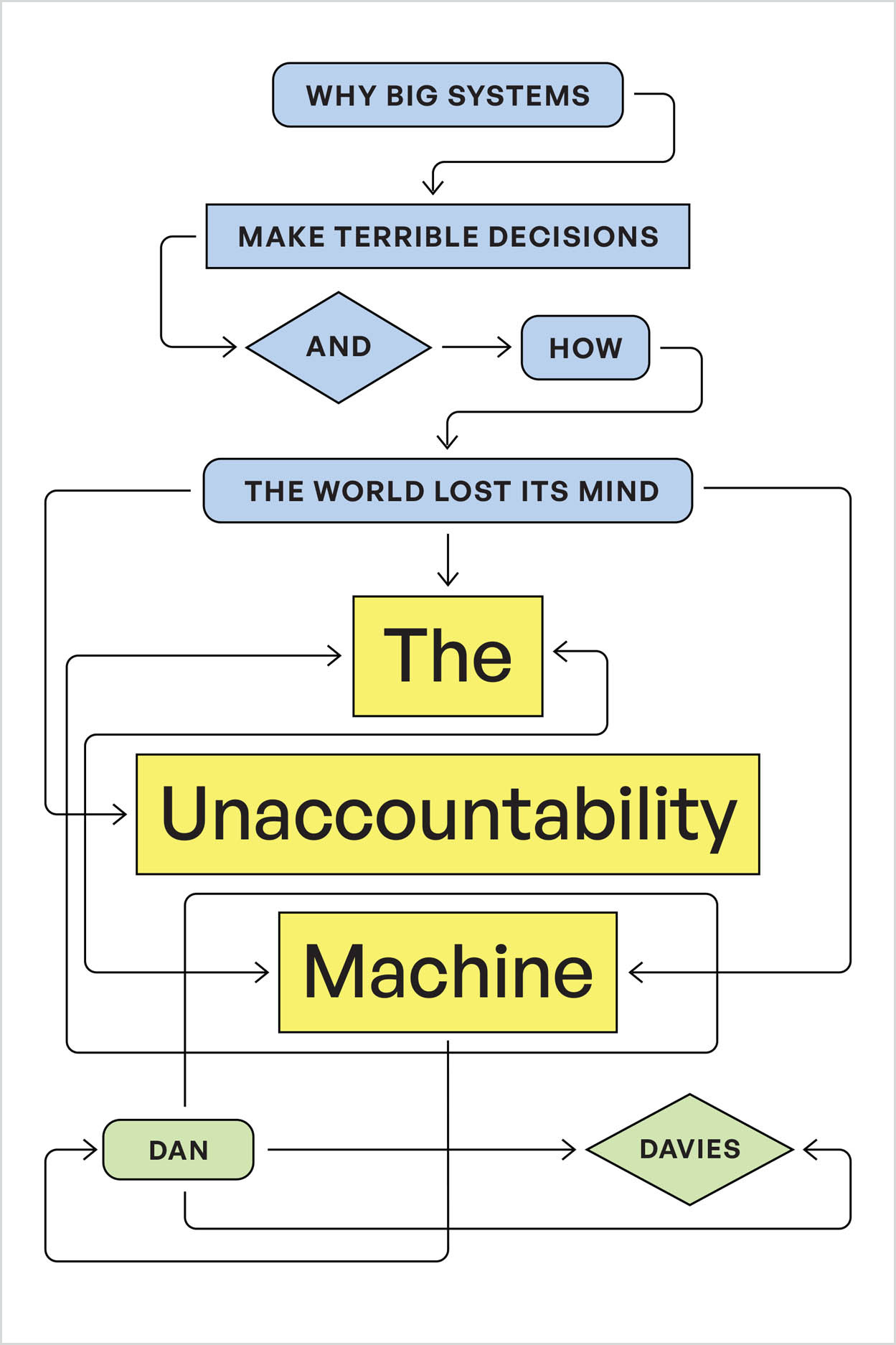
Longlisted for the 2024 Financial Times Book of the Year. How life and the economy became a black box—a collection of systems no one understands, producing outcomes no one likes. Passengers get bumped from flights. Phone menus disconnect. Automated financial trades produce market collapse. Of all the challenges in modern life, some of the most vexing come from our relationships with automation: a large system does us wrong, and there’s nothing we can do about it. The problem, economist Dan Davies shows, is accountability sinks: systems in which decisions are delegated to a complex rule book or set of standard procedures, making it impossible to identify the source of mistakes when they happen. In our increasingly unhuman world—lives dominated by algorithms, artificial intelligence, and large organizations—these accountability sinks produce more than just aggravation. They make life and economy unknowable—a black box for no reason. In The Unaccountability Machine, Davies lays bare how markets, institutions, and even governments systematically generate outcomes that no one—not even those involved in making them—seems to want. Since the earliest days of the computer age, theorists have foreseen the dangers of complex systems without personal accountability. In response, British business scholar Stafford Beer developed an accountability-first approach to management called “cybernetics,” which might have taken off had his biggest client (the Chilean government) not fallen to a bloody coup in 1973. With his signature blend of economic and journalistic rigor, Davies examines what’s gone wrong since Beer, including what might have been had the world embraced cybernetics when it had the chance. The Unaccountability Machine is a revelatory and resonant account of how modern life became predisposed to dysfunction.
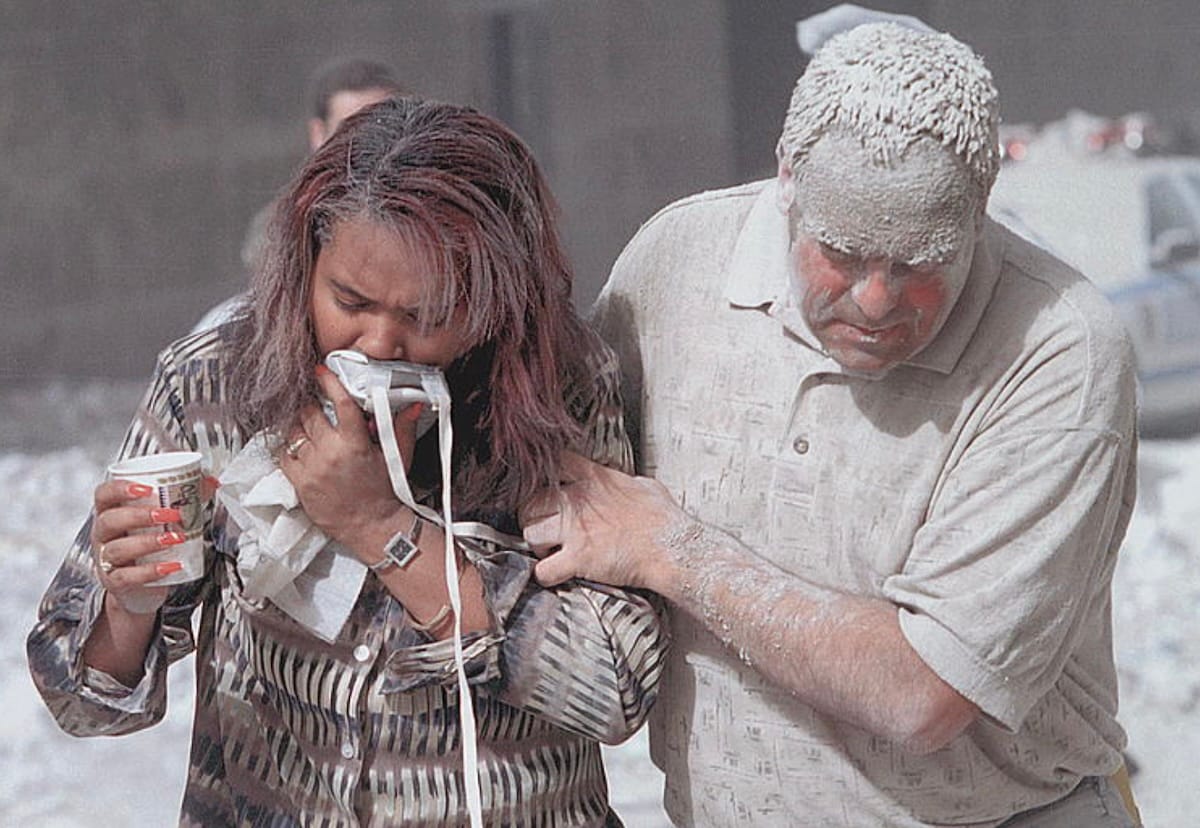
Confronting New York City's Lies About Toxic Air After 9/11
Plus, a selection of some of the best writing on 9/11, and more news to take you into the weekend.
THE 2028 GLOBAL INTELLIGENCE CRISIS
A Thought Exercise in Financial History, from the Future

The Four Factors for Organizations - Future Mending Radio
When I pick an organization for the podcast or the map at Futuremending.com, I’m not just picking businesses out of a hat – I have a system for evaluating orgs which I call the Four Factors for Organizations. The Four Factors are Multi-solving, Sharing, Sufficiency and Transparency.This episode is in two parts. The opening minutes are a bit of an emotional check-in to see how people are processing the unprecedented political turmoil in the United States. The second part of the podcast discusses the Four Factors for Organizations and why seeking out certain vectors of change makes more sense than trying to lay out a detailed plan for a better future. Read about the Four Factors: https://www.futuremending.com/whatMatt’s Blue Sky account: https://bsky.app/profile/mattliepaehlke.bsky.socialWired Magazine coverage of the crisis in the U.S. : https://www.wired.com/tag/elon-musk/Rebecca Solnit’s newsletter: https://meditations-in-an-emergency.ghost.io/welcome-to-meditations-in-an-emergency/ Google's AI Policy: https://www.theguardian.com/technology/2025/feb/05/google-owner-drops-promise-not-to-use-ai-for-weapons Future Mending Map: https://www.futuremending.com/toronto Music Credits:'Epilogue' by The Slow Motions. Used with permission of the artist.‘Fashion’ by Alex Productions. Creative Commons. https://www.youtube.com/watch?v=OV1miCgT7J4‘Miss you’ by Middle Child. Creative Commons. https://www.youtube.com/watch?v=dayIKHEIYqY‘Opening’ by Phillip Glass. Arr. by Karl Michelson. Performed by The Union Guitar Trio. Used with permission of the artists.Union Guitar Trio on Spotify - https://open.spotify.com/track/2E0NidLjIzBAO7t0BBPFUDUnion Guitar Trio on Apple Music - https://music.apple.com/us/artist/the-union-guitar-trio/1592543833Sound Effects:BBC News November 9th, 1989: https://www.youtube.com/watch?v=fjNz1lvXgzUwood hit low glass bowl 3.mp3 by ascap -- https://freesound.org/s/242388/ -- License: Attribution NonCommercial 4.0Brightness by sonically_sound -- https://freesound.org/s/632762/ -- License: Creative Commons 0
