Are you confident that your company is effectively handling potential customers’ online queries? Think hard. Our research shows that most companies are not responding nearly fast enough. Companies in financial services, automobiles, education, software, health care, professional services, and many other industries have increasingly turned to the internet to generate sales leads. Indeed, corporate spending […]
Platform Information Provision and Consumer Search: A Field Experiment
Despite substantial efforts to help consumers search in more intuitive ways, text search remains the predominant tool for product discovery online. In this paper, we explore the effects of visual and textual cues for search refinement on consumer search and purchasing behavior. We collaborate with one of the largest e-commerce platforms in China and study its roll out of a new search tool. When a customer searches for a general term (e.g., “headphones”), the tool suggests refined queries (e.g., “bluetooth headphones” or “noise-canceling headphones”) with the help of images and texts. The search tool was rolled out with a long-run experiment, which allows us to measure its short-run and long-run effects. We find that, although there was no immediate effect on orders or total expenditures, the search tool changed customers’ search and purchasing behavior in the long-run. Customers with access to the new tool eventually increased orders and expenditures compared to those in the control group, especially for non top-selling products. The purchase increase comes from more effective searches, rather than an increase in activity on the platform. We also find that the effect is not only driven by the direct value of suggested searches, but also by customers indirectly learning to perform more effective searches on their own.

Websets | People Search, AI SDR & B2B Lead Generation
Use Websets for people search, AI SDR discovery, lead generation, and B2B marketing. Explore sales automation tools and AI research tools in one place.
Can We Ever Know If Online Advertising Really Works?
In the summer of 2003, Viacom executive Mel Karmazin managed to sum up old media’s horror of the Internet with one of business lore’s greatest vulgar...

How Targeting Affects Customer Search: A Field Experiment
It has become common practice for retailers to personalize direct marketing efforts based on customer transaction histories as a tactic to increase sales. Targeted email offers featuring products in the same category as a customer’s previous purchases generate higher purchase rates. However, a targeted offer emphasizing familiar products could result in curtailed search for unadvertised products, as a closely matched offer weakens a customer’s incentives to search beyond the targeted items. In a field experiment using email offers sent by an online wine retailer, targeted offers resulted in decreased search activity on the retailer’s website. This effect is driven by a lower rate of search by customers who visit the site, rather than a lower incidence of search. There are several ways this could potentially hurt retailers and consumers, such as reduced cross-selling and fewer opportunities for customers to explore new products. This paper was accepted by Pradeep Chintagunta, marketing.

EX-99.1
This year, Amazon became the fastest company ever to reach $100 billion in annual sales. Also this year, Amazon Web Services is reaching $10 billion in annual sales … doing so at a pace even faster than Amazon achieved that milestone.
Frontiers: ChatGPT Referrals to E-Commerce Websites: How Do LLMs Compare Against Traditional Channels?
This is a descriptive study reporting financial and engagement metrics for 973 e-commerce websites, comparing organic large language model traffic (oLLM) with traditional digital channels. , We investigate organic large language model traffic (oLLM) versus traditional digital channels in e-commerce. Analyzing 12 months of first-party data from 973 websites with $20 billion combined revenue, we examine more than 50,000 transactions from ChatGPT referrals alongside 164 million transactions from traditional channels. Using regression models that account for data sparsity, we assess financial metrics (conversion rate, average order value, revenue per session) and engagement metrics (bounce rate, session duration, page views). Results are consistent across extensive robustness checks. One year after launch, oLLM exhibits conversion rates and revenue per session above paid social but below all other traditional channels. Product complexity moderates the effects: oLLM’s financial outcomes and traffic shares are stronger in complex product categories. Engagement metrics show favorable bounce rates but lower session duration and page views. Temporal analysis shows increasing conversion rates but declining average order values, yielding only moderate revenue-per-session gains over time. Cross-website analyses support growing consumer LLM proficiency as the underlying mechanism. The descriptive study positions oLLM as a new and developing channel. With low volumes and modest revenue per session, oLLM currently serves niche informational needs of proficient consumers and does not yet function as a broad conversion channel. History: Puneet Manchanda served as the senior editor. This paper was accepted through the Marketing Science: Frontiers review process. Supplemental Material: The online appendices and data files are available at https://doi.org/10.1287/mksc.2025.0489 .

Future - The AI Tipping Point
Learn more about the latest advancements in the field of artificial intelligence over the last six months, from new innovative AI tools and services to how these are shaping consumers' online behavior.
The Web Can Thrive Without Google’s Search Monopoly
Viable browsers and meaningful contributions to web standards can be sustained with more modest revenue streams, writes Alissa Cooper.

How Google and AI Nearly Made a Seasoned Reporter Spiral — ProPublica
I thought I had missed something major in my reporting. Turns out I had stumbled into an AI-fueled feedback loop that involved a real LLC’s fictional website and a search engine that’s thrusting unreliable answers on users.

Bluesky follower sales websites
As Bluesky grows, so does the spam industry orbiting it

The Oxymoron of “Data-Driven Innovation”
Once upon a time, in the dawn of the internet era, web products came from college dudes. The dudes were almost always wealthy and well-connected, but they weren’t usually market-savvy. These …

A week of not using a search engine
A week or so ago, I wondered if I actually needed to use a search engine as much as I did. Why was I sending so much traffic to a third party service, especially since I can’t seem to find a search engine which aligns with my ethics and delivers good search results?

Is Google Getting Worse? A Longitudinal Investigation of SEO Spam in Search Engines
Many users of web search engines have been complaining in recent years about the supposedly decreasing quality of search results. This is often attributed to an increasing amount of search-engine-optimized but low-quality content. Evidence for this has always been anecdotal, yet it’s not unreasonable to think that popular online marketing strategies such as affiliate marketing incentivize the mass production of such content to maximize clicks. Since neither this complaint nor affiliate marketing as such have received much attention from the IR community, we hereby lay the groundwork by conducting an in-depth exploratory study of how affiliate content affects today’s search engines. We monitored Google, Bing and DuckDuckGo for a year on 7,392 product review queries. Our findings suggest that all search engines have significant problems with highly optimized (affiliate) content—more than is representative for the entire web according to a baseline retrieval system on the ClueWeb22. Focussing on the product review genre, we find that only a small portion of product reviews on the web uses affiliate marketing, but the majority of all search results do. Of all affiliate networks, Amazon Associates is by far the most popular. We further observe an inverse relationship between affiliate marketing use and content complexity, and that all search engines fall victim to large-scale affiliate link spam campaigns. However, we also notice that the line between benign content and spam in the form of content and link farms becomes increasingly blurry—a situation that will surely worsen in the wake of generative AI. We conclude that dynamic adversarial spam in the form of low-quality, mass-produced commercial content deserves more attention. (Code and data: https://github.com/webis-de/ECIR-24).

Is Google Getting Worse? A Longitudinal Investigation of SEO Spam in Search Engines
Many users of web search engines have been complaining in recent years about the supposedly decreasing quality of search results. This is often attributed to an increasing amount of search-engine-optimized but low-quality content. Evidence for this has always been anecdotal, yet it’s not unreasonable to think that popular online marketing strategies such as affiliate marketing incentivize the mass production of such content to maximize clicks. Since neither this complaint nor affiliate marketing as such have received much attention from the IR community, we hereby lay the groundwork by conducting an in-depth exploratory study of how affiliate content affects today’s search engines. We monitored Google, Bing and DuckDuckGo for a year on 7,392 product review queries. Our findings suggest that all search engines have significant problems with highly optimized (affiliate) content—more than is representative for the entire web according to a baseline retrieval system on the ClueWeb22. Focussing on the product review genre, we find that only a small portion of product reviews on the web uses affiliate marketing, but the majority of all search results do. Of all affiliate networks, Amazon Associates is by far the most popular. We further observe an inverse relationship between affiliate marketing use and content complexity, and that all search engines fall victim to large-scale affiliate link spam campaigns. However, we also notice that the line between benign content and spam in the form of content and link farms becomes increasingly blurry—a situation that will surely worsen in the wake of generative AI. We conclude that dynamic adversarial spam in the form of low-quality, mass-produced commercial content deserves more attention. (Code and data: https://github.com/webis-de/ECIR-24).
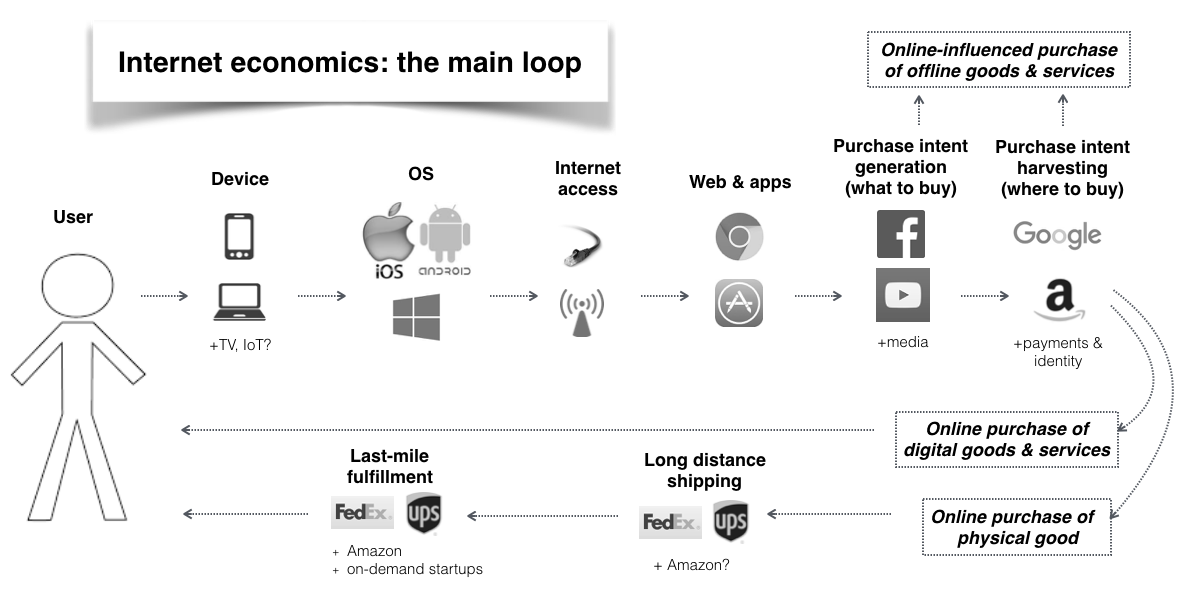
The Internet Economy
We are living in an era of bundling. The big five consumer tech companies — Google, Apple, Facebook, Amazon, and Microsoft — have moved far…