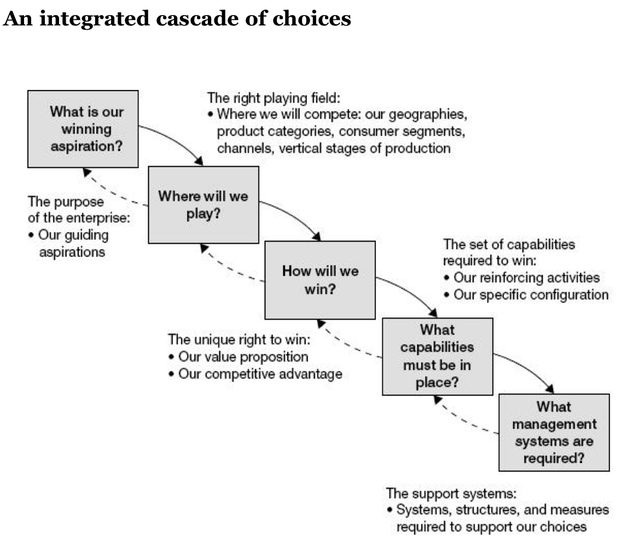
Many strategy execution processes fail because “new strategies” are often not strategies at all. A real strategy involves a clear set of choices that define what the firm is going to do and what it’s not going to do. Many strategies fail to get implemented because they do not represent such a set of clear choices. And many so-called strategies are in fact goals. “We want to be the number one or number two in all the markets in which we operate” is one of those. It does not tell you what you are going to do; all it does is tell you what you hope the outcome will be. But you’ll still need a strategy to achieve it. Another reason why many implementation efforts fail is that executives see it as a pure top-down, two-step process: “The strategy is made; now we implement it.” That’s unlikely to work. A successful strategy execution process is seldom a one-way trickle-down cascade of decisions.
Strategy Is a Loop, Not a Plan | Ragan McGill
Most strategies don't fail because they were wrong. They fail because the world moved and the strategy didn't. Here is how I combine John Boyd's OODA loop with Richard Rumelt's strategy kernel to build strategy that keeps learning.

Having no Strategy is a Strategy in Ottawa
What I said at my recent keynote for the Ottawa Tech Investment Summit — and what the government said three days later.

What Is Strategy?
Today’s dynamic markets and technologies have called into question the sustainability of competitive advantage. Under pressure to improve productivity, quality, and speed, managers have embraced tools such as TQM, benchmarking, and re-engineering. Dramatic operational improvements have resulted, but rarely have these gains translated into sustainable profitability. And gradually, the tools have taken the place of strategy. In his five-part article, Michael Porter explores how that shift has led to the rise of mutually destructive competitive battles that damage the profitability of many companies. As managers push to improve on all fronts, they move further away from viable competitive positions. Porter argues that operational effectiveness, although necessary to superior performance, is not sufficient, because its techniques are easy to imitate. In contrast, the essence of strategy is choosing a unique and valuable position rooted in systems of activities that are much more difficult to match. Porter thus traces the economic basis of competitive advantage down to the level of the specific activities a company performs. Using cases such as Ikea and Vanguard, he shows how making trade-offs among activities is critical to the sustainability of a strategy. Whereas managers often focus on individual components of success such as core competencies or critical resources, Porter shows how managing fit across all of a company’s activities enhances both competitive advantage and sustainability. While stressing the role of leadership in making and enforcing clear strategic choices, Porter also offers advice on how companies can reconnect with strategies that have become blurred over time.


Playing to Win: How Strategy Really Works
How Strategy Really Works. This approach grew out of the strategy practice at Monitor Company and subsequently became the standard process at P&G.
Patterns of Strategy
Patterns of Strategy shows how the strategic fit between organisations drives strategic direction. It is essential reading for those who wish to understand how to manoeuvre their organisation to change its strategic fit to their advantage. The 80 ‘patterns’ of strategy help you explore options for collaboration and competition within your strategic ecosystem. A practical and authoritative guide, you can use it to plan and navigate your strategic future.

How to not screw up your product strategy | Jade Rubick - Engineering Leadership
An overview of common mistakes people make while developing a product strategy, tips for creating a successful strategy, and how to communicate and execute on a product strategy.

Strategy in Life
What is Strategy? Why is it easy to get wrong and so hard to get right? Strategy Structures in Life Concept-Space Getting from one point to another In a predefined direction Stars as Concept-space analogy By predefined actions Strategy in Life Know your surroundings Creating Strategies Using Strategies Summary Strategy...

Hot Take: Google has a company strategy, not a product strategy
Or, Why Google keeps killing products

How to Get Things Done When You Don’t Feel Like It: Five strategies for pushing through: Queue: Vol 16, No 4
If you want to be successful, then it serves you better to rise to the occasion no matter what. That means learning how to push through challenges and deliver valuable results.

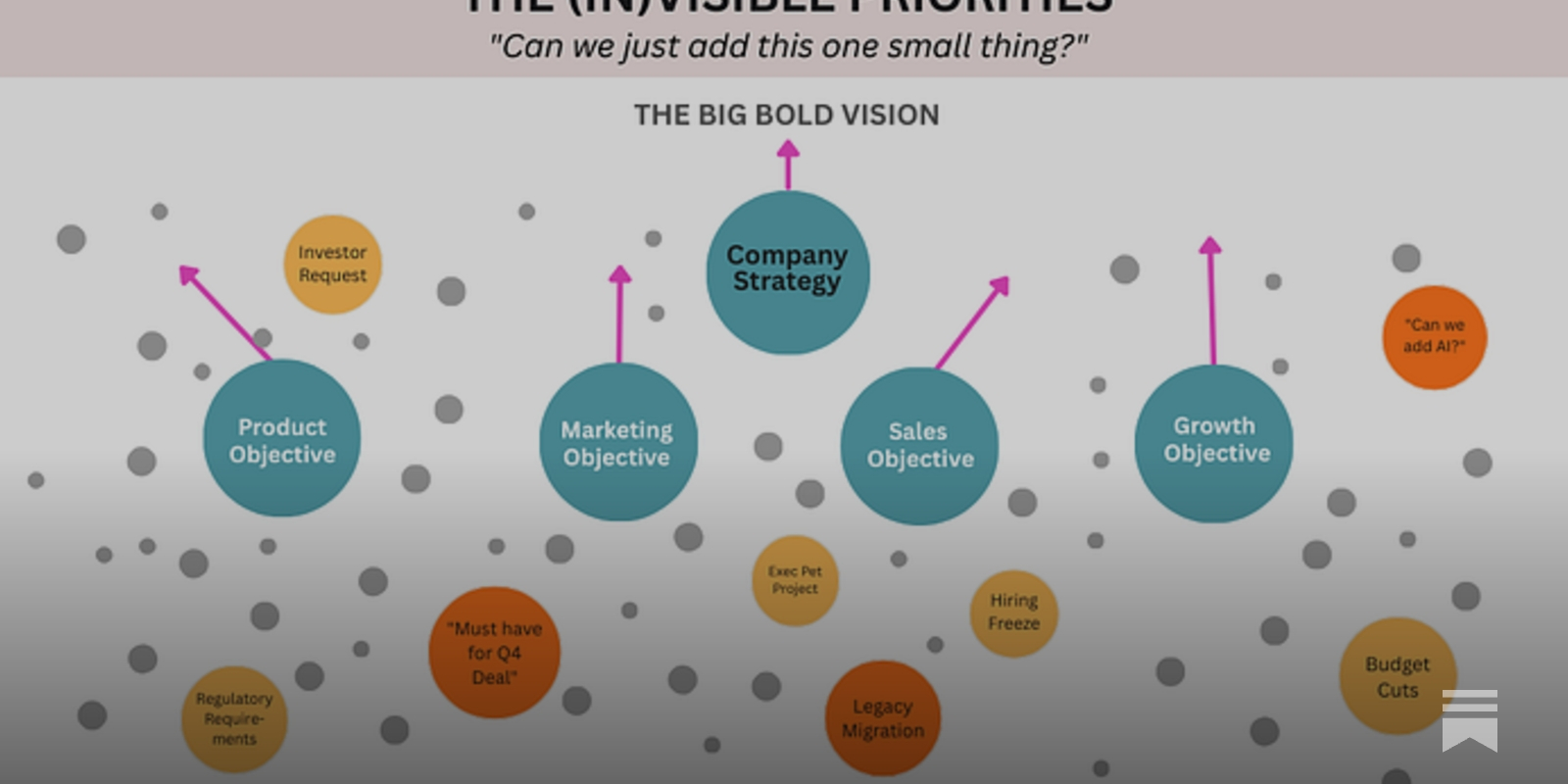
The Illusion of Decisiveness
Why product teams spin in chaos despite a "clear" strategy
Designing Strategy: Rushdown, Economy, and Defense
Hey everyone! Today I have a good-old-fashioned formalist-ish game design article. It’s been a little while since I’ve really done one of those, unless it was attached to Push the Lane.…


9 signs that your business idea will probably fail - Dan Norris
After 14 years running my own businesses, I’ve failed a lot. I haven’t kept count thankfully, but I’d say I’ve started at least 50 businesses / ideas and out of those, 3 have worked. And when I say worked I don’t mean staying in business, I mean resulting in either a decent income for me […]

How To Be Successful
I’ve observed thousands of founders and thought a lot about what it takes to make a huge amount of money or to create something important. Usually, people start off wanting the former and end up...
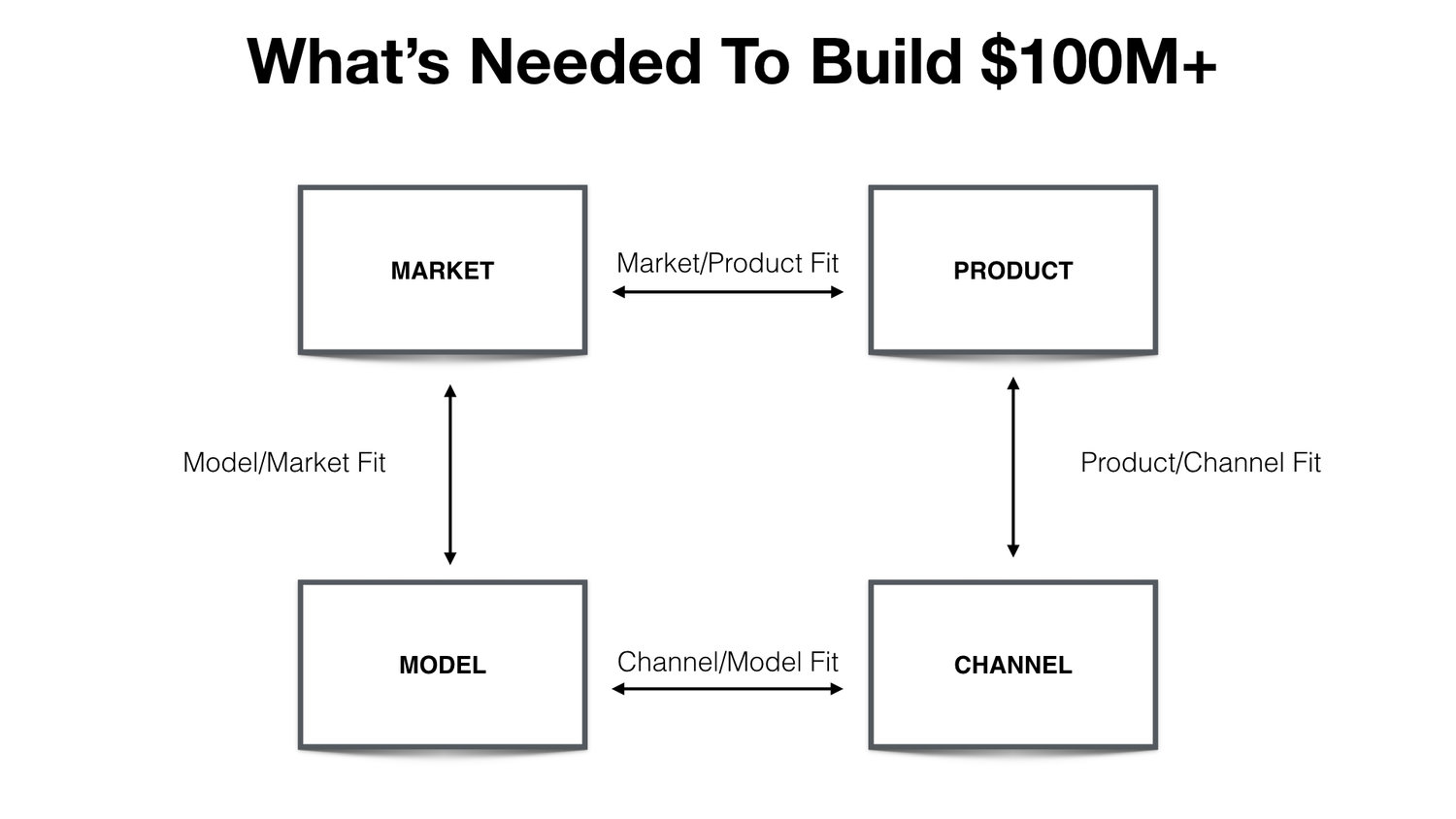
Why Product Market Fit Isn't Enough — Brian Balfour
I’ve been lucky to have been part of building, advising, or investing in 40+ tech companies in the past 10 years. Some $100M+ wins. Some, complete losses. Most end up in the middle. One of my main observations is that there are certain companies where growth seems to come easily, like gui