


On Conspicuous Despair, the Ponzi stage of being alive, and why your grandparents are wrong about you.
Open source confronts its midlife crisis | The Observation Deck
Midlife is tough: the idealism of youth has faded, as has inevitably some of its fitness and vigor. At the same time, the responsibilities of adulthood have grown: the kids that were such a fresh adventure when they were infants and toddlers are now grappling with their own transition into adulthood – and you try to remind yourself that the kids that you have sacrificed so much for probably don’t actually hate your guts, regardless of that post they just liked on the ‘gram. Making things more challenging, while you are navigating the turbulence of teenagers, your own parents are likely entering life’s twilight, needing help in new ways from their adult children. By midlife, in addition to the singular joys of life, you have also likely experienced its terrible sorrows: death, heartbreak, betrayal. Taken together, the fading of youth, the growth in responsibility and the endurance of misfortune can lead to cynicism or (worse) drastic and poorly thought-out choices. Add in a little fear of mortality and some existential dread, and you have the stuff of which midlife crises are made…
Three important steps in my maturation process – Thomas Dullien / Halvar Flake
My father passed recently, and he was twice my age. I am approximately the same age that he was when I was born, and I am now “the old generation” - there’s no one left in the generation above me.
The Global Decline in the Mental Health of the Young
One of the major findings in wellbeing research until recently was that happiness was U-shaped by age and unhappiness hump-shaped by age. There was a midlife crisis — a finding reported in well over 600 published papers using data on 145 countries. It was present in both developing and developed countries. And it was persistent over time. The finding of a peak in ill-being in midlife was consistent with Anne Case and Angus Deaton’s work on mortality and the so-called “deaths of despair.”1 In the US in particular and to a lesser extent in other countries, White prime-aged individuals without a college degree had high death rates from suicide, drug overdoses, and cirrhosis of the liver. Drug overdose deaths in the US, for example, peaked at midlife ages. In 2023, the Centers for Disease Control and Prevention (CDC) reported that overdose death rates per 100,000 by age rose from 13.5 for 15-to-24-year-olds to 45.6 for 25-to-34-year-olds and 60.8 for 35-to-44-year-olds, and then declined to 53.3 for 45-to-54-year-olds, 49.2 for 55-to-64-year-olds, and 14.7 for those over the age of 65.2 The morbidity data matched the mortality data.

Late Diagnosis, Demographic Shifts, and Narrative Resistance:
A Critical Analysis
LF11 - Cohort Futures
On belonging, becoming, and communities with a clock.

Stop Blowhard Syndrome
When I express any shred of doubt about whether I deserve or am qualified for something, people often try to reassure me that I am just experiencing impostor syndrome. About 10% of the time, it’s true. Amelia Greenhall’s excellent piece, however, has inspired me to clear up a big misconception about what is happening the other 90% of the time.
The Joy of Becoming Worthless…except to each other — Douglas Rushkoff
My last piece, The Intentional Collapse, seems to have agitated a few people. I know it came off a bit dark. I talked about how the Uber wealthy believe the world as we know it is ending and that there won’t be enough essential resources to go around, so they need to take control of as much money and stuff and land as possible in order to position themselves for the end of days.
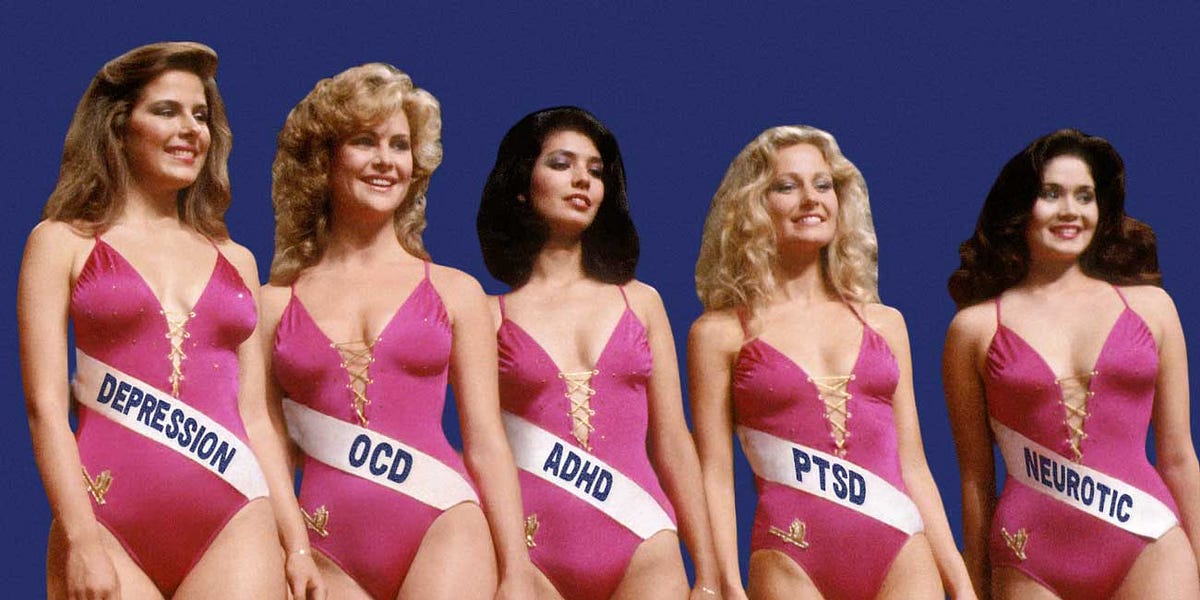
Nobody Has a Personality Anymore
My generation is obsessed with treating every trait as a symptom of a disorder: You’re not shy, you’re autistic; you’re not forgetful, you’ve got ADHD, writes Freya India.
Economic Possibilities for our Grandchildren- John Maynard Keynes
We are suffering just now from a bad attack of economic pessimism. It is common to hear people say that the epoch of enormous economic progress which characterised the nineteenth century is over; that the rapid improvement in the standard of life is now going to slow down—at any rate in Great Britain; that a decline in prosperity is more likely than an improvement in the decade which lies ahead of us.
Post-exertional malaise (PEM) in ME/CFS
Post-exertional malaise (PEM), the cardinal feature of ME/CFS, is particularly debilitating as it involves the amplification of existing symptoms, alongside the potential appearance of new ones, following minimal exertion. However, the term “exertion” may be misconstrued, by those unfamiliar with ME/CFS, as activities typically considered high intensity by healthy individuals. Consequently, healthy individuals may inappropriately…

Want to Be Happy? Think Like an Old Person (Published 2017)
In a series update, we catch up with a group of New Yorkers over age 90: warm, cranky, funny and three years older than when we first met them.

What Happens When Your Career Becomes Your Whole Identity
Many people with high-pressure jobs find themselves unhappy with their careers, despite working hard their whole lives to get to their current position. Hating your job is one thing – but what happens if you identify so closely with your work that hating your job means hating yourself?Psychologists use the term “enmeshment” to describe a situation where the boundaries between people become blurred, and individual identities lose importance. Enmeshment prevents the development of a stable, independent sense of self. While identifying closely with your career isn’t necessarily bad, it makes you vulnerable to a painful identity crisis if you burn out, get laid off, or retire. Individuals in these situations frequently suffer anxiety, depression, and despair. By claiming back some time for yourself and diversifying your activities and relationships, you can build a more balanced and robust identity in line with your values.

banteg (@banteg)
>be me >discover effective altruism >apparently normal charity is inefficient >why donate to random sad thing when spreadsheet can tell you optimal sad thing >fair enough >buy mosquito nets >save lives >numbers look good >feel powerful >couple years later >someone asks an innocent question >why only count people alive today >huh >future people matter too >obviously >my grandchildren shouldn't matter less just because they haven't spawned yet >reasonable.jpg >keep following logic >what about their grandchildren >also yes >what about people in 500 years >sure >5000 years >why not >500 million years >starting to get weird but morality is morality >open calculator >humanity could survive for an astronomically long time >could colonize galaxy >could have trillions upon trillions of descendants >maybe digital people too >maybe simulated civilizations >maybe dyson spheres full of happy uploaded minds >calculator starts smoking >realize currently living humans are rounding error >8 billion people suddenly looking extremely beta >future contains potentially 10^something people >can't even fit beneficiaries in google sheets >new moral priority unlocked >protect the long-term future >stop thinking in units of "people helped" >start thinking in "fraction of cosmic endowment preserved" >malaria? >terrible >but only kills existing humans >AI extinction could delete the entire light cone >nuclear war could permanently derail civilization >bad institutions could lock in terrible values for ten million years >someone invents wrong constitution in 2140 >quadrillions suffer >better fund governance workshop now >friend says maybe we should improve hospitals >explain opportunity cost >friend says hospitals are full of actual sick people >explain scope sensitivity >friend stops inviting me to dinner >need to decide what to fund >easy >expected value >suppose project has one in a million chance of preventing extinction >sounds tiny >but extinction destroys 10^50 future lives >multiply >mother of god >$10 million project has expected value of several galaxies >charity evaluation complete >someone asks where the one-in-a-million number came from >expert judgement >which expert >us >how calibrated >extremely thoughtfully >reduce estimate to one in ten million to be conservative >still beats curing cancer by 38 orders of magnitude >epistemic robustness achieved >someone says maybe project doesn't work >assign 20% chance >still astronomical >maybe project makes problem worse >assign 5% chance >still astronomical >why 5 >because 30 felt pessimistic >publish 46-page report >contains seventeen sensitivity analyses >every sensitivity analysis begins after assuming intervention has positive sign >critic says you're multiplying enormous hypothetical stakes by extremely uncertain probabilities >yes >that's literally why it's important >critic says the uncertainty might be structural rather than numerical >make probability smaller >critic says no, I mean maybe your model is wrong >make probability smaller again >critic begins rubbing temples >discover AI safety >perfect longtermist cause >AI might kill everyone >or create utopia >or seize galaxy >or tile universe with paperclips >or create billions of conscious software minds >finally a problem with numbers big enough for me >start AI safety nonprofit >mission: prevent dangerous AI >hire smartest people available >smartest people immediately start building better AI to understand dangerous AI >interesting >we must understand capabilities to understand safety >we must scale models to study alignment >we must race ahead so less responsible actors don't get there first >we must deploy systems to learn how deployment can go wrong >we must build the thing quickly because building the thing quickly is dangerous >outsider asks why the people most worried about AI apocalypse all work at AI companies >complicated field >company releases stronger model >very concerned >company begins training even stronger model >extremely concerned >company raises $14 billion >concern reaches unprecedented levels >need to influence government >future is at stake >normal democratic process too slow >politicians don't understand exponential curves >public doesn't understand x-risk >experts must guide them >who counts as expert >people who understand x-risk >who understands x-risk >our friends >someone objects that this seems politically convenient >explain we're representing future generations >future generations unavailable for comment >develop concept of value lock-in >terrifying possibility that one ideology controls civilization forever >therefore extremely important that civilization adopts correct values before lock-in >whose values >let's circle back >begin with impartial morality >end with small group of people deciding what quadrillions of hypothetical beings would want >beautiful arc >meanwhile actual humans keep doing annoying things >voting wrong >having parochial attachments >loving family more than strangers >caring about local community >getting upset when told their suffering is cosmically negligible >evolutionary biases everywhere >explain that moral intuition cannot be trusted >except intuition that future digital people count >and intuition that extinction is uniquely bad >and intuition that our probability estimates are sane >and intuition that our institutional choices improve the future >those intuitions survived peer review >someone donates $5k to local homeless shelter >inefficient >could have funded 0.0000000000003% of an AI governance researcher >think of all the simulated people you just killed >okay maybe don't phrase it that way publicly >PR team says "future generations deserve a voice" >much better >journalist asks what longtermism means >say "future people matter" >everyone agrees >great >journalist asks what follows from that >well technically we should redirect enormous resources toward low-probability interventions affecting astronomical futures >journalist raises eyebrow >return to "future people matter" >motte has entered the chat >critic: of course future people matter >me: glad we agree >critic: I don't agree that your institute knows how to help them >me: why do you hate our grandchildren >eventually notice uncomfortable implication >if future value dominates everything >then helping people today mostly matters through effects on future >education matters because future institutions >health matters because future productivity >democracy matters because future trajectory >human beings slowly become instrumental variables in their own moral philosophy >see starving child >feel compassion >check spreadsheet >child's direct welfare contribution negligible >but perhaps childhood nutrition improves national institutional quality >compassion restored >tell myself this is impartial altruism >one day assistant asks obvious question >"how do you know your intervention actually improves the far future?" >silence >open spreadsheet >increase column width >add confidence interval >assistant asks again >"no, I mean how do you know the sign is positive?" >stare into cosmic light cone >10^50 people staring back >none of them exist >none of them can tell me >none of them can falsify my assumptions >realize I have invented the perfect constituency >infinitely important >completely silent >and always represented by me
Imposter Syndrome: Understanding and Managing It
Imposter Syndrome can be unnerving and frustrating. Here I unpick what it is, why it happens, and how to pragmatically manage it.
there is a piece to be written about this "no contact" as a very specific kind of moral panic about status, intergenerational mobility, and maybe dementia. because it is wild how much this no contact thing riles up older people.

Michael Hobbes
Another one. The premise: Young people are cutting off their parents for minor mistakes and misunderstandings. The lead anecdote: A woman severs ties with her family for refusing to get vaccinated before her wedding — to a man who *lost his mother and brother to COVID*

