


Douglas Engelbart built a system that millions would use to augment intellect. The way he introduced it would be almost as groundbreaking as the device itself.
The Mother of All Demos, presented by Douglas Engelbart (1968)
50 Years Later, We Still Don't Grasp the Mother of All Demos
Doug Engelbart didn't just want to show off new technology. He wanted to demonstrate a system for improving humanity.

The Mother of All Demos
"The Mother of All Demos" was a landmark computer demonstration, named retroactively, of developments by Stanford Research Institute's Augmentation Research Center. It was presented at the Association for Computing Machinery / Institute of Electrical and Electronics Engineers (ACM/IEEE)—Computer Society's Fall Joint Computer Conference in San Francisco, by Douglas Engelbart, on December 9, 1968.
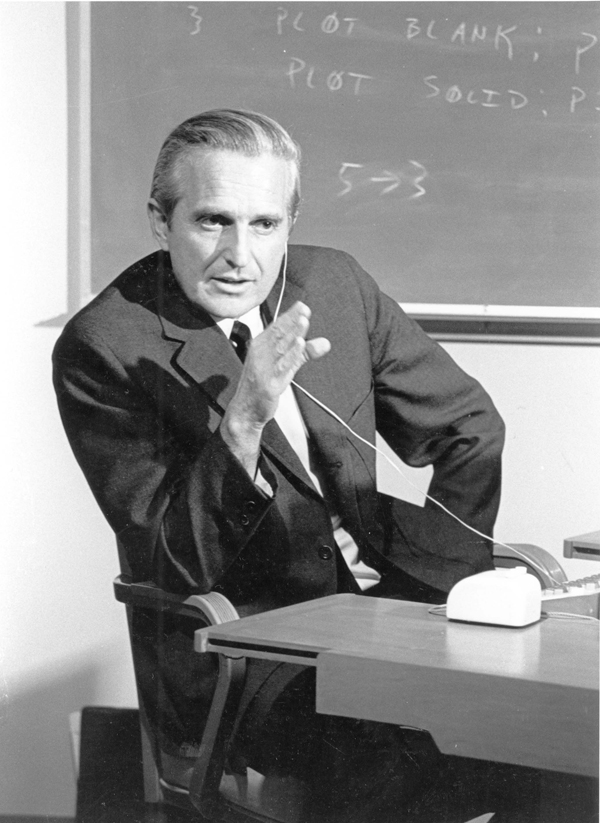
From the archives: Douglas Engelbart’s lasting legacy, 1999

Engelbart: Augmenting Human Intellect (1962)
AUGMENTING HUMAN INTELLECT : A Conceptual Framework Dr. Engelbart 1962
Augmenting Human Intellect: A Conceptual Framework - 1962 (AUGMENT,3906,)
Visit the Doug Engelbart Institute to explore his remarkable legacy and all it inspires (official site)

Father of the Mouse: Doug Engelbart. An exclusive interview in SuperKids Software Review.
History of the computer mouse.
Welcome
Visit the Doug Engelbart Institute to explore his remarkable legacy and all it inspires (official site)
Engram is a sampler that turns broken AI hallucinations into music
Thoughtful Things says Engram is a ‘field recorder for latent space’ and circuit-bending tiny AI models.

Humanities in the Machine - Blain Smith
There is something quietly remarkable about the people who built the foundations of modern computing. Not their technical achievements, though those are extraordinary. What is remarkable is where they came from before they ever touched a machine.
Ursula's list
Ursula Franklin is one of my all-time favorite thinkers about both the obvious and obscured parts of our technological world.
Viewpoint demo — Scott Kim's PhD project, Stanford University 1988
Minimum Viable Demos
An evening showcase of ambitious projects exploring technology, art, and science.
More Work For Mother
In this classic work of women's history (winner of the 1984 Dexter Prize from the Society for the History of Technology), Ruth Schwartz Cowan shows how and w...

Operation Voder: AT&T, Bell Labs, and the Labor of Techno-Utopia at the 1939 New York World’s Fair
This article explores the labor demands of the Voder, the electrical speech synthesis machine developed by Bell Labs for AT&T’s 1939 New York World’s Fair exhibit. The article situates the Voder within the historical context of the fair, with the United States emerging from the Great Depression and political tensions escalating across the globe. By examining the decision to incorporate the machine’s young female operators into the exhibit, the article argues that AT&T executives used Voder operators to normalize a new vision of technological utopia that relied heavily and conspicuously on the infrastructural labor of women. Moreover, the article highlights the previously unacknowledged engineering contributions of Voder operators in the years before the fair, writing women into the origin story of a machine that laid critical groundwork for speech recognition and voice encryption technology.