


Version 1.0. Created 24 December 2021. Note: This project is NOT meant to be a definitive anything. If people find it useful to visually note some aspects of their experiences or just find it...
Vibe Coding: The Final Form of Hyper-Individualism
A few days ago, I had to deal with the first "vibe coded" PR to my software. In this article, I reflect on this encounter, and analyze the social …

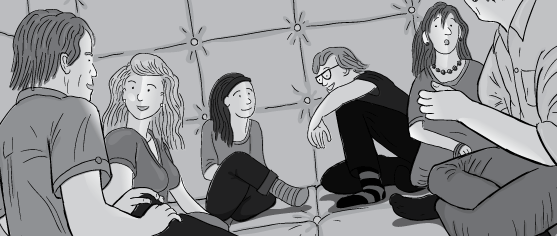
Deviance in the Dark psychology experiment – Stuart McMillen comics
A classic behavioral psychology experiment. In the 1970s, researchers took eight strangers and shut them inside a dark room for an hour. What happened next?
Why “Autism Is Not A Spectrum” – But Not For the Reasons You May Have Heard
By Dr Chloe Farahar | Autistic Researcher, Project Manager for Learning Disability and Autism at Kent and Medway Mental Health NHS Trust, and Founder of Aucademy CIC The Spectrum Was Never Fit For …

Weirding Diary: 3
A sense of weirdness in the environment can be understood as unfactored reality. A blooming, buzzing confusion of sensory input that impinges on awareness…

Sense of abundance
Expansive, curious, open, unfearful, unhurried. The opposite of Scarcity mindset .NoteLink.Active { background-color: rgba(10, 132, 255, 0.15); } .
Ghost in the Cloud | Meghan O'Gieblyn
A new, more pernicious thought had come to dominate my mind: transhumanist ideas were not merely similar to theological concepts but could in fact be the events described in the Bible. It was only a short time before my obsession reached its culmination. I got out my old study Bible and began to scan the prophetic literature for signs of the cybernetic revolution. I began to wonder whether I could pray to beings outside the simulation. I had initially been drawn to transhumanism because it was grounded in science. In the end, I became consumed with the kind of referential mania and blind longing that animates all religious belief.

People Who Can't Visualize Anything Are Challenging a 300-Year-Old Theory of Thought
Mental imagery might not be as central to complex human thought as we believed, philosophers say.

Analytic racecraft: Race-based averages create illusory group differences in perceptions of racism.


Are You Undiagnosed Autistic? How To Tell If You're On The Autism Spectrum | Patron's Choice
<span style="font-variant:small-caps;">AI</span> ‐induced dehumanization
Abstract Recent technological advancements have empowered nonhuman entities, such as virtual assistants and humanoid robots, to simulate human intelligence and behavior. This paper investigates how autonomous agents influence individuals' perceptions and behaviors toward others, particularly human employees. Our research reveals that the socio‐emotional capabilities of autonomous agents lead individuals to attribute a humanlike mind to these nonhuman entities. Perceiving a high level of humanlike mind in the nonhuman, autonomous agents affects perceptions of actual people through an assimilation process. Consequently, we observe “assimilation‐induced dehumanization”: the humanness judgment of actual people is assimilated toward the lower humanness judgment of autonomous agents, leading to various forms of mistreatment. We demonstrate that assimilation‐induced dehumanization is mitigated when autonomous agents possess capabilities incompatible with humans, leading to a contrast effect (Study 2), and when autonomous agents are perceived as having a high level of cognitive capability only, resulting in a lower level of mind perception of these agents (Study 3). Our findings hold across various types of autonomous agents (embodied: Studies 1–2 and disembodied: Studies 3–5), as well as in real and hypothetical consumer choices.

Neumorphism – the accessible and inclusive way | Axess Lab
There's a new kid in design town: neumorphism. It's predicted to become a big design trend ahead. Let's look at what neumorphism is, the potential…

The snake eating its own tail effect of AI agents isn’t so much a problem of training data model collapse as the collapse of the social epistemic foundations by which human sense-making can be carried out at all—and which AI agents *also* rely on for whatever facsimile of sense-making they conduct.

Ryan McGrady
The original: arstechnica.com/ai/2026/02/after-a-routine-co… and the context: theshamblog.com/an-ai-agent-published-a-hit-p… I hope they elaborate on the retraction, too, though I'm glad they acted quickly to take it down (and hope they put more effort into covering this terrifying story, since it's in their wheelhouse)
