

Naturally, when DrRacket calculates for you, it uses the rules that you know and love from math. Like you, it can determine the result of an addition only when all the operands are plain numbers. If an operand is a parenthesized operator expression—something that starts with a “(” and an operation—it determines the result of that nested expression first. Unlike you, it never needs to ponder which expression to calculate first—because this first rule is the only rule there is.
Intuiting Pratt parsing
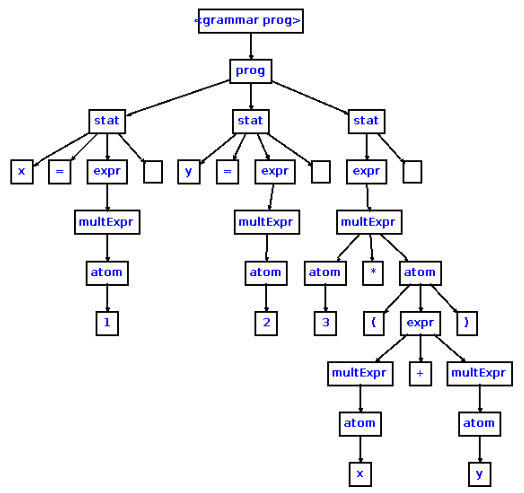
You already know that a + b * c + d is calculated as a + (b * c) + d. But how do you encode that knowledge precisely enough for a machine to act on it?
An invitation into Droste's Lair
A swords-and-sorcery programming environment for building and counting mathematical structures

An invitation into Droste's Lair
A swords-and-sorcery programming environment for building and counting mathematical structures
Lucy D’Agostino McGowan on Twitter / X
in a twist, the code below is correct!"The ^ operator indicates crossing to the specified degree. For example (a+b+c)^2 is identical to (a+b+c)*(a+b+c) which in turn expands to a formula containing the main effects for a, b and c together with their second-order interactions" https://t.co/sBErcEfV6B pic.twitter.com/RrF6bKY5Sl— Lucy D’Agostino McGowan (@LucyStats) February 21, 2024

Mathematicians still don’t know the fastest way to multiply numbers
A 23-year-old student overturned an ancient conjecture about one of math’s simplest operations

All elementary functions from a single binary operator
A single two-input gate suffices for all of Boolean logic in digital hardware. No comparable primitive has been known for continuous mathematics: computing elementary functions such as sin, cos, sqrt, and log has always required multiple distinct operations. Here I show that a single binary operator, eml(x,y)=exp(x)-ln(y), together with the constant 1, generates the standard repertoire of a scientific calculator. This includes constants such as e, pi, and i; arithmetic operations including addition, subtraction, multiplication, division, and exponentiation as well as the usual transcendental and algebraic functions. For example, exp(x)=eml(x,1), ln(x)=eml(1,eml(eml(1,x),1)), and likewise for all other operations. That such an operator exists was not anticipated; I found it by systematic exhaustive search and established constructively that it suffices for the concrete scientific-calculator basis. In EML (Exp-Minus-Log) form, every such expression becomes a binary tree of identical nodes, yielding a grammar as simple as S -> 1 | eml(S,S). This uniform structure also enables gradient-based symbolic regression: using EML trees as trainable circuits with standard optimizers (Adam), I demonstrate the feasibility of exact recovery of closed-form elementary functions from numerical data at shallow tree depths up to 4. The same architecture can fit arbitrary data, but when the generating law is elementary, it may recover the exact formula.

Simply Typed Reverse-Mode Automatic Differentiation with Variants: Denotational Correctness via Idempotent Completion
Reverse-mode automatic differentiation can be derived denotationally as a structure-preserving interpretation of program syntax. In the usual simply typed model, each source type has one cotangent type. Variants break this representation because the valid cotangent space depends on the branch selected at run time; established correctness results therefore use primal-indexed families of cotangent spaces, whose direct internal language is dependent.
clingo
Current answer set solvers work on variable-free programs. Hence, a grounder is needed that, given an input program with first-order variables, computes an e...
Regnestykker
Sheets with calculus exercises suitable for kids that are learning the first basic arithmetic operations.
Generic deriving of generic traversals | Proceedings of the ACM on Programming Languages
Functional programmers have an established tradition of using traversals as a design pattern to work with recursive data structures. The technique is so prolific that a whole host of libraries have been designed to help in the task of automatically ...

All elementary functions from a single operator
A single two-input gate suffices for all of Boolean logic in digital hardware. No comparable primitive has been known for continuous mathematics: computing elementary functions such as sin\sin, cos\cos, \sqrt{\phantom{x}}, and log\log has always required multiple distinct operations. Here we show that a single binary operator,
Qalculate! - the ultimate desktop calculator
Fidget
Fidget is a library for representing, compiling, and evaluating large-scale math expressions, i.e. hundreds or thousands of arithmetic clauses. It's mainly designed as a backend for implicit surfaces, but the library is flexible enough for many different uses!
Grade 3 » Operations & Algebraic Thinking » Represent and solve problems involving multiplication and division. » 1 | Common Core State Standards Initiative
Interpret products of whole numbers, e.g., interpret 5 × 7 as the total number of objects in 5 groups of 7 objects each. For example, describe a context in which a total number of objects can be expressed as 5 × 7.