This essay by Carson Gross explores when to use hypermedia in web development, highlighting its advantages and trade-offs. Carson discusses scenarios where hypermedia is a good fit, such as text and image-heavy UIs, CRUD applications, and nested UIs with well-defined areas. He also addresses when hypermedia may not be ideal, including situations with frequent UI state updates, offline requirements, or dynamic interdependencies. Using a 'Transitional' approach (as suggested by Rich Harris), Carson advocates for combining hypermedia with other strategies to optimize web application development, emphasizing its practical benefits and alignment with the web's architecture.
Hypermedia Systems
The revolutionary ideas that empowered the Web. A simpler approach to building applications on the Web and beyond with htmx and Hyperview. Enhancing web applications without using SPA frameworks.
</> htmx ~ Hypermedia APIs vs. Data APIs
In this essay, Carson Gross explores the fundamental differences between hypermedia APIs and data APIs, He explains how hypermedia APIs, which return HTML over HTTP, can embrace frequent changes due to their self-describing nature, while data APIs require more stability and versioning to avoid breaking client code. Carson argues that these distinct characteristics should inform different design approaches for each type of API.

Hypermedia: A Reintroduction
Hypermedia is a universal technology today, almost as common as electricity.
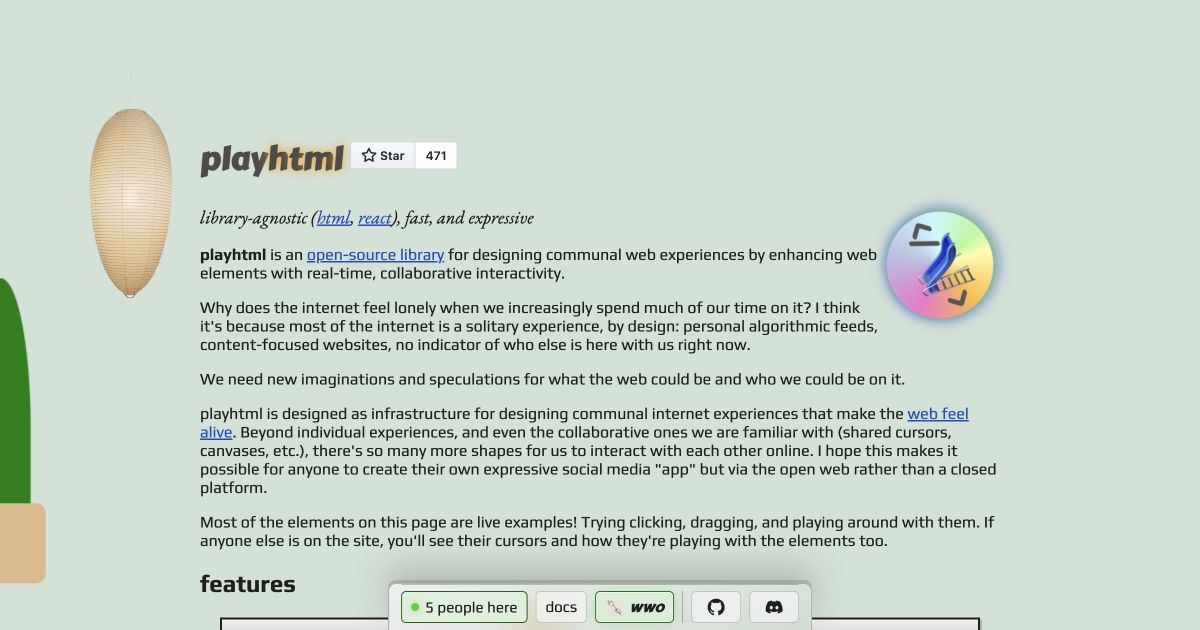
playhtml — make the web feel alive
Make the web feel alive with interactive, collaborative HTML elements and no backend to run.
Close to the metal: web design and the browser
Websites have evolved over the years, but in the name of evolution, there seems to be mistaken thinking that the process of building a website needs to get more complex, using Javascript frameworks and modern backend systems; when at the end of the day, browsers still only need static HTML content to interpret.

The Web Is For User Agency
We take the Web for granted as that thing that's there and we talk of things being good or bad for the Web, but we don't ever sit down and really say what the Web is for. I take a look at this question with an eye towards understanding what it is we need to do to build a Web that's actually better.

Web Components Are Not the Future
A few years ago I wrote an article suggesting that Web Components might not be the most beneficial...

Context engineering is sleeping on the humble hyperlink
The dream of hypermedia can come to fruition in a world where clients can not only parse, but navigate with intent.
Rethinking the creative web: Part 3 — Towards a new read/write web
Part 3 looks towards a future inhabited by new tools, behaviours, and standards that champion user agency and creativity on the open web.

Web components are okay
Every so often, the web development community gets into a tizzy about something, usually web components. I find these fights tiresome, but I also see them as a…


The HotJava Browser: A White Paper
Browsers allow people to treat the data spread across the Internet as a cohesive whole. Web browsers integrate the function of fetching the data with figuring out what it is and displaying it. One of the most important file types browsers understand is the hypertext markup language (HTML). HTML allows text data objects to embed simple formatting information and references to other objects.
Designing with Hypertextual Friction in the Algorithmic Web – Sophia Liu | ACM Hypertext '25
Web Interface Guidelines
Guidelines for building great interfaces on the web. Covers interactions, animations, layout, content, forms, performance & design.