


Join the discussion on this paper page
Connected Papers | Find and explore academic papers
A unique, visual tool to help researchers and applied scientists find and explore papers relevant to their field of work.
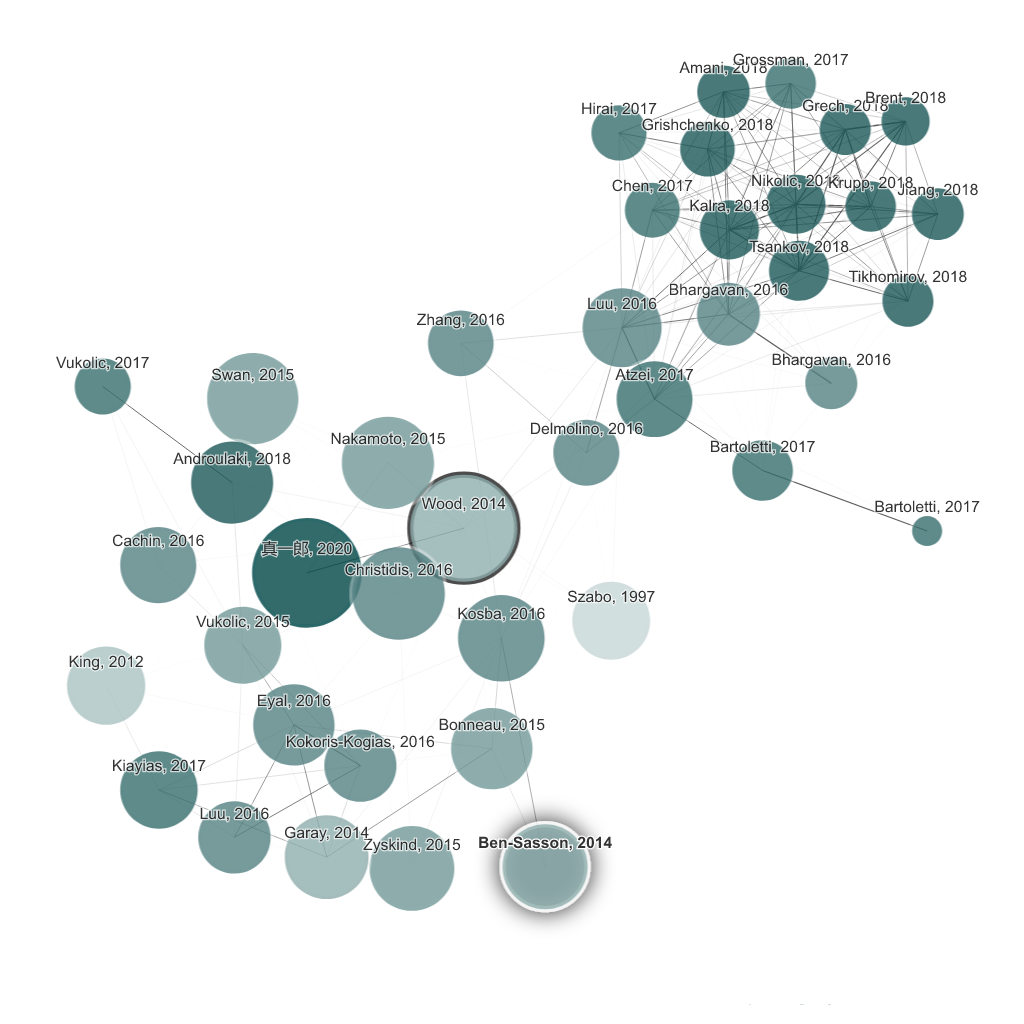
Connected Papers | Find and explore academic papers
A unique, visual tool to help researchers and applied scientists find and explore papers relevant to their field of work.
Guest Post — Scholarly AI Search Shortcomings and the Need for Better Metadata - The Scholarly Kitchen
AI scholarly search tools often miss important literature due to incomplete metadata. Better full-text-derived metadata could significantly improve discovery.
The new way we’ll do science
Papers should become human-readable views over a graph of data, tools, results, and certificates.
atproto-aware concept search engine
a mockup of a webpage search engine that only indexes webpages that are referenced in atproto records. Surfaces related links based on social and community context.
Lacuna: A Research Map for Machine Learning
Lacuna is a research map for machine learning that uses LLMs to turn papers and scholarly metadata into markdown summaries, concept elements, research directions, and research proposals. Each item keeps links to the primary source records and papers that support it. We release the map with web, markdown, and MCP interfaces. Across LitSearch, Multi-XScience-CS/ML, and ScholarQA-CS-ML, Lacuna outperforms OpenScholar with the strongest gains on LitSearch retrieval (Recall@10 0.538 vs. 0.424 for OpenScholar v3). We also evaluate Lacuna Deep Research, a multi-stage report agent over the map, on 25 ReportBench-ML survey tasks: Lacuna Deep Research reaches 0.052 citation F1, 0.339 citation precision, 99 expert-reference hits, and 7.82/10 RACE report quality, while GPT-Researcher reaches 0.039 F1, 0.290 precision, 72 hits, and 5.24/10 RACE.

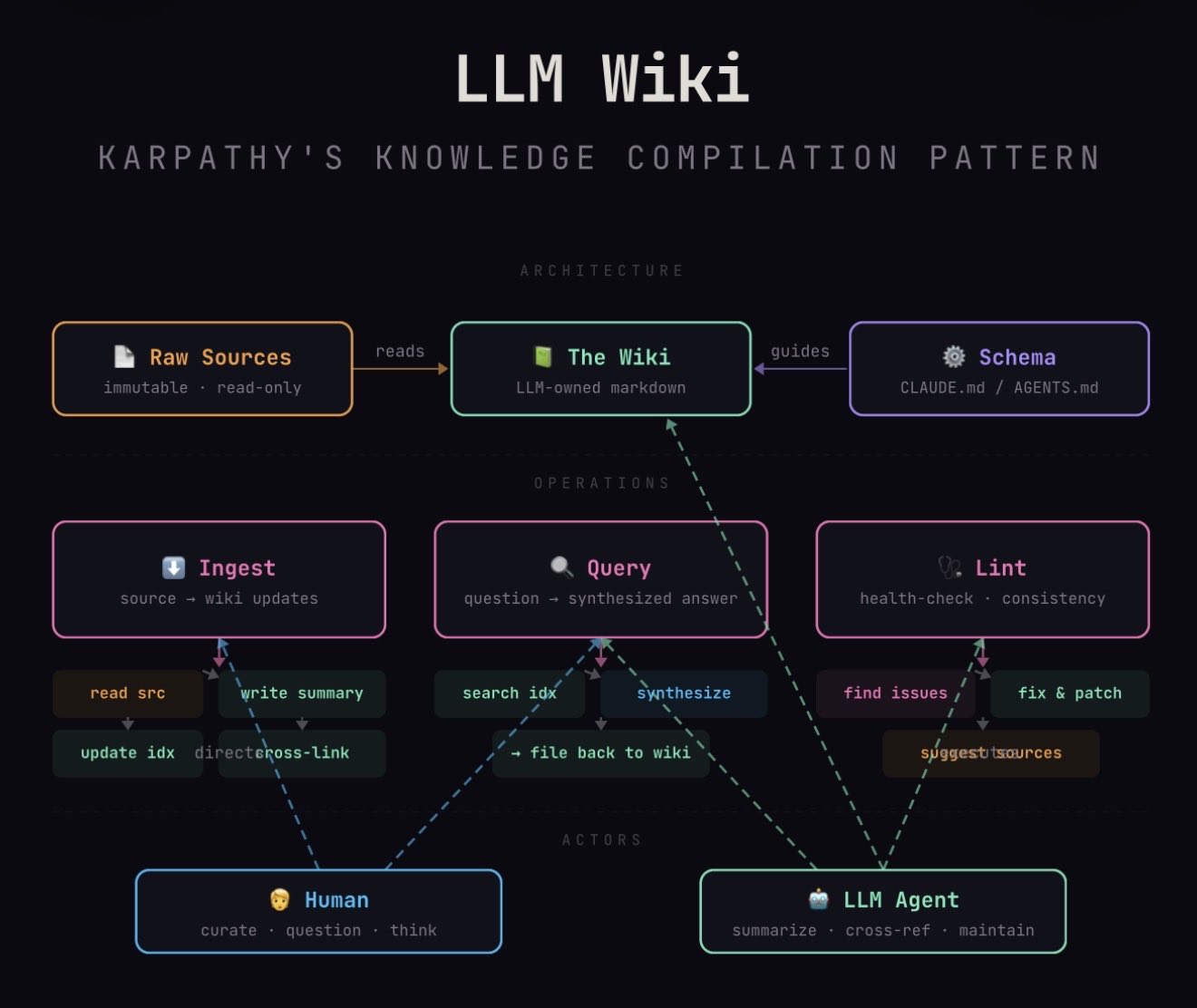
Yuchen Jin on Twitter / X
Karpathy’s “LLM Wiki” pattern: stop using LLMs as search engines over your docs. Use them as tireless knowledge engineers who compile, cross-reference, and maintain a living wiki. Humans curate and think.Diagram generated by my Claude agent knowledge worker. https://t.co/5u5i1GeFK8 pic.twitter.com/NIaq3KlAok— Yuchen Jin (@Yuchenj_UW) April 4, 2026
Building Scholar-Ready AI: A Conversation with Todd Toler - The Scholarly Kitchen
A conversation on AI retrieval, the provenance problem, and the shared infrastructure scholarly publishing needs.

Crossref: The sustainable source of community-owned scholarly metadata
This paper describes the scholarly metadata collected and made available by Crossref, as well as its importance in the scholarly research ecosystem. Containing over 106 million records and expanding at an average rate of 11% a year, Crossref’s metadata has become one of the major sources of scholarly data for publishers, authors, librarians, funders, and researchers. The metadata set consists of 13 content types, including not only traditional types, such as journals and conference papers, but also data sets, reports, preprints, peer reviews, and grants. The metadata is not limited to basic publication metadata, but can also include abstracts and links to full text, funding and license information, citation links, and the information about corrections, updates, retractions, etc. This scale and breadth make Crossref a valuable source for research in scientometrics, including measuring the growth and impact of science and understanding new trends in scholarly communications. The metadata is available through a number of APIs, including REST API and OAI-PMH. In this paper, we describe the kind of metadata that Crossref provides and how it is collected and curated. We also look at Crossref’s role in the research ecosystem and trends in metadata curation over the years, including the evolution of its citation data provision. We summarize the research used in Crossref’s metadata and describe plans that will improve metadata quality and retrieval in the future.

SemRepo.org
SemRepo is a large-scale RDF knowledge graph of GitHub repositories linked to scientific research. SemRepo captures fine-grained repository-level metadata (e.g., contributors, issues, programming languages) and interlinks this with external scholarly knowledge graphs: repositories to publications in LPWC, repository authors to their profiles in SemOpenAlex, and research artifacts (e.g., datasets, experiments) are linked via MLSea.
SemRepo: A Knowledge Graph for Research Software and Its Scholarly Ecosystem
We present SemRepo, an RDF knowledge graph comprising over 81 million triples describing nearly 200,000 GitHub repositories associated with scientific research. SemRepo captures repository-level metadata, such as contributors, issues, and programming languages, and interlinks this information with external scholarly knowledge graphs. In particular, repository authors are linked to their profiles in SemOpenAlex, repositories are connected to scholarly publications in LPWC, and research artifacts, such as datasets and experiments, are linked via MLSea-KG. This integration enables queries that span publications and their scholarly artifacts, which are typically fragmented across separate platforms. SemRepo supports analyses that are difficult to perform with existing resources in isolation, including provenance reconstruction across repositories and publications, as well as the systematic identification of risks to research reproducibility and software sustainability. By unifying research software with its scholarly context in a single graph, SemRepo provides an important infrastructure for large-scale analysis of software within the broader scientific research ecosystem.
AI maps science papers to predict research trends two to three years ahead
The number of scientific papers is growing so rapidly that scientists are no longer able to keep track of all of them, even in their own research area. Researchers from the Karlsruhe Institute of Technology ...

Great survey of the "scholarly interface design" frontier that also highlights the emerging role of the atproto.science and modular research ecosystems - @chive.pub @paperstarsorg.bsky.social @cosmik.network @semble.so @margin.at @discoursegraphs.bsky.social @curvenote.com and many more!

leotrs
1/ Scholarly publishing spent thirty years arguing about access. It has barely started arguing about what readers do with the paper once they have it. That second argument is turning into a field, forming around how science gets read and judged. Here is the map as I see it: aris.pub/blog/scholarly-interface-desi…
Researcher Pages

All things related to personal pages for researchers on atproto
Sifa — Portable professional identity on the open web

Lanyards - Researcher Profiles on AT Protocol

Ronen Tamari (@ronentk.me)

Mosh Lee (@mosh.bsky.social)