

Welcome to the Hypermedia Protocol: a decentralized publishing and discussion network
Chad Kohalyk (@chadkoh@indieweb.social)
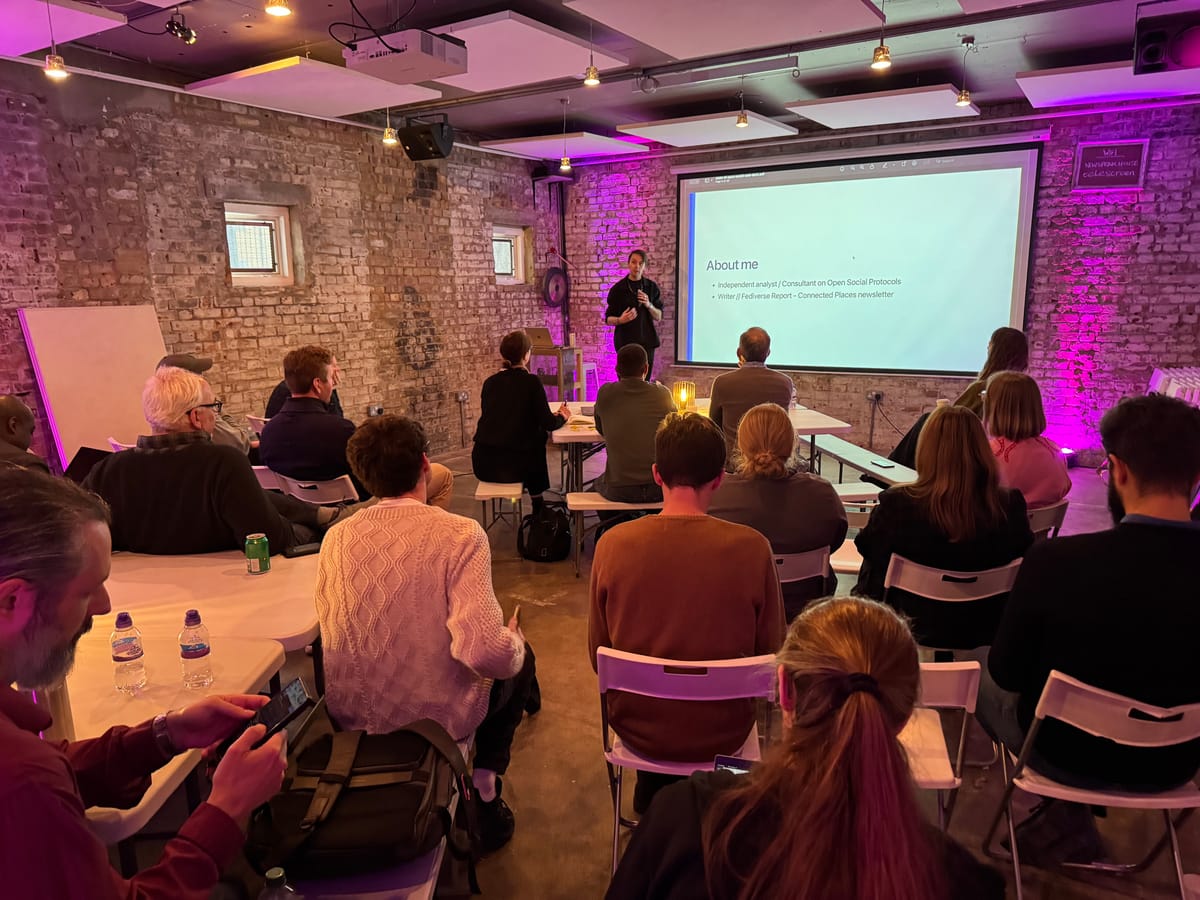
Web publishing is facing its next challenge: a new iteration of centralizing platforms. BUT there is also a new wave of open protocols and standards that can help us gain our independence. Next month in NYC we are gathering a group of frontier technologists and popular web publishers to discuss how we can sail into this next platform shift as captains. #ProtocolsForPublishers https://pfp.unternet.co
Protocols for Publishers
A series bringing together publishers, developers, and researchers to explore open protocols for a sustainable agentic web.
#protocolsforpublishers #atproto #mcp #webapplets | Chad Kohalyk
Web publishing is facing its next challenge: a new iteration of centralizing platforms. BUT there is also a new wave of open protocols and standards that can help us gain our independence. Next month in NYC we are gathering a group of frontier technologists and popular web publishers to discuss how we can sail into this next platform shift as captains. #ProtocolsForPublishers Learn more and sign up here: https://pfp.unternet.co We will be hosting talks on #atproto #mcp #webapplets and web payments, and give publishers the opportunity to interact directly with developers working on these frontier technologies. Thank you to Unternet, Graze Social, Free our Feeds, and betaworks for their support.

01 - Decentralized Web: An Introduction - Resource Guide
This resource guide was created to accompany Session 01 of the Webinar Series Imagining a Better Online World: Exploring the Decentralized Web. This session introduced essential DWeb concepts to library workers through demonstrations, resources, and examples of decentralized technologies in action. A video recording of this session has been archived by the Internet Archive and it can be viewed here.

Decentralized Syndication — The Missing Internet Protocol
The Internet is decentralized by design. It came into being not at once, but in parts. New protocols were added on top of previous ones…
The Decentralized Web: Defending Internet Freedom through Decentralization: Back to the Future? — MIT Digital Currency Initiative
In this report, we explore two important ways structurally decentralized systems could help address the risks of mega-platform consolidation: First, these systems can help users directly publish and discover content directly, without intermediaries, and thus without censorship. All of the systems we

Bluesky and the AT Protocol: Usable Decentralized Social Media
Bluesky is a new social network built upon the AT Protocol, a decentralized foundation for public social media. It was launched in private beta in February 2023, and has grown to over 10 million registered users by October 2024. In this paper we introduce the architecture of Bluesky and the AT Protocol, and explain how the technical design of Bluesky is informed by our goals: to enable decentralization by having multiple interoperable providers for every part of the system; to make it easy for users to switch providers; to give users agency over the content they see; and to provide a simple user experience that does not burden users with complexity arising from the system's decentralized nature. The system's openness allows anybody to contribute to content moderation and community management, and we invite the research community to use Bluesky as a dataset and testing ground for new approaches in social media moderation.

Empowering science communities with open, democratic, researcher-owned infrastructure.
We’re building communities and tech for publishing, curating, sharing, and discussing research online using ATProto and other decentralized protocols.

Empowering science communities with open, democratic, researcher-owned infrastructure.
We’re building communities and tech for publishing, curating, sharing, and discussing research online using ATProto and other decentralized protocols.
Protocols for Publishers✨
Bringing together publishers and developers for a sustainable agentic web

Building trust in the open
How Protocols for Publishers points to the future of journalism – and the web
Seeing the Politics of Decentralized Social Media Protocols
Calls to decentralize feed-based social media have been driven by concerns about the concentrated power of centralized platforms and their societal impact. In response, numerous decentralized social media protocols have emerged, each interpreting “decentralization” in a different way. We analyze four such protocols (ActivityPub, AT Protocol, Nostr, and Farcaster) drawing on protocol documentation, media coverage, direct usage, and semi-structured interviews with protocol developers and experts to situate each protocol within its socio-technical goals. To support this analysis, we develop a grounded lexicon that facilitates the description and comparison of analogous components across each protocol. With it, we show how each protocol distributes control over key components differently, shaping who holds power over critical aspects such as user identity, curation, and infrastructural ownership. By examining protocols as socio-technical artifacts, we show how they prioritize different values and make distinct trade-offs, providing CSCW researchers with a lens to more effectively evaluate and design future decentralized social media systems.

Web publishing is facing its next challenge: a new iteration of centralizing platforms. BUT there is also a new wave of open protocols+standards to gain independence. Next month in NYC let's discuss how we can sail into this next platform shift as captains. #ProtocolsForPublishers pfp.unternet.co
Protocols for Publishers
pfp.unternet.co