
More and more nonprofits are using AI. However, the excitement around scale and efficiency often overshadows a critical question: What does it mean to bring machine-generated abstraction into systems built on trust, context, and relationship?
Our Approach to Artificial Intelligence
We are experimenting with using AI tools to extend our work as a small nonprofit, so that we can focus our time on reinforcing human connections, conversations, and communities that have eroded.

Building a Solidarity Ecosystem for AI (SSIR)
How cooperatives, public institutions, and social movements can come together to intentionally build a practical, community-owned alternative to extractive AI systems. <meta property=

3: Consulting the Record: AI Consistently Fails the Public - AI Now Institute
Amid the excitement over AI’s (speculative, hypothetical) potential, we have lost sight of the sobering reality of its present and recent past. AI is already intermediating critical social infrastructures, materially reshaping our institutions in ways that ratchet up inequality and concentrate power in the hands of the already powerful. It is consistently deployed in ways […]

AI as Social Technology: Astor Lecture by Professor Henry Farrell
AI as Social Technology: Astor Lecture by Professor Henry Farrell
Collective Governance for AI: Points of Intervention
People often speak about AI as if it is one thing. It can seem like that when we use today’s most popular interfaces: a single product, packaged by an unfathomably big company. But that view is both misleading and disempowering. It implies that only the big companies could possibly create and control this technology, because only they can handle its immensity. But another orientation is possible.
How should social science think about AI?
Big structures and large processes are back, baby

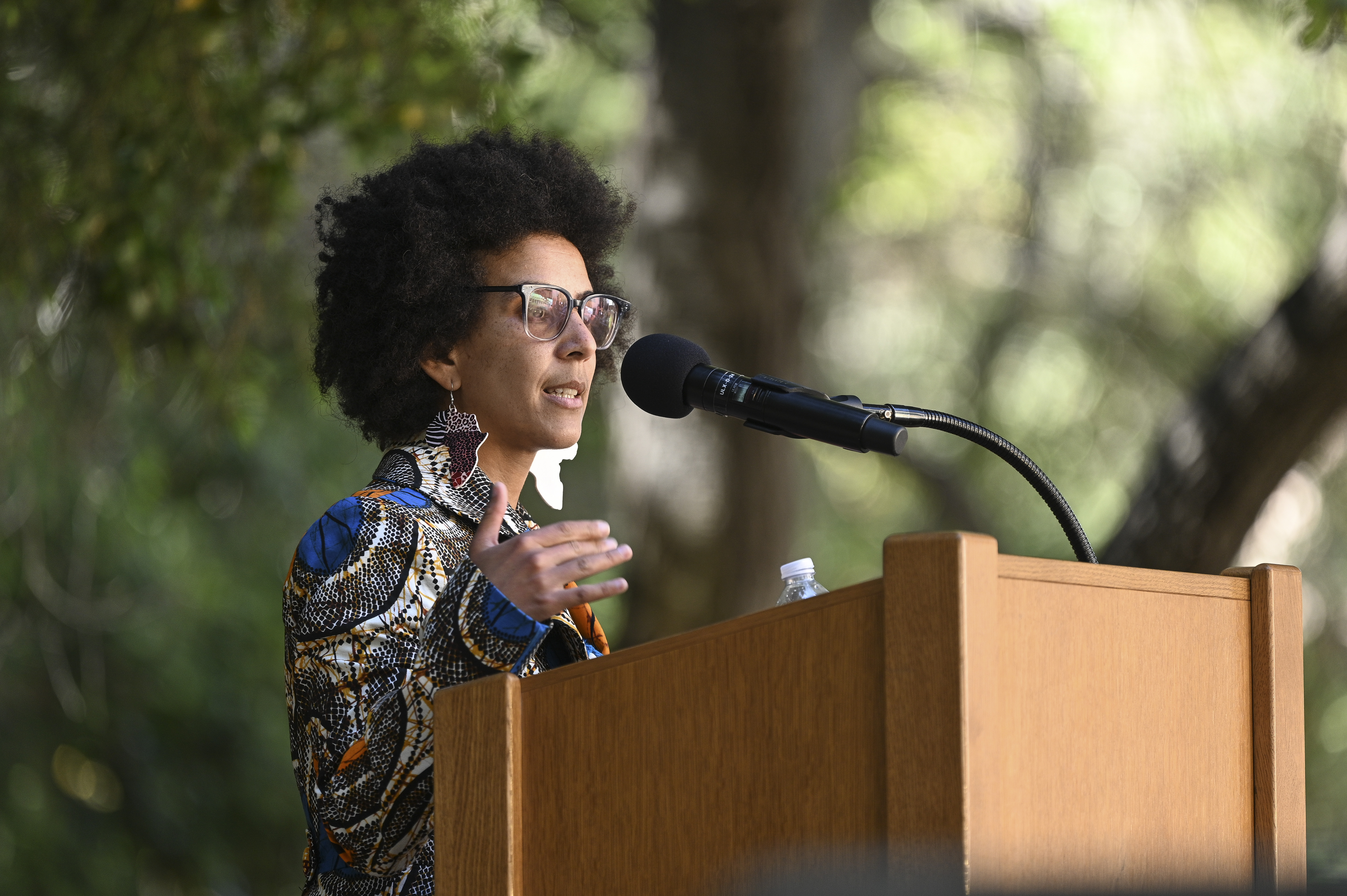
Timnit Gebru: Ethical AI Requires Institutional and Structural Change | Stanford HAI
The computer scientist discusses breaking down the power structures that use AI to exploit communities.
AI Bros Wanted Trump. Now They Learn What Happens When You Tell Him No.
Last year, in Fascism For First Time Founders, I warned the tech industry what happens when you cozy up to authoritarians. As I wrote then: Innovation requires trust. Not just between individuals, …

Field Theory: AI as Social Science Question, Object & Tool
Uses of advanced artificial intelligence are changing how societies organize labor, govern, produce knowledge, and make meaning. In light of these developments, this essay argues that AI models, tools, and systems pose three interrelated imperatives for social science: they demand renewed attention to social theories of how technology, human experience, and social order are entangled; they require study as objects of inquiry in their own right; and they offer capabilities that may transform—or upend—the practice of social investigation itself. From Weber’s analysis of rationalization to Du Bois’s study of technology and inequality to contemporary scholarship on algorithmic governance, the essay examines what social science distinctively offers: the capacity to historicize the apparently unprecedented, to trace connections across scales, and to center those most affected by technological change. It identifies how algorithmic systems are remaking the distribution of opportunity and risk as a central task of social inquiry and asks what futures social science might help bring into being.
From the Platform Society to the AI Society: Towards Critical Studies of Generative AI
The era of AI has begun. Generative AI is rapidly reshaping knowledge production, culture, and political authority, giving rise to an emerging AI society. Yet this transformation did not emerge ex nihilo. This paper argues that the AI society can only be understood in relation to the platform society from which it arises. Tracing the transition from platforms to AI, we identify interlinked economic, epistemic, and political shifts. Economically, AI emerges within platform-based rentier capitalism but reconfigures the monopoly mechanisms on which its accumulation depends. Epistemically, LLMs mark a shift from predictive to generative epistemics, entangling theory formation and knowledge production with private research-as-a-service infrastructures. Politically, governance shifts from data politics to alignment politics: from shaping visibility to shaping what can be said, thought, and imagined. Together, these transformations signal a qualitative shift in mediation—from governing interaction to governing cognition itself—and call for a Critical AI Studies.
Social physics in the age of artificial intelligence
Artificial intelligence (AI) systems are rapidly becoming more capable, autonomous, and deeply embedded in social life. As humans increasingly interact, cooperate, and compete with AI, we move from purely human societies to hybrid human-AI societies whose collective dynamics cannot be captured by existing behavioural models alone. Drawing on evolutionary game theory, cultural evolution, and Large Language Models (LLMs) powered simulations, we argue that these developments open a new research agenda for social physics centred on the co-evolution of humans and machines. We outline six key research directions. First, modelling the evolutionary dynamics of social behaviours (e.g. cooperation, fairness, trust) in hybrid human-AI populations. Second, understanding machine culture: how AI systems generate, mediate, and select cultural traits. Third, analysing the co-evolution of language and behaviour when LLMs frame and participate in decisions. Fourth, studying the evolution of AI delegation: how responsibilities and control are negotiated between humans and machines. Fifth, formalising and comparing the distinct epistemic pipelines that generate human and AI behaviour. Sixth, modelling the co-evolution of AI development and regulation in a strategic ecosystem of firms, users, and institutions. Together, these directions define a programme for using social physics to anticipate and steer the societal impact of advanced AI.

AI experienced through AI co-created tools
AI co-created tools and social spaces as a new medium

Human-Centered Artificial Intelligence: Three Fresh Ideas
Human-Centered AI (HCAI) is a promising direction for designing AI systems that support human self-efficacy, promote creativity, clarify responsibility, and facilitate social participation. These human aspirations also encourage consideration of privacy, security, environmental protection, social justice, and human rights. This commentary reverses the current emphasis on algorithms and AI methods, by putting humans at the center of systems design thinking, in effect, a second Copernican Revolution. It offers three ideas: (1) a two-dimensional HCAI framework, which shows how it is possible to have both high levels of human control AND high levels of automation, (2) a shift from emulating humans to empowering people with a plea to shift language, imagery, and metaphors away from portrayals of intelligent autonomous teammates towards descriptions of powerful tool-like appliances and tele-operated devices, and (3) a three-level governance structure that describes how software engineering teams can develop more reliable systems, how managers can emphasize a safety culture across an organization, and how industry-wide certification can promote trustworthy HCAI systems. These ideas will be challenged by some, refined by others, extended to accommodate new technologies, and validated with quantitative and qualitative research. They offer a reframe -- a chance to restart design discussions for products and services -- which could bring greater benefits to individuals, families, communities, businesses, and society.
Bridging the gap: inequalities that divide those who can and cannot create sustainable outcomes with AI
The widespread use of AI technologies impacts individuals, organisations, and societies in ways that warrant more comprehensive investigation. Inequalities in benefiting from AI advancements may le...

The Productivity Is Real. The Scaling Isn't.
What running an AI agent team taught me about why organizations can't do what one person can.