Metadata contributes to ensuring semantic interoperability, data reuse, and efficient information retrieval across heterogeneous systems. However, existing studies present fragmented approaches and lack a consolidated view of the strategies adopted in different domains. This fragmentation creates a gap in understanding the current state of the art and identifying cross-domain trends and challenges. This systematic review aims to address this gap by analyzing metadata integration practices across multiple domains, including Health and Medicine, Smart Cities and IoT, Data Science, Geosciences, Cultural Heritage, Library and Information Science. This review follows the Kitchenham structure, encompassing the planning, execution, and reporting phases. A total of 81 peer-reviewed articles published between 2014 and 2025 were selected from five major databases, based on the defined inclusion and exclusion criteria and a structured quality assessment process. The results reveal a predominance of the use of ontology, followed by metadata-driven language, standards, processes, and common metadata schema with an emerging trend towards automation through the adoption of AI-based approaches. The identified challenges include semantic heterogeneity, lack of standardization, limited automation, and usability issues in the current tools and platforms. We provide a comprehensive synthesis of existing approaches, highlighting domain-specific and cross-domain trends, and identifying research opportunities to advance metadata integration through automation, semantic enrichment, and standardized practices.
The Impact of Modern AI in Metadata Management
Metadata management plays a critical role in data governance, resource discovery, and decision-making in the data-driven era. While traditional metadata approaches have primarily focused on organization, classification, and resource reuse, the integration of modern artificial intelligence (AI) technologies has significantly transformed these processes. This paper investigates both traditional and AI-driven metadata approaches by examining open-source solutions, commercial tools, and research initiatives. A comparative analysis of traditional and AI-driven metadata management methods is provided, highlighting existing challenges and their impact on next-generation datasets. The paper also presents an innovative AI-assisted metadata management framework designed to address these challenges. This framework leverages more advanced modern AI technologies to automate metadata generation, enhance governance, and improve the accessibility and usability of modern datasets. Finally, the paper outlines future directions for research and development, proposing opportunities to further advance metadata management in the context of AI-driven innovation and complex datasets.

Semantic alignment of the German Human Genome-Phenome Archive metadata model in Europe’s genomics field
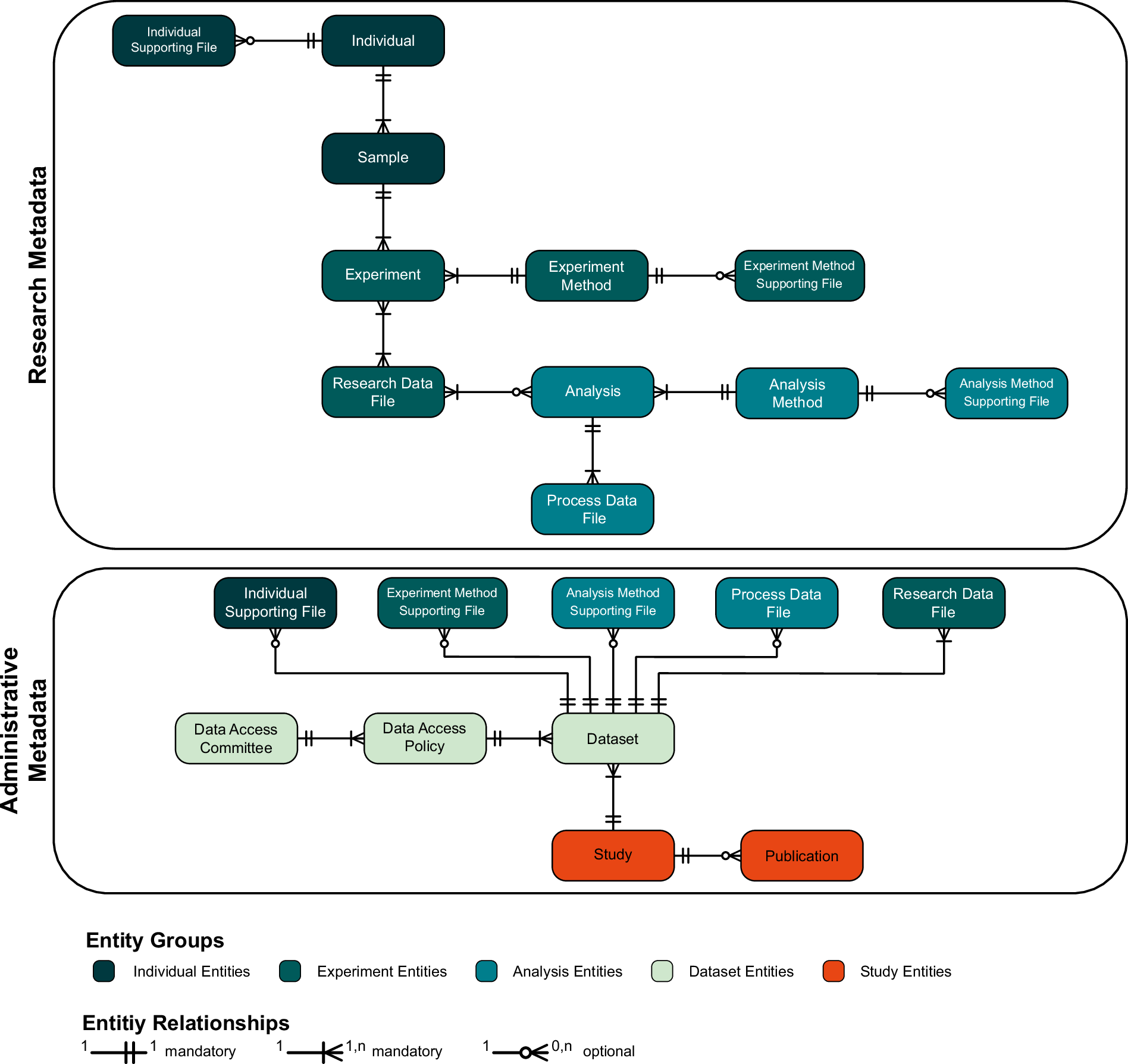
Legal and technical developments drive data sharing via federated infrastructures, especially in the field of human omics. This requires interoperability across technical, syntactic, organizational, and semantic layers. The German Human Genome-Phenome Archive (GHGA) has been building a national, federated infrastructure for secure sharing of human omics data. As part of its mission to enhance interoperability and to promote reliable data sharing, a detailed crosswalk analysis was conducted comparing the GHGA metadata model with four other domain-relevant standards and metadata models: EGA (Submission API and model draft), FAIR Genomes and ISA-tab. The analysis aimed at identifying semantic consensus fields to define datasets in the context of human omics by forward mapping (GHGA model to external models). Backward mapping (external models to GHGA) focused on spotting gaps in GHGA’s semantic metadata representation. Forward mapping showed overall similar property coverage across models, aligning with MINSEQE. Backward mapping showed greater model heterogeneity. None of the identified information gaps spanned across all models. These findings highlight the detail and adaptability of the GHGA metadata model.
(PDF) Understanding the Nature of Metadata: Systematic Review
PDF | Background Metadata are created to describe the corresponding data in a detailed and unambiguous way and is used for various applications in... | Find, read and cite all the research you need on ResearchGate

Home
The Dublin Core Metadata Initiative (DCMI) is an open forum engaged in metadata innovation and support the development of interoperable online metadata standards that support a broad range of purposes and business models. DCMI's activities include consensus-driven working groups, global conferences and workshops, standards liaison, and educational efforts to promote widespread acceptance of metadata standards and practices.
OWL - Semantic Web Standards
The W3C Web Ontology Language (OWL) is a Semantic Web language designed to represent rich and complex knowledge about things, groups of things, and relations between things. OWL is a computational logic-based language such that knowledge expressed in OWL can be exploited by computer programs, e.g., to verify the consistency of that knowledge or to make implicit knowledge explicit. OWL documents, known as ontologies, can be published in the World Wide Web and may refer to or be referred from other OWL ontologies. OWL is part of the W3C’s Semantic Web technology stack, which includes RDF, RDFS, SPARQL, etc.
DSWB | Metadata Standards: Selecting and Applying Standards in Research | Webinar Recording
Self-Driving Datasets: From 20 Million Papers to Nuanced Biomedical Knowledge at Scale
Manually curated biomedical repositories -- spanning bioactivity, genomics, and chemistry -- are expensive to maintain, lag behind primary literature, and discard experimental context, obscuring nuances needed to assess data correctness and coverage. We show that PubMed itself can be autonomously and cost-effectively turned into structured datasets that are larger, more nuanced, and more accurate than the curated databases they replace. We present three coupled contributions: (1) an LLM-based entity-tagging pipeline, grounded in nine biomedical ontologies, that tags 4.5B entities across 19 categories in a 22.5M-paper, 2.5T-token PubMed corpus; (2) hybrid sparse-dense retrieval supporting entity-filtered semantic queries over the tagged corpus; and (3) Starling, a multi-agent deep research system that, given only a natural-language task description, designs precision- and recall-targeted retrieval filters, induces an extraction schema, and emits structured records with nuance-rich fields and supporting passages. Across six tasks -- blood-brain barrier permeability, oral bioavailability, acute toxicity (LD50), gene-disease associations, protein subcellular localization, and chemical reactions -- Starling produces ~6.3M records (91K-3M per task); several are, to our knowledge, the largest public datasets for their property. Frontier-model rejection of our extractions is 0.6-7.7% across tasks, far below error rates we measure on widely used curated counterparts (e.g., 16.5% on BBB_Martins, 7.3% on Bioavailability_Ma). Beyond scale and accuracy, the supporting passages carry nuance tabular databases discard -- e.g., oral bioavailability may depend on fed vs. fasted state. Together, the corpus, retrieval, and agent establish a foundation for AI-driven therapeutic design. Code and datasets: https://github.com/starling-labs/starling.

Haystack: A Platform for Authoring End User Semantic Web Applications
The Semantic Web promises to open innumerable opportunities for automation and information retrieval by standardizing the protocols for metadata exchange. However, just as the success of the World Wide Web can be attributed to the ease of use and ubiquity of Web browsers, we believe that the unfolding of the Semantic Web vision depends on users getting powerful but easy-to-use tools for managing their information. But unlike HTML, which can be easily edited in any text editor, RDF is more complicated to author and does not have an obvious presentation mechanism. Previous work has concentrated on the ideas of generic RDF graph visualization and RDF Schema-based form generation. In this paper, we present a comprehensive platform for constructing end user applications that create, manipulate, and visualize arbitrary RDF-encoded information, adding another layer to the abstraction cake. We discuss a programming environment specifically designed for manipulating RDF and introduce user interface concepts on top that allow the developer to quickly assemble applications that are based on RDF data models. Also, because user interface specifications and program logic are themselves describable in RDF, applications built upon our framework enjoy properties such as network updatability, extensibility, and end user customizability – all desirable characteristics in the spirit of the Semantic Web.

Manuscript submission systems and metadata completeness in Crossref: Patterns and associations
The importance of open research information, particularly publication metadata, is widely recognised. Crossref is one of the most important infrastructures for registering open metadata as part of DOI record registration. It is widely known, however, that the metadata of many publications is far from complete, with many publishers making certain metadata openly available, but failing to do so for other metadata elements. Publishers’ ability to register this metadata with Crossref depends on their capacity to capture and retain this data in their production workflows. Manuscript submission systems are an important, yet largely overlooked, factor in the extent to which publishers make metadata available through Crossref. In this paper, we present the results of an analysis investigating the relation between the level of metadata that publishers deposit with Crossref and the submission systems that they deploy for their journals. We have looked at the 153 publishers with the largest amounts of publications in Crossref and concentrate on the four most commonly used systems: Editorial Manager, ScholarOne, Open Journal Systems (OJS) and eJournalPress. We show that some submission systems appear better suited to capturing certain metadata elements. However, there are always cases where publishers using the same system differ widely in the level of metadata they register, suggesting that technology is not the only prohibiting factor and other considerations are at play.
Crossref: The sustainable source of community-owned scholarly metadata
This paper describes the scholarly metadata collected and made available by Crossref, as well as its importance in the scholarly research ecosystem. Containing over 106 million records and expanding at an average rate of 11% a year, Crossref’s metadata has become one of the major sources of scholarly data for publishers, authors, librarians, funders, and researchers. The metadata set consists of 13 content types, including not only traditional types, such as journals and conference papers, but also data sets, reports, preprints, peer reviews, and grants. The metadata is not limited to basic publication metadata, but can also include abstracts and links to full text, funding and license information, citation links, and the information about corrections, updates, retractions, etc. This scale and breadth make Crossref a valuable source for research in scientometrics, including measuring the growth and impact of science and understanding new trends in scholarly communications. The metadata is available through a number of APIs, including REST API and OAI-PMH. In this paper, we describe the kind of metadata that Crossref provides and how it is collected and curated. We also look at Crossref’s role in the research ecosystem and trends in metadata curation over the years, including the evolution of its citation data provision. We summarize the research used in Crossref’s metadata and describe plans that will improve metadata quality and retrieval in the future.
Evolution of AI Agent Registry Solutions: Centralized, Enterprise, and Distributed Approaches
Autonomous AI agents now operate across cloud, enterprise, and decentralized domains, creating demand for registry infrastructures that enable trustworthy discovery, capability negotiation, and identity assurance. We analyze five prominent approaches: (1) MCP Registry (centralized publication of mcp.json descriptors), (2) A2A Agent Cards (decentralized self-describing JSON capability manifests), (3) AGNTCY Agent Directory Service (IPFS Kademlia DHT content routing extended for semantic taxonomy-based content discovery, OCI artifact storage, and Sigstore-backed integrity), (4) Microsoft Entra Agent ID (enterprise SaaS directory with policy and zero-trust integration), and (5) NANDA Index AgentFacts (cryptographically verifiable, privacy-preserving fact model with credentialed assertions). Using four evaluation dimensions: security, authentication, scalability, and maintainability, we surface architectural trade-offs between centralized control, enterprise governance, and distributed resilience. We conclude with design recommendations for an emerging Internet of AI Agents requiring verifiable identity, adaptive discovery flows, and interoperable capability semantics.
Experiences with recombinant computing: Exploring ad hoc interoperability in evolving digital networks
This article describes an infrastructure that supports the creation of interoperable systems while requiring only limited prior agreements about the specific forms of communication between these systems. Conceptually, our approach uses a set of “meta-interfaces”—agreements on how to exchange new behaviors necessary to achieve compatibility at runtime , rather than requiring that communication specifics be built in at development time —to allow devices on the network to interact with one another. While this approach to interoperability can remove many of the system-imposed constraints that prevent fluid, ad hoc use of devices now, it imposes its own limitations on the user experience of systems that use it. Most importantly, since devices may be expected to work with peers about which they have no detailed semantic knowledge, it is impossible to achieve the sort of tight semantic integration that can be obtained using other approaches today, despite the fact that these other approaches limit interoperability. Instead, under our model, users must be tasked with performing the sense-making and semantic arbitration necessary to determine how any set of devices will be used together. This article describes the motivation and details of our infrastructure, its implications on the user experience, and our experience in creating, deploying, and using applications built with it over a period of several years.

Open Agent Specification (Agent Spec): A Unified Representation for AI Agents
The proliferation of agent frameworks has led to fragmentation in how agents are defined, executed, and evaluated. Existing systems differ in their abstractions, data flow semantics, and tool integrations, making it difficult to share or reproduce workflows. We introduce Open Agent Specification (Agent Spec), a declarative language that defines AI agents and agentic workflows in a way that is compatible across frameworks, promoting reusability, portability and interoperability of AI agents. Agent Spec defines a common set of components, control and data flow semantics, and schemas that allow an agent to be defined once and executed across different runtimes. Agent Spec also introduces a standardized Evaluation harness to assess agent behavior and agentic workflows across runtimes - analogous to how HELM and related harnesses standardized LLM evaluation - so that performance, robustness, and efficiency can be compared consistently across frameworks. We demonstrate this using four distinct runtimes (LangGraph, CrewAI, AutoGen, and WayFlow) evaluated over three different benchmarks (SimpleQA Verified, $τ^2$-Bench and BIRD-SQL). We provide accompanying toolsets: a Python SDK (PyAgentSpec), a reference runtime (WayFlow), and adapters for popular frameworks (e.g., LangGraph, AutoGen, CrewAI). Agent Spec bridges the gap between model-centric and agent-centric standardization & evaluation, laying the groundwork for reliable, reusable, and portable agentic systems.
Definitions of “Metadata”: A Brief Survey of International Standards
A search on the term “metadata” in the International Organization for Standardization's Online Browsing Platform (ISO OBP) reveals that there are 96 separate ISO standards that provide definitions of the term. Between them, these standards supply 46 different definitions—a lack of standardization that we might not have expected, given the context. In fact, if we make creative use of Simpson's index of concentration (originally devised as a measure of ecological diversity) to measure the degree of standardization of definition in this case, we arrive at a value of 0.05, on a scale of zero to one. It is suggested, however, that the situation is not as problematic as it might seem: that low cross‐domain levels of standardization of definition should not be cause for concern.

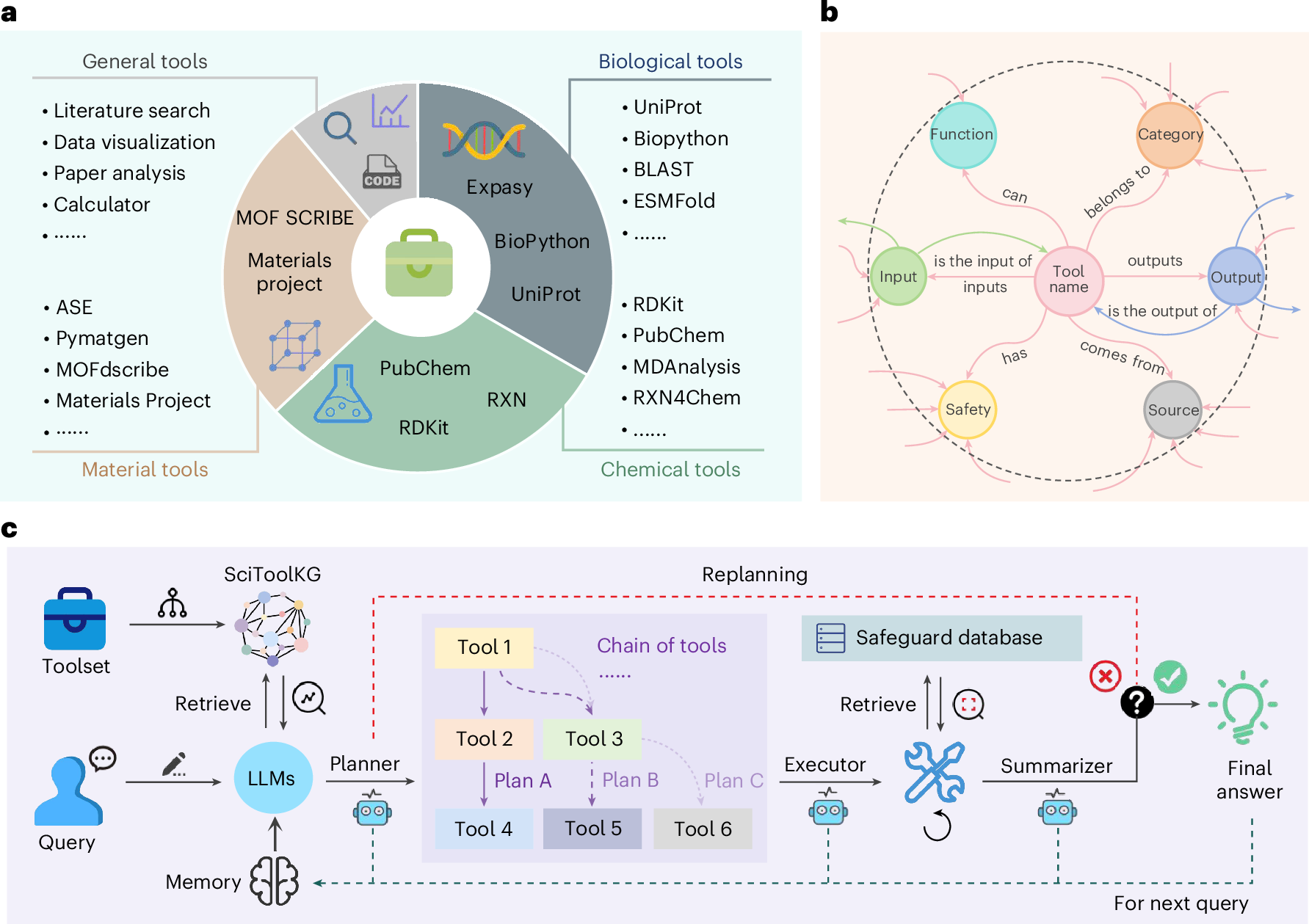
SciToolAgent: a knowledge-graph-driven scientific agent for multitool integration
Scientific research increasingly relies on specialized computational tools, yet effectively utilizing these tools requires substantial domain expertise. While large language models show promise in tool automation, they struggle to seamlessly integrate and orchestrate multiple tools for complex scientific workflows. Here we present SciToolAgent, a large language model-powered agent that automates hundreds of scientific tools across biology, chemistry and materials science. At its core, SciToolAgent leverages a scientific tool knowledge graph that enables intelligent tool selection and execution through graph-based retrieval-augmented generation. The agent also incorporates a comprehensive safety-checking module to ensure responsible and ethical tool usage. Extensive evaluations on a curated benchmark demonstrate that SciToolAgent outperforms existing approaches. Case studies in protein engineering, chemical reactivity prediction, chemical synthesis and metal–organic framework screening further demonstrate SciToolAgent’s capability to automate complex scientific workflows, making advanced research tools accessible to both experts and nonexperts.