The conventional approach for building pervasive environments relies on middleware to integrate different systems. Instead, we have built a system that can deal with these environments by exporting system resources through distributed virtual file systems. This requires no middleware, simplifies interoperation, and permits applying general purpose tools to any system resource. A constraint-based file system import mechanism allows the system to adapt to changes in the environment and permits users to customize the environment and tailor adaptation according to their needs. The system has been in use for over a year to carry out our daily work and is underlying the smart space that we built for our department
Hello, Operator!
Part of the WonderOS project, this is presented as the operating manual that would come with the reader’s first machine running WonderOS. It is an exercise in exploring how people familiar with mainstream personal computing devices and systems would become computer literate in an itemized environment. It is written as though the reader is familiar with today’s mainstream operating systems, and is exploring their first itemized OS.
The Interfaces With Which We Think
The concepts in modern operating systems — apps, windows, desktops, notifications, and so on — have so permeated our understanding of personal computing, it’s hard to imagine anything else, let alone believe there could be anything better.
Lifestreams: a storage model for personal data
Conventional software systems, such as those based on the “desktop metaphor,” are ill-equipped to manage the electronic information and events of the typical computer user. We introduce a new metaphor, Lifestreams, for dynamically organizing a user's personal workspace. Lifestreams uses a simple organizational metaphor, a time-ordered stream of documents, as an underlying storage system. Stream filters are used to organize, monitor and summarize information for the user. Combined, they provide a system that subsumes many separate desktop applications. This paper describes the Lifestreams model and our prototype system.
Basic | The Personal Computing Platform
We build products, tools, and standards to make computers more personal.

Malleable software: Restoring user agency in a world of locked-down apps
The original promise of personal computing was a new kind of clay. Instead, we got appliances: built far away, sealed, unchangeable. In this essay, we envision malleable software: tools that users can reshape with minimal friction to suit their unique needs.

Experiences with recombinant computing: Exploring ad hoc interoperability in evolving digital networks
This article describes an infrastructure that supports the creation of interoperable systems while requiring only limited prior agreements about the specific forms of communication between these systems. Conceptually, our approach uses a set of “meta-interfaces”—agreements on how to exchange new behaviors necessary to achieve compatibility at runtime , rather than requiring that communication specifics be built in at development time —to allow devices on the network to interact with one another. While this approach to interoperability can remove many of the system-imposed constraints that prevent fluid, ad hoc use of devices now, it imposes its own limitations on the user experience of systems that use it. Most importantly, since devices may be expected to work with peers about which they have no detailed semantic knowledge, it is impossible to achieve the sort of tight semantic integration that can be obtained using other approaches today, despite the fact that these other approaches limit interoperability. Instead, under our model, users must be tasked with performing the sense-making and semantic arbitration necessary to determine how any set of devices will be used together. This article describes the motivation and details of our infrastructure, its implications on the user experience, and our experience in creating, deploying, and using applications built with it over a period of several years.

The Plan B OS for ubiquitous computing. Voice control, security, and terminals as case studies
Composer by DXOS
Introducing programmable documents. Blend the power of popular file formats (docs, sheets, sketch & tables) inside of a collaborative local-first workspace.
Personal sync servers for composable data
Exploring the possibilities of interoperability and composability for local-first software & data by using a personal sync server tied to an atproto identity
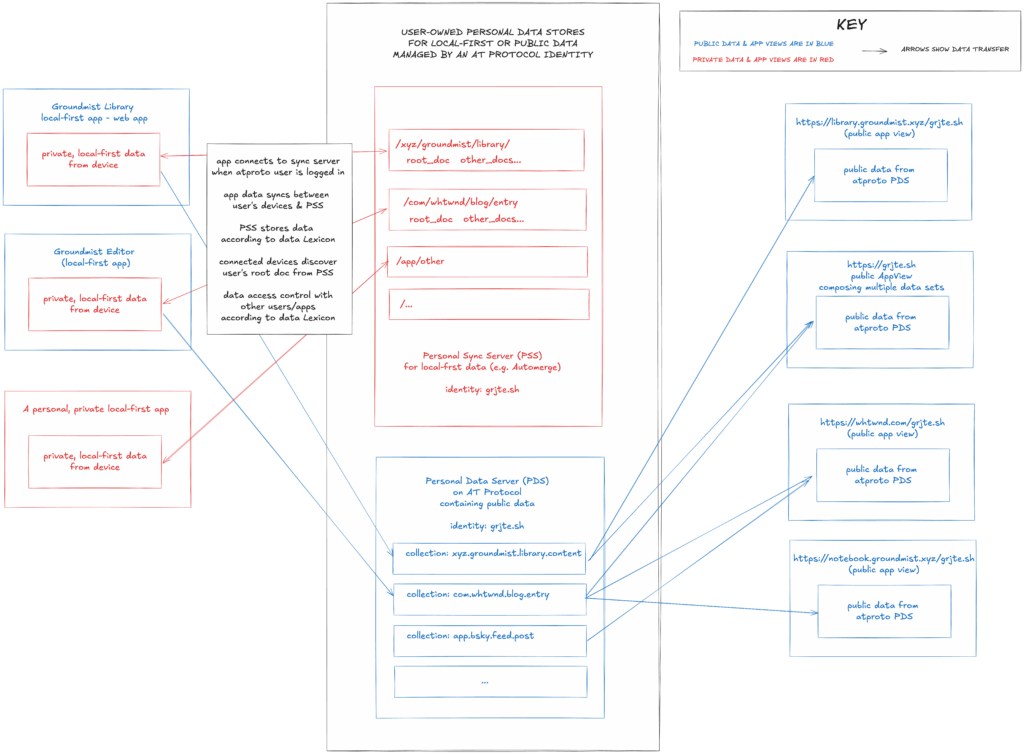
Personal sync servers for composable data
Exploring the possibilities of interoperability and composability for local-first software & data by using a personal sync server tied to an atproto identity
Home | cse223b
CSE 223B is a 4-unit graduate subject with lectures, paper discussions, a midterm, and technical report exercise, and a major term research project culminating in writing a research paper of your own. It will present abstractions and implementation techniques that facilitate the design of distributed systems–including both operating systems and sophisticated Internet servers–that can deal with the demands of real-world workloads. Topics will include efficient operating system primitives, high-performance network servers, load shedding, storage systems, security, and fault tolerance.
Peter van Hardenberg - Ink and Switch, Automerge
Folders Are Broken, So I Built Heaper
Folders Are Broken, So I Built Heaper
Pocket: atproto user preference storage
API Documentation for Pocket, a simple user-preference storage system for atproto