

Disruption-tolerant networks (DTNs) rely on intermittent contacts between mobile nodes to deliver packets using a store-carry-and-forward paradigm. We earlier proposed the use of throwbox nodes, which are stationary, battery-powered nodes with storage and processing, to enhance the capacity of DTNs. However, the use of throwboxes without efficient power management is minimally effective. If the nodes are too liberal with their energy consumption, they will fail prematurely. However, if they are too conservative, they may miss important transfer opportunities, hence increasing lifetime without improving performance. In this paper, we present a hardware and software architecture for energy-efficient throwboxes in DTNs. We propose a hardware platform that uses a multitiered, multiradio, scalable, solar-powered platform. The throwbox employs an approximate heuristic for solving the NP-hard problem of meeting an average power constraint while maximizing the number of bytes forwarded by the throwbox. We built and deployed prototype throwboxes in UMass DieselNet, a bus-based DTN testbed. Through extensive trace-driven simulations and prototype deployment, we show that a single throwbox with a 270-cm2 solar panel can run perpetually while improving packet delivery by 37% and reducing message delivery latency by at least 10% in the network.
Study of a bus-based disruption-tolerant network: mobility modeling and impact on routing
As part of the Digital Library's transition to Open Access, new features for researchers are available in the Premium Edition. Click here to learn more.

An Internet for the KV Cache: Rethinking Classical Infrastructure Boundaries in the LLM Inference Age
LLM inference has become a global-scale, heterogeneous workload spanning agents, retrieval, tool-use, code execution and multi-modal reasoning. These workloads naturally enable context reuse from overlapping inputs, creating a major opportunity to store and reuse the contexts' KV Caches instead of recomputing them. However, model-side advances that shrink the KV Cache and system-side advances that reduce compute, storage, and transfer costs are evolve independently within legacy cloud boundaries. We argue that future inference infrastructure should allow decoupling of compute and KV Cache storage across cloud and datacenters. The network becomes an active distribution channel; bandwidth, latency and pricing directly determines how the KV Cache should be managed. We propose a vision for an Internet for the KV Cache, with KV Cache management working as a content-distribution system. In this view, KV Cache storage and recompute decisions are driven by model, infrastructure, and application metrics, to enable adaptive, content-driven decisions for minimizing latency and cost.

designing a storage engine for AT Protocol backlinks - charlotte!
economical full-network-scale application-agnostic data storage
Meshtastic
An open source, off-grid, decentralized mesh network built to run on affordable, low-power devices

Intelligence per Watt: Measuring Intelligence Efficiency of Local AI
Large language model (LLM) queries are predominantly processed by frontier models in centralized cloud infrastructure. Demand growth strains this paradigm faster than providers can scale. Two advances create an opportunity to rethink it: small, local LMs (<=20B active parameters) now achieve competitive performance to frontier models on many tasks, and local accelerators (e.g., Apple M4 Max) can host these models at interactive latencies. This raises the question: can local inference viably redistribute demand from centralized infrastructure? This requires measuring both whether local LMs can accurately answer real-world queries and whether they can do so efficiently on power-constrained devices (e.g., laptops). We propose intelligence per watt (IPW), task accuracy per unit of power, as a unified metric for the capability and efficiency of local inference across model-accelerator configurations. We evaluate 20+ state-of-the-art local LMs, 8 hardware accelerators (local and cloud), and 1M real-world single-turn chat and reasoning queries. For each query, we measure accuracy (local LM win rate against frontier models), energy, latency, and power. We find three key results. First, local LMs successfully answer 88.7% of these queries, with accuracy varying by domain. Second, longitudinal analysis from 2023-2025 shows IPW improved 5.3x, driven by both algorithmic and accelerator advances, with locally-serviceable query coverage rising from 23.2% to 71.3%. Third, local accelerators achieve at least 1.4x lower IPW than cloud accelerators running identical models, revealing significant headroom for local accelerator optimization. These findings demonstrate that local inference can meaningfully redistribute demand from centralized infrastructure for a substantial subset of queries, with IPW serving as the critical metric for tracking this transition.
Silicon Foraging: Harvesting Excess Compute for Sustainable Edge Computing
apple/swift-nio
Event-driven network application framework for high performance protocol servers & clients, non-blocking.
Nodebuster
Nodebuster is a short, experimental incremental game about busting nodes and destroying reality.

Cloudflare’s Gen X: Servers for an Accelerated Future
We designed and built Cloudflare’s network to be able to grow capacity quickly and inexpensively; to allow every server, in every city, to run every service; and to allow us to shift customers and traffic across our network efficiently.
Home | cse223b
CSE 223B is a 4-unit graduate subject with lectures, paper discussions, a midterm, and technical report exercise, and a major term research project culminating in writing a research paper of your own. It will present abstractions and implementation techniques that facilitate the design of distributed systems–including both operating systems and sophisticated Internet servers–that can deal with the demands of real-world workloads. Topics will include efficient operating system primitives, high-performance network servers, load shedding, storage systems, security, and fault tolerance.
Moving Beyond Containers - Introducing Boxer by Daniel Phillips @Wasm I/O 2025
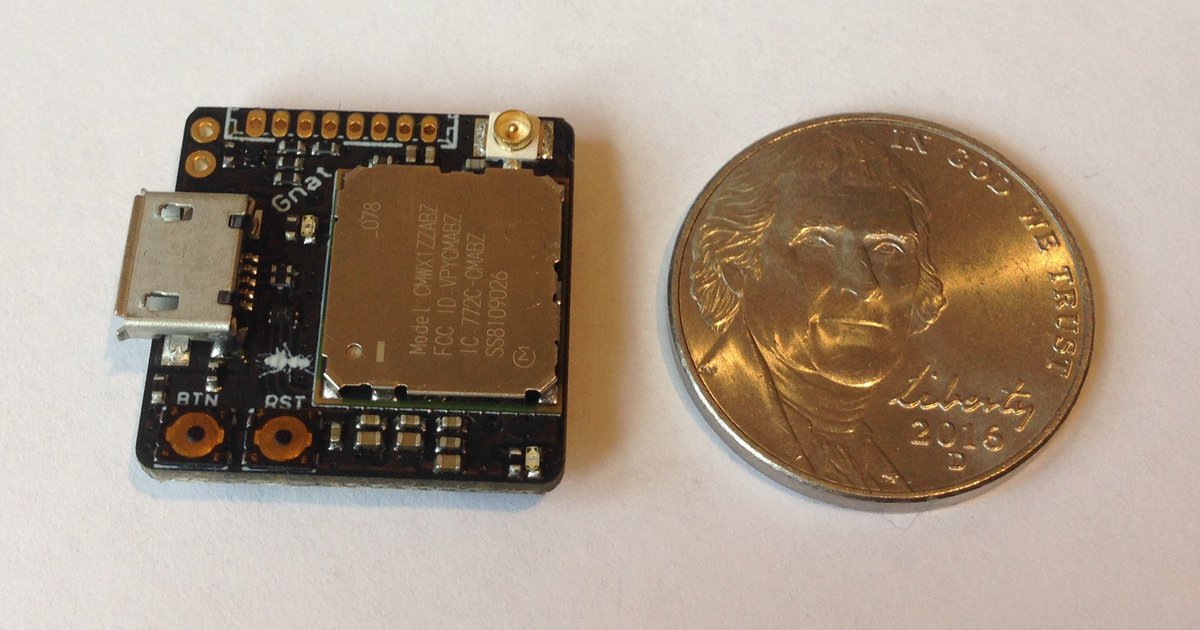
Gnat LoRa+GNSS Asset Tracker
Ultra-small, ultra-low-power LoRa/LoRaWAN + Concurrent GNSS Asset Tracker
A FORTRAN client for atproto @formerlab.bsky.social + an interesting mission "We are building Drocket, Bricks & Brick OS - modular computing and a cluster OS. Things that shouldn't exist yet. The internet should be decentralized, community-owned, & resilient. DTTP is our attempt to make that real."

Former Lab
@atmosphereconf.org @atprotocol.dev Do you Formula Translate?
low-volume local atproto over LoRA (or other radio) could be really interesting. previously though a bit about El Paquet hard disk distribution, or cheap Othernet/Lantern satellite broadcast

Toxic
I mean... underneath that is an ESP32, which is pretty capable considering its price and power draw. ATproto over LoRA or Wifi mesh might be within the capabilities of the hardware.

