

In this interview, Richard Barbrook shares his perspective on the essay “The Californian Ideology,” which he published in 1995 and 1996 with Andy Cameron, who died in 2012. Richard Barbrook lays out the essay’s genesis, explores the inspiration offered by Marx and Engels’ The German Ideology, discusses his ambivalent but not simply dismissive relationship to California and the United States, and provides insight into the thinking around the masters program in hypermedia at the University of Westminster, United Kingdom, that he and Cameron were setting up at the time of the essay’s publication. In the essay they wanted to impart a different approach to digital technologies than was prevalent in the Californian computer industry at the time. Overall, the interview makes it apparent how “The Californian Ideology” should be seen in its temporal context—as well as how the basic questions the essay raises continue to shape the discussion about digital media and infrastructures today.
Californian ideology
Californian ideology refers to the dominant ideology of Silicon Valley, as described by the British media theorists Barbrook and Cameron in their 1995 essay "The Californian Ideology". The ideology is very influential because of the ubiquity of Californian technology products, as well as because siliconization has made it prominent in computing industries all around the world.
Thirty Years On, the Californian Ideology is Alive and Well
In the seminal essay, Barbrook and Cameron insisted that there are other ways to build technology, and to do it democratically, writes Nathan Schneider.
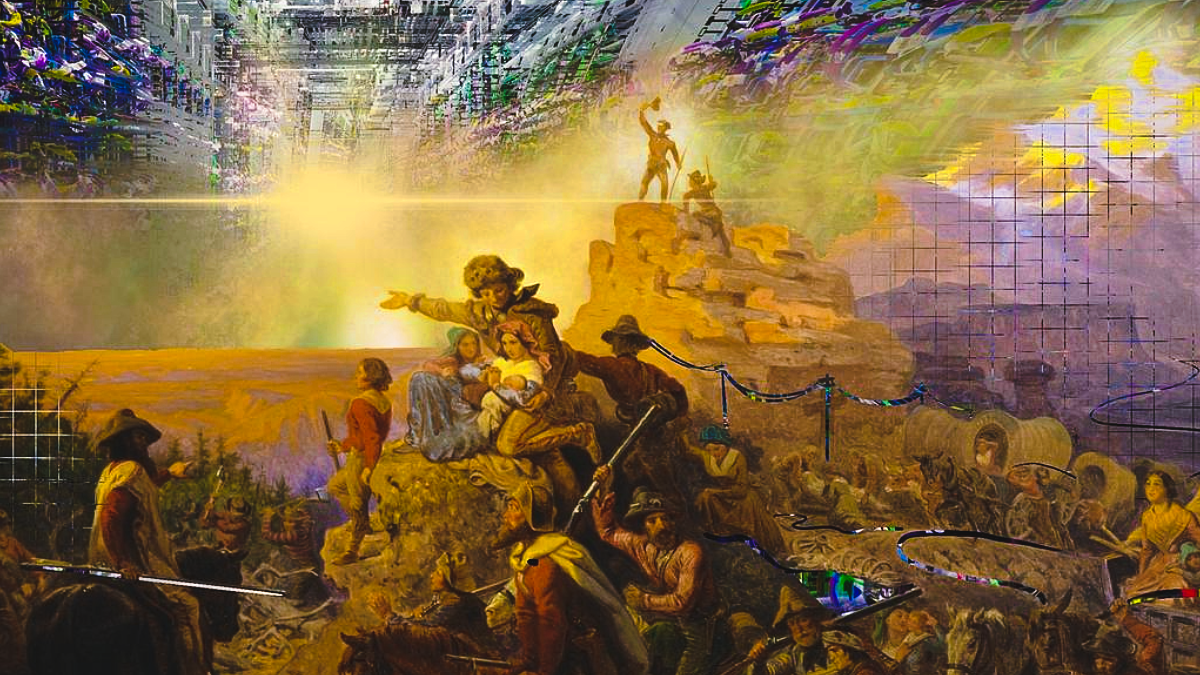
RESPONSES TO THE CALIFORNIAN IDEOLOGY BY CELIA PEARCE
The publication of 'The Californian Ideology' has inspired an impassioned debate over the issues raised by the article. Here is a selection of some of the most interesting responses to the piece:
THE CALIFORNIAN IDEOLOGY by Richard Barbrook and Andy Cameron | Imaginary Futures
“Not to lie about the future is impossible and one can lie about it at will” – Naum Gabo [1]
The scent of Musk: Power, charisma and paranoia in Silicon Valley
Historical pragmatism and the internet
This article argues that the literature describing the internet revolution in the 1990s was characterized by the rhetoric of the technological sublime. This rhetoric suffered from three fatal flaws: (1) it was not sufficiently grounded in the historical development of technology; (2) it viewed the internet in isolation, failing to consider the wider technological context; and (3) it failed to examine the internet in view of the social, economic, religious and political circumstances of its users. Several examples from history are cited, demonstrating that changes in various systems for the production, dissemination and preservation of cultural information both border and deborder the world. The article suggests that if internet researchers take a pragmatic, historically grounded approach, they will discover that the introduction of internet technology can be seen to have similar consequences. While the technology overcomes many boundaries (of space and time, politics and economics), other social borders may be created at the same time. It is easier to see old boundaries coming down than to see new ones being erected. Rather than being swept by utopian or dystopian enthusiasms, the article insists that the really interesting discoveries are to be made in locating the subtle social shifts taking place, relatively unnoticed, as a consequence of technological change.

Eaten by the Internet
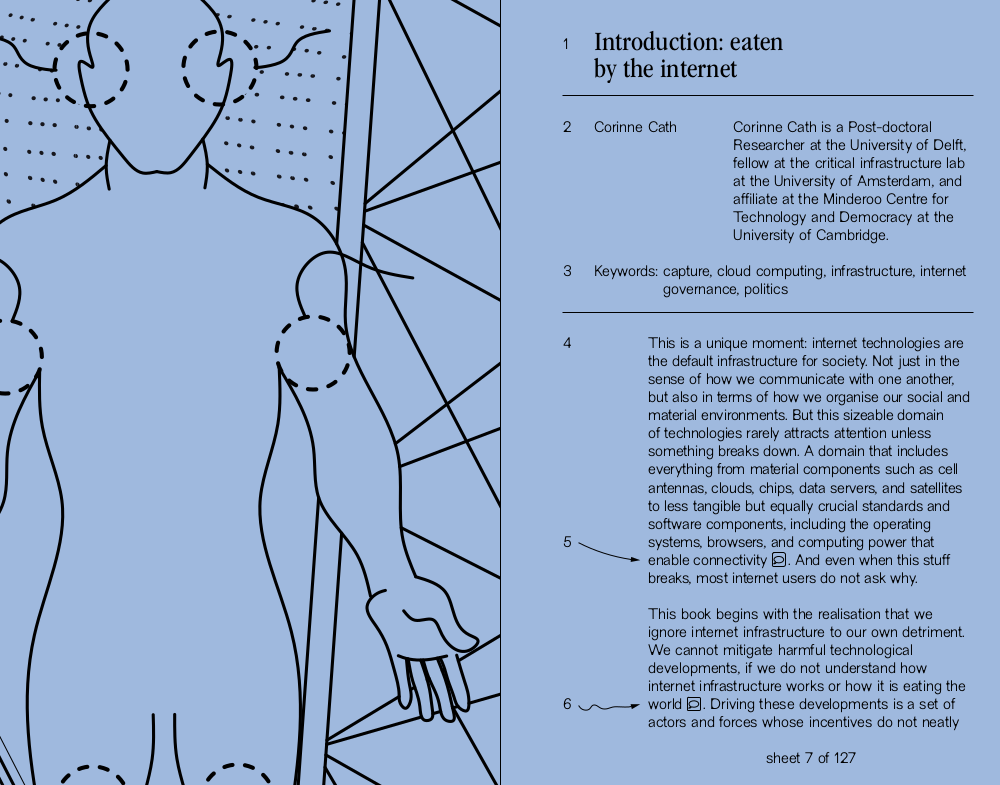
This book makes internet infrastructure visible as a force of political power, which is transforming the social world, from the bottom up—through fifteen chapters contributed by a global set of researchers, activists, and techies. We are living a unique moment: internet technologies are the default infrastructure for society, not just how we communicate but also how we organise our social life, politics, and economy, all the way down to our material environments, like cities. Our world is eaten by the internet. This means that those who control the internet control the bounds of public speech, economic production, social cohesion, and politics, making its infrastructure a core political terrain in the networked age. The book’s chapters cover a wide set of topics, spanning from the global politics of content moderation by internet infrastructure to the colonialism inherent in the race to plug the moon, from the harms wrought by blockchain companies in rural America to the particularities of online censorship across Asia. The chapters take on thorny topics, discussing power consolidation in the advertisement and cloud industry, the role of internet infrastructure in the war in Ukraine, and tech’s environmental impact—amongst others. In doing so, this book roots contemporary technology debates in the politics of internet infrastructure and urges us to ask how can we ensure our infrastructures sustain us, rather than consume us?
The Internet Ideology: Why We Are Allowed to Hate Silicon Valley
It knows how to talk about tools but is barely capable of talking about social, political, and economic systems that these tools enable and disable, amplify and pacify. Why the “digital debate” leads us astray.

Cyber-Marx: Cycles and circuits of struggle in high technology capitalism - Nick Dyer-Witheford
The complete text of Nick Dyer-Witheford's 1999 book, which provides an analysis of information-age capitalism and the movements currently dissolving it. In PDF format.

The Rise of Silicon Valley’s Techno-Religion (Published 2025)
The Rationalists, a community focused on the risks of artificial intelligence, regularly gather with tech figures and other like-minded people in a complex that covers much of a city block.

TESCREAL
TESCREAL is a neologism proposed by computer scientist Timnit Gebru and philosopher Émile P. Torres. An acronym, it stands for Transhumanism, Extropianism, Singularitarianism, (modern) Cosmism, Rationalists (the internet community, not to be confused with other uses of the term), Effective Altruism, and Longtermism.[1][2] Gebru and Torres argue that these ideologies should be treated as an "interconnected and overlapping" group with shared origins.[1] They claim these constitute a movement that allows its proponents to use the threat of human extinction to justify expensive or detrimental projects and consider it pervasive in social and academic circles in Silicon Valley centered on artificial intelligence.[3] As such, the acronym is sometimes used to criticize a perceived belief system associated with Big Tech.[3][4][5]
Utopian media studies: Introduction
This introduction to the special issue ‘Utopian Media Studies’ sketches a framework for how media studies can become a site of utopian praxis, research and experimentation. It first addresses three apprehensions media scholars might have about the notion of utopian media studies and its appeal to a loaded concept like ‘utopia’. The introduction then outlines five sensibilities to explicate the nature and significance of this special issue’s contribution to the field: a utopian media studies must adopt an ecological approach to media; recognize and be invigorated by limits; work toward the technological liberation of time; connect imagination with practice; and emphasize and enable conditions for transmitting hope. Lastly, the introduction considers Ruth Levitas’s distinction between utopia’s archaeological, ontological, and architectural mode to map some of the concrete ways in which existing media studies research is doing utopian work that aligns with these sensibilities. In connecting work that operates in these modes with the various contributions to this special issue, the introduction reveals the utopian currents that already run through media studies as a discipline and opens up new conceptual and methodological approaches to studying and modeling digital utopias.
Utopian media studies: Introduction
This introduction to the special issue ‘Utopian Media Studies’ sketches a framework for how media studies can become a site of utopian praxis, research and experimentation. It first addresses three apprehensions media scholars might have about the notion of utopian media studies and its appeal to a loaded concept like ‘utopia’. The introduction then outlines five sensibilities to explicate the nature and significance of this special issue’s contribution to the field: a utopian media studies must adopt an ecological approach to media; recognize and be invigorated by limits; work toward the technological liberation of time; connect imagination with practice; and emphasize and enable conditions for transmitting hope. Lastly, the introduction considers Ruth Levitas’s distinction between utopia’s archaeological, ontological, and architectural mode to map some of the concrete ways in which existing media studies research is doing utopian work that aligns with these sensibilities. In connecting work that operates in these modes with the various contributions to this special issue, the introduction reveals the utopian currents that already run through media studies as a discipline and opens up new conceptual and methodological approaches to studying and modeling digital utopias.
The Anti-Intellectualism of Silicon Valley Elites
I recently re-read Richard Hofstadter's Anti-Intellectualism in American Life, and now every time a reactionary Silicon Valley billionaire opens his mouth, I think about it. So I wrote about it for The Nation. Here's the column: On Instagram, there’s an activist named Brian Patrick (@pano.

During the 1980s and 1990s, networks of evangelists and venture capitalists fused technological boosterism with reactionary social ideals. Our video of the week examines the deep roots of Silicon Valley's shift toward the right. Featuring @beccalew.bsky.social at @westernu.ca buff.ly/ydgntnc
Have people heard or read about the California Ideology from Barbrook and Cameron circa 1995? networkcultures.org/wp-content/uploads/2015/10/05…

