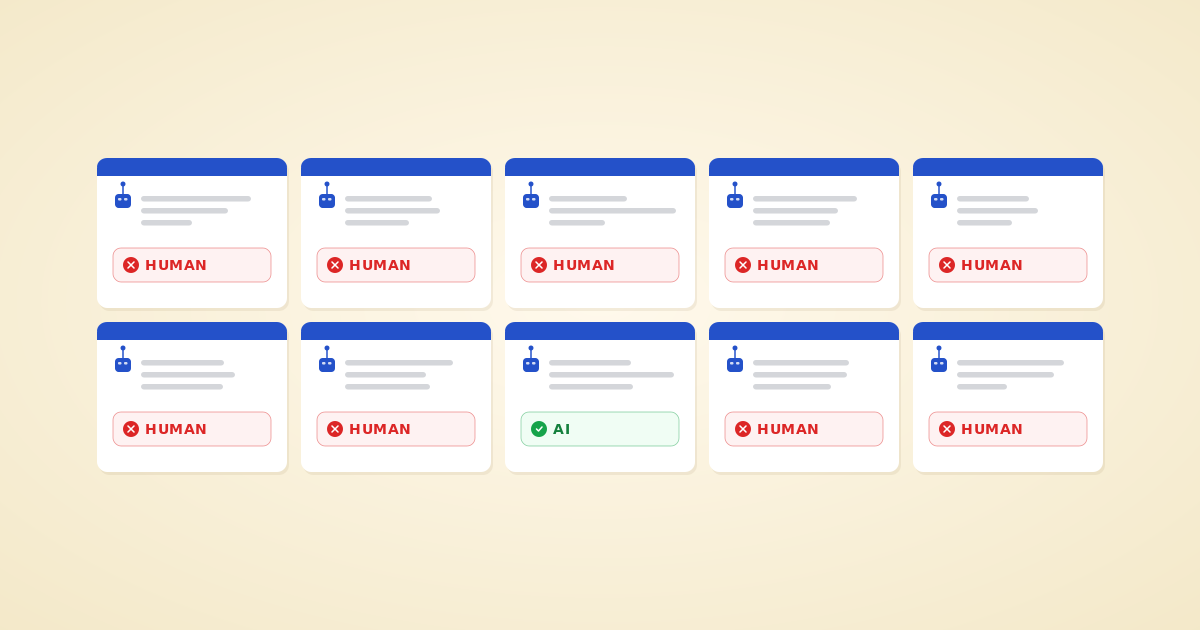
If you get your bot to rhyme / Pangram will misclassify it many a time
AI-text detection tools are really easy to fool
A recent crop of AI systems claiming to detect AI-generated text perform poorly—and it doesn’t take much to get past them.

Technical Report on the Pangram AI-Generated Text Classifier
We present Pangram Text, a transformer-based neural network trained to distinguish text written by large language models from text written by humans. Pangram Text outperforms zero-shot methods...

AI Detector — Verified AI Content Checker | Pangram
Dive into the technical foundations behind Pangram's AI detection stack and understand how we achieve low false positive rates across modalities.

Be Careful What You Tell Your AI Chatbot | Stanford HAI
A Stanford study reveals that leading AI companies are pulling user conversations for training, highlighting privacy risks and a need for clearer policies.

Technical Report on the Pangram AI-Generated Text Classifier
We present Pangram Text, a transformer-based neural network trained to distinguish text written by large language models from text written by humans. Pangram Text outperforms zero-shot methods such as DetectGPT as well as leading commercial AI detection tools with over 38 times lower error rates on a comprehensive benchmark comprised of 10 text domains (student writing, creative writing, scientific writing, books, encyclopedias, news, email, scientific papers, short-form Q&A) and 8 open- and closed-source large language models. We propose a training algorithm, hard negative mining with synthetic mirrors, that enables our classifier to achieve orders of magnitude lower false positive rates on high-data domains such as reviews. Finally, we show that Pangram Text is not biased against nonnative English speakers and generalizes to domains and models unseen during training.
America Has a Pangram Problem
AI-detection tools are getting better. But they still aren’t good enough.

The Consent Layer: Using ligatures to make web text expensive to scrape without asking
ShieldFont is an open-source creative technology project that offers a practical opt-out from unauthorized AI training and disrupts what is collected when that choice is ignored. It swaps 45.8% of content words (around 24.4% of all words) in a page's source code for other (partially) random words, while the font restores the original text on screen. Readers see the work as intended; mass scrapers collect an altered version. In testing, shielding caused over 90% of pages that would otherwise pass the quality filter to be rejected, keeping them out of the training pipeline. Of those that still passed, 19.4% of all words conveyed false meaning, adding noise to unauthorized AI training datasets. This paper's goal is to walk newcomers through the whole process, in plain language and in order: the project's rationale, how it was built, the results, how to deploy it, and where to contribute.
Artificial Writing and Automated Detection
Artificial intelligence (AI) tools are increasingly used for written deliverables. This has created demand for distinguishing human-generated text from AI-generated text at scale, e.g., ensuring assignments were completed by students, product reviews written by actual customers, etc. A decision-maker aiming to implement a detector in practice must consider two key statistics: the False Negative Rate (FNR), which corresponds to the proportion of AI-generated text that is falsely classified as human, and the False Positive Rate (FPR), which corresponds to the proportion of human-written text that is falsely classified as AI-generated. We evaluate three leading commercial detectors—Pangram, OriginalityAI, GPTZero—and an open-source one —RoBERTa—on their performance in minimizing these statistics using a large corpus spanning genres, lengths, and models. Commercial detectors outperform open-source, with Pangram achieving near-zero FNR and FPR rates that remain robust across models, threshold rules, ultra-short passages, "stubs" (≤ 50 words) and ’humanizer’ tools. A decision-maker may weight one type of error (Type I vs. Type II) as more important than the other. To account for such a preference, we introduce a framework where the decision-maker sets a policy cap—a detector-independent metric reflecting tolerance for false positives or negatives. We show that Pangram is the only tool to satisfy a strict cap (FPR ≤ 0.005) without sacrificing accuracy. This framework is especially relevant given the uncertainty surrounding how AI may be used at different stages of writing, where certain uses may be encouraged (e.g., grammar correction) but may be difficult to separate from other uses.

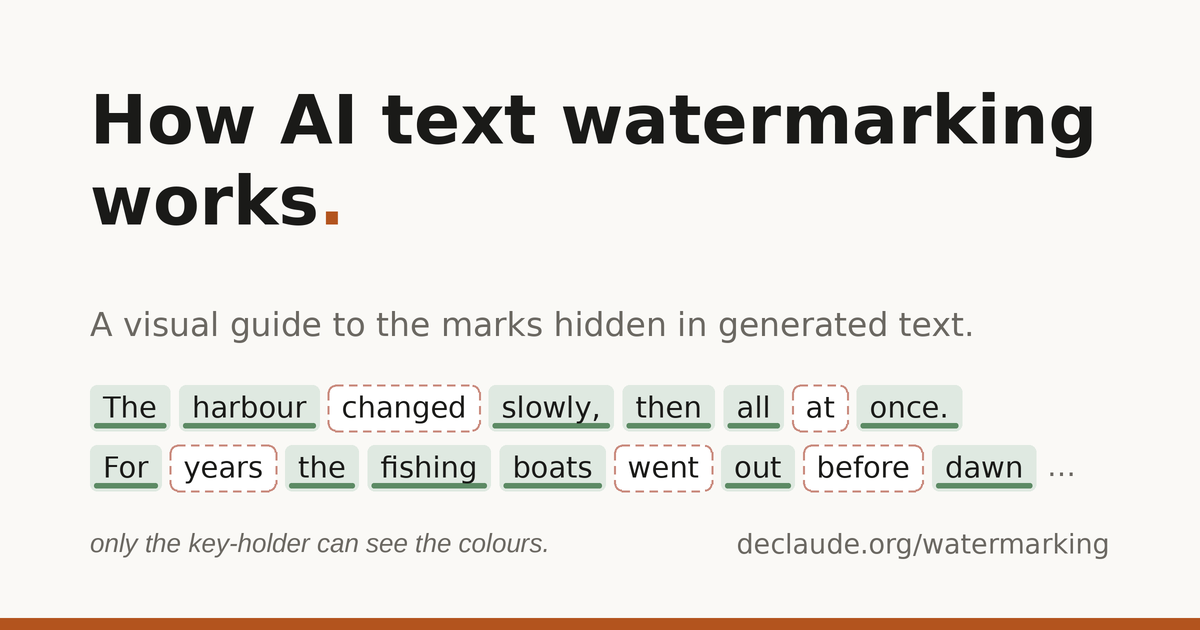
How AI text watermarking works
A gentle visual guide to how a statistical mark hides inside generated text, and what erases it.
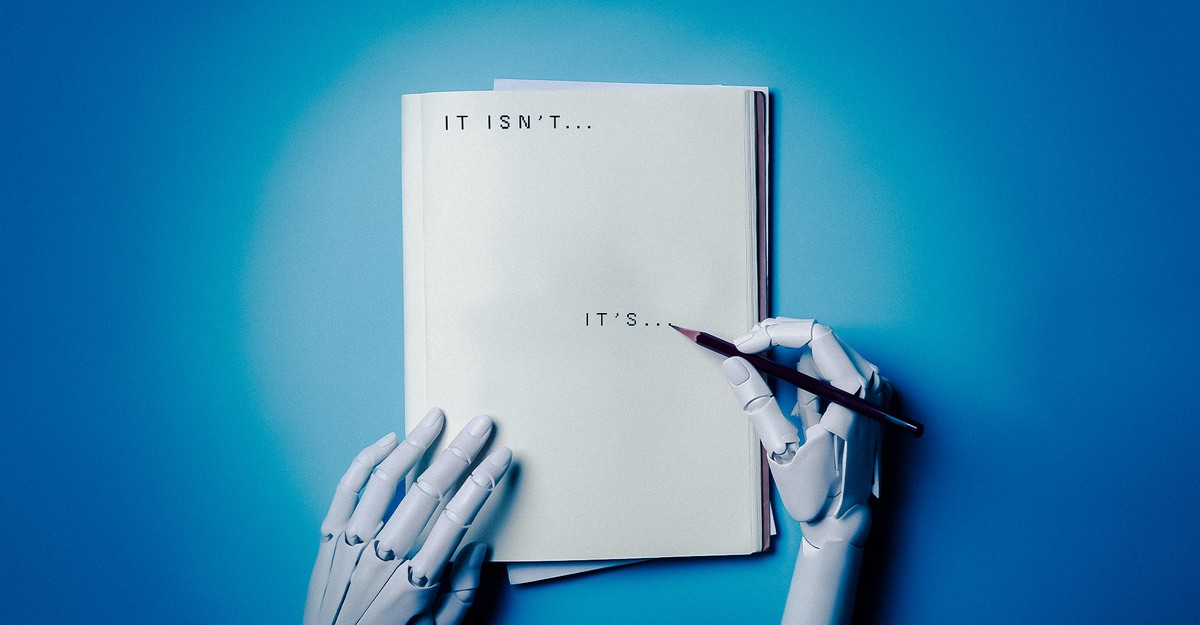
The Most Famous AI Writing Tic Is Also the Most Mysterious
Why chatbots love “it’s not X, it’s Y”
Covert Racism in AI: How Language Models Are Reinforcing Outdated Stereotypes | Stanford HAI
Despite advancements in AI, new research reveals that large language models continue to perpetuate harmful racial biases, particularly against speakers of African American English.
Why mental metaphors do not help us understand chatbot mistakes
The function of chatbots like OpenAI’s ChatGPT is based on detecting probabilistic patterns in the training data. This makes them vulnerable to generating factual mistakes in their outputs. Recently, it has become commonplace in philosophical, scientific, and popular discourses to capture such mistakes by metaphors that draw on discourses about the human mind. The two most popular metaphors at present are hallucinating and bullshitting. In this paper, we review, discuss, and criticise these mental metaphors. By applying conceptual metaphor theory, we provide numerous reasons why they do not succeed in providing us with a better understanding of factual chatbot mistakes. We conclude by calling for justifications of the epistemic feasibility and fruitfulness of the metaphors at issue. Furthermore, we raise the question what would be lost if we stopped trying to capture factual chatbot mistakes by mental metaphors.