

Why LLM Wiki? 🧠 Future Of Knowledge For Agentic AI & Humans
Cognitive Architectures for Language Agents
Recent efforts have augmented large language models (LLMs) with external resources (e.g., the Internet) or internal control flows (e.g., prompt chaining) for tasks requiring grounding or reasoning, leading to a new class of language agents. While these agents have achieved substantial empirical success, we lack a framework to organize existing agents and plan future developments. In this paper, we draw on the rich history of cognitive science and symbolic artificial intelligence to propose Cognitive Architectures for Language Agents (CoALA). CoALA describes a language agent with modular memory components, a structured action space to interact with internal memory and external environments, and a generalized decision-making process to choose actions. We use CoALA to retrospectively survey and organize a large body of recent work, and prospectively identify actionable directions towards more capable agents. Taken together, CoALA contextualizes today’s language agents within the broader history of AI and outlines a path towards language-based general intelligence.
Karpathy's LLM Wiki: What It Means & How to Build One
How To Build LLM Wiki In Obsidian? 🧠 A Memory Layer For Any Agentic AI
A Survey on Large Language Model based Autonomous Agents
Autonomous agents have long been a prominent research focus in both academic and industry communities. Previous research in this field often focuses on training agents with limited knowledge within isolated environments, which diverges significantly from human learning processes, and thus makes the agents hard to achieve human-like decisions. Recently, through the acquisition of vast amounts of web knowledge, large language models (LLMs) have demonstrated remarkable potential in achieving human-level intelligence. This has sparked an upsurge in studies investigating LLM-based autonomous agents. In this paper, we present a comprehensive survey of these studies, delivering a systematic review of the field of LLM-based autonomous agents from a holistic perspective. More specifically, we first discuss the construction of LLM-based autonomous agents, for which we propose a unified framework that encompasses a majority of the previous work. Then, we present a comprehensive overview of the diverse applications of LLM-based autonomous agents in the fields of social science, natural science, and engineering. Finally, we delve into the evaluation strategies commonly used for LLM-based autonomous agents. Based on the previous studies, we also present several challenges and future directions in this field. To keep track of this field and continuously update our survey, we maintain a repository of relevant references at https://github.com/Paitesanshi/LLM-Agent-Survey.

10 Easy Ways to Enhance Your LLM Wiki or Knowledge Base
Model Collapse Ends AI Hype
Networked Intelligence: Active Shared Context Graphs for Human-AI Team Science
Most AI-for-science systems focus on scaling a single reasoning process by using better models, larger context windows, long-horizon agentic execution, or digital co-scientists working with one principal user. However, challenging scientific problems are rarely solved by one reasoner alone. They are solved by teams whose members carry different priors, experimental background, tacit knowledge, and domain-trained intuitions. The open problem is therefore not only how to scale models, but how to develop "networked intelligence", scaling the connections between humans and AI systems so that a result or hypothesis produced in one context reaches another person, agent, instrument or robot that can act on it. We introduce Mycelium, an active shared workspace that automatically connects researchers and AI agents. As human users and agents work, the system captures important observations and hypotheses, tracks how they relate to the team's evolving knowledge model, and routes them to the person or agent whose next decision they can inform. We evaluate Mycelium through a real-world scientific discovery use case: a biological multi-omics campaign where shared context turned a local analytical finding into a cross-expert mechanistic constraint and ultimately into an experimental design. Finally, we describe networked intelligence as sparse conditional computation over distributed scientific contexts. This framework establishes when a scaled standalone agent is sufficient, and when isolated data and specialized expertise make a networked approach essential.
Turn 10,994 Notes Into Memory - Paul Iusztin, Decoding AI & Louis-François Bouchard, Towards AI
Eliciting Reasoning in Language Models with Cognitive Tools
The recent advent of reasoning models like OpenAI's o1 was met with excited speculation by the AI community about the mechanisms underlying these capabilities in closed models, followed by a rush of replication efforts, particularly from the open source community. These speculations were largely settled by the demonstration from DeepSeek-R1 that chains-of-thought and reinforcement learning (RL) can effectively replicate reasoning on top of base LLMs. However, it remains valuable to explore alternative methods for theoretically eliciting reasoning that could help elucidate the underlying mechanisms, as well as providing additional methods that may offer complementary benefits. Here, we build on the long-standing literature in cognitive psychology and cognitive architectures, which postulates that reasoning arises from the orchestrated, sequential execution of a set of modular, predetermined cognitive operations. Crucially, we implement this key idea within a modern agentic tool-calling framework. In particular, we endow an LLM with a small set of "cognitive tools" encapsulating specific reasoning operations, each executed by the LLM itself. Surprisingly, this simple strategy results in considerable gains in performance on standard mathematical reasoning benchmarks compared to base LLMs, for both closed and open-weight models. For instance, providing our "cognitive tools" to GPT-4.1 increases its pass@1 performance on AIME2024 from 32% to 53%, even surpassing the performance of o1-preview. In addition to its practical implications, this demonstration contributes to the debate regarding the role of post-training methods in eliciting reasoning in LLMs versus the role of inherent capabilities acquired during pre-training, and whether post-training merely uncovers these latent abilities.
Big AI is accelerating the metacrisis: What can we do?
The world is in the grip of ecological, meaning, and language crises that are converging into a metacrisis. Big AI is accelerating them all. LLM engineering sits at the core. Despite the public good motives of language engineers and the promise of LLMs, this work is being leveraged to create unprecedented wealth and power for a handful of individuals and corporations while causing existential harm to life on earth. As a profession, we urgently need to come together to explore alternatives and to design a life-affirming future for our field of natural language processing that is centered on human flourishing on a living planet.
Structured Outputs with Will Kurt and Cameron Pfiffer - Weaviate Podcast #119!
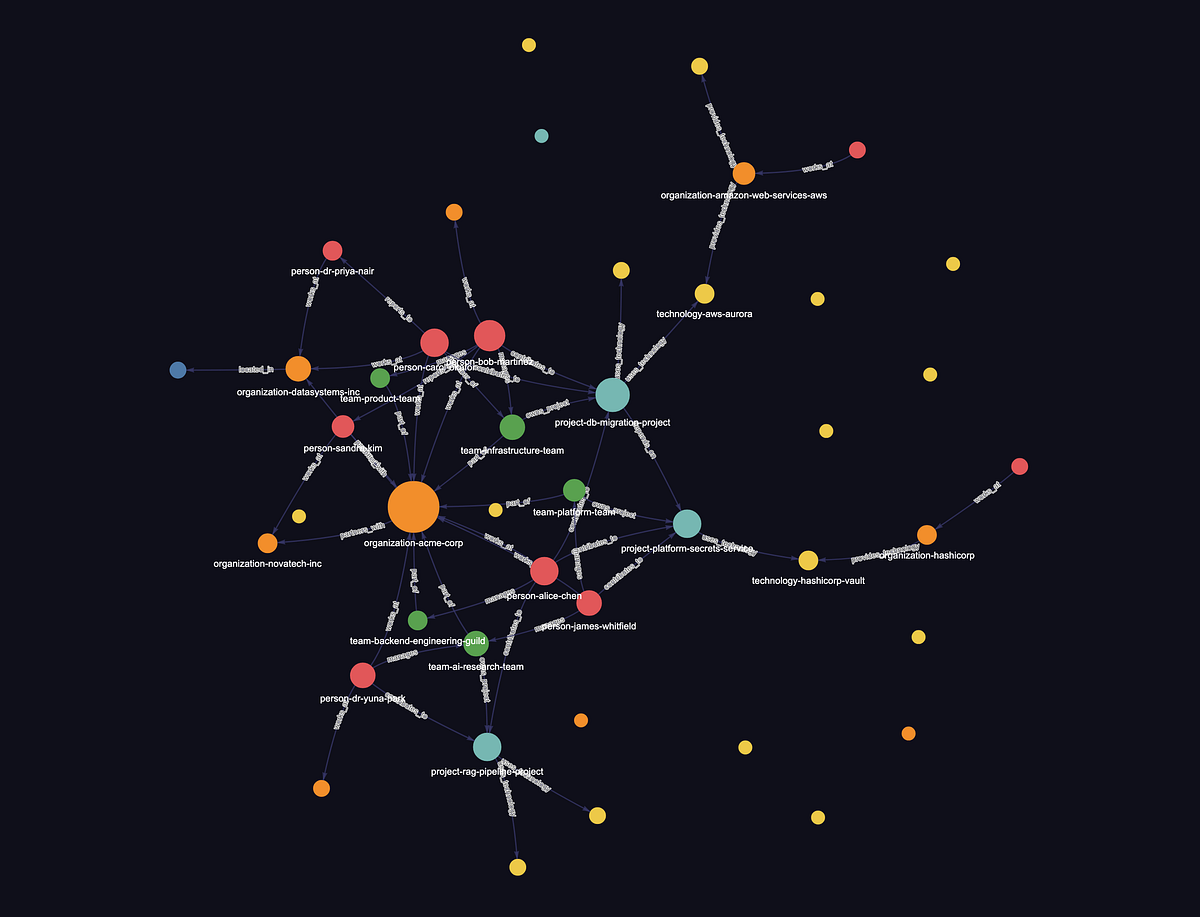
Build an LLM Wiki for Your AI Agents
Build an LLM Wiki for Your AI Agents with myKG and Obsidian How to turn a folder of mixed format documents into a typed, interlinked knowledge graph your agents can actually read — using myKG and …
Supporting Our AI Overlords: Redesigning Data Systems to be Agent-First
Large Language Model (LLM) agents, acting on their users' behalf to manipulate and analyze data, are likely to become the dominant workload for data systems in the future. When working with data,...
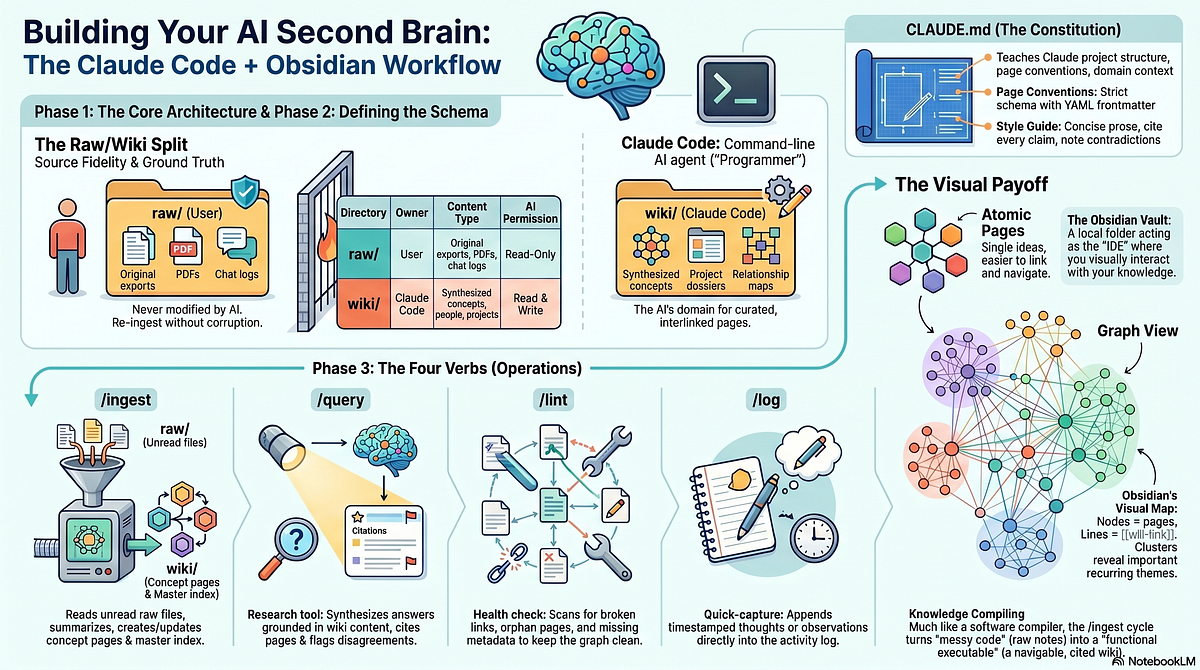
Build an AI Second Brain(LLM Wiki Pattern) With Claude Code and Obsidian
TLDR:Build an AI-powered knowledge base in Obsidian. Use Claude Code slash commands to ingest, link, and query your notes into a smart…
François Chollet on Twitter / X
Eventually, much of AI will converge towards intuition-guided symbolic world modeling, i.e. deep learning-guided program synthesis. It is inevitable. Symbolic modeling lets a system construct a compact, reusable, highly generalizable mental model of a problem space using minimal…— François Chollet (@fchollet) July 2, 2026
The InfoCentral project has historically been focused more heavily upon the symbolic (human-meaningful) side of AI. This included derivatives of Semantic Web and related knowledge representation research, which were dependent on human effort to curate and categorize structured data. The symbolic approach to AI has largely lost the race to the neuro/neuro-symbolic (opaque vectors, statistical) side of AI research, notably the success of the Large Language Model (LLM) paradigm. Due to its faculties with natural language, remarkably little human involvement is needed to infer structure and meaning from traditional (mostly unstructured) information. As such, some of the approaches previously explored in the InfoCentral project have lost relevance. That said, LLM-based tools can perhaps help us finish the symbolic side of the grand AI project, by doing the tedious work that humans were reluctant to do! It has long been theorized that a combination of approaches will ultimately provide the most robust and performant systems, able to work with messy transient unstructured information while also building networks of verifiable persistent structured information that both humans and machines can cross-verify. This may prove useful in both ensuring that future AI systems remain aligned to human goals and values and that inevitable abuses and failures can be easily recovered from. To that end, some research results of this project may be re-usable in a new context.