

AI (artificial intelligence) is making consequential decisions about consumers’ financial lives, including who gets access to credit, which claims get paid, what financial products consumers are shown, and how users are advised to manage their accounts, among many others. It’s doing this at scale, largely out of sight, and with almost no accountability when it
Artificial intelligence and personal finance
Artificial intelligence (AI) is transforming how consumers access and use financial information, education and advice for personal financial decision making. While consumers’ increasing use of AI tools and AI-generated content for personal finance brings opportunities in terms of accessibility, personalisation and decision making, it also increases risks related to bias, hallucinations, commercial influence, data privacy and exclusion, with uncertain benefits on long-term financial well-being. This policy paper provides policymakers and stakeholders with an overview of current trends, opportunities and risks in the use of AI in personal finance and in the design and delivery of financial education. It also proposes a set of financial literacy competencies to support the use of AI in personal financial decision making.

Consumer Reports unveils 'Consumer Finance AI Standard' a first-of-its-kind framework defining what consumers are owed from AI-powered financial products
Washington, DC – Consumer Reports today published the Consumer Finance AI Standard, a first-of-its-kind framework defining the rights, protections, and design practices consumers are owed…

AI
Discover Block AI: Building intelligent financial tools to empower commerce. Explore our open-source agent Goose, latest research papers, and the Agentic AI Foundation.

Human + AI in Accounting: Early Evidence from the Field
This paper provides early evidence on the integration and impact of Generative Artificial Intelligence (GenAI) in accounting at both the accountant and task levels. Using a multi-method approach, we first identify the heterogeneous adoption patterns, perceived benefits, and concerns through survey data from 277 accountants, which we formalize into testable predictions. Leveraging field data from a technology firm providing AI-based accounting software to 79 small- and medium-sized enterprises, we analyze hundreds of thousands of transaction-level records. We document significant productivity gains among adopters, including an 18% increase in weekly client support per standard deviation of AI use, with estimates reaching 59% when comparing the highest to lowest usage levels. We also find a reallocation of approximately 9% of accountant time from routine data entry toward high-value tasks. AI use corresponds to improved financial reporting quality, evidenced by a 12% increase in ledger granularity and a 7.5-day reduction in monthly close time. Experienced accountants selectively intervene when AI confidence scores are low, suggesting complementarity between expertise and AI. A framed field experiment shows that accountants sometimes over-rely on inaccurate AI-suggested classifications, illustrating risks of AI use. Overall, our findings highlight AI’s role in potentially augmenting, rather than replacing, professional accounting expertise.

We All Hate AI, but if You’re Poor, It Can Really Ruin Your Life
Debt collection. Parole decisions. Oversight of public services. It’s all being outsourced to AI, with terrible consequences for poor people.

Fi Money rolls out AI feature for users' queries on personal finance via ChatGPT, Gemini- Moneycontrol.com
Until now, users relied on generic prompts and manual inputs to use AI tools for financial advice, Fi has replaced this with a structured, consent-driven way to share real financial data, the neo-banking firm's co-founder Sumit Gwalani has said

AI Companies Are Trying to Hide a Staggering Amount of Debt
AI companies are pouring tens of billions of dollars into enormous data centers. They're being built on top of a mountain of hidden debt.

Using AI and Behavioral Finance to Cope with Limited Attention and Reduce Overdraft Fees
<p><span>We test how effective a human-algorithm interaction is at stopping users from overdrawing their bank accounts. We use a randomized field experiment and
The end of theory? AI and ignorance in financial markets
AI’s growing role in finance challenges traditional expectations of transparency and theoretical understanding. While machine learning (ML) models enhance financial decision-making, they remain largely agnostic to established financial theories, producing knowledge and ignorance in ways that differ from traditional models like VaR, DCF, and Black-Scholes. This essay explores the decoupling of AI models from theoretical financial knowledge and the resulting forms of ignorance. Using 22 semi-structured interviews, we investigate how ML models generate epistemic uncertainties. We focus on causal ignorance: AI systems, including those supported by XAI, fail to provide genuine causal explanations. Because understanding causation is inherently theoretical, AI-driven finance remains theory-agnostic and marked by theoretical ignorance. We explore how this ignorance differs from that of traditional models and what it implies for the role of theory in finance. Finally, we present three possible scenarios for the future of theory in finance and outline directions for further research.

Robinhood Lets Customers Use AI to Trade Stocks, Make Credit-Card Purchases
The brokerage’s new feature links artificial-intelligence tools to investment and credit-card accounts.

Chatbots in consumer finance | Consumer Financial Protection Bureau
Many financial institutions are using advanced technologies to deploy customer service chatbots. Poorly designed chatbots can lead to customer frustration, reduced trust, and even violations under the law.

Generative AI and Finance
Since ChatGPT's release in 2022, demand for artificial intelligence (AI)–related skills in finance has grown rapidly, as generative AI drives significant technological changes in both the financial research field and the broader economy. We show that financial occupations are highly exposed to the productivity effects of generative AI, review the literature on the impact of ChatGPT on firm value, and provide directions for future research investigating the impact of this major technology shock. Generative AI also holds great potential as a tool for finance researchers and practitioners: We review and describe innovations in research methods linked to improvements in AI tools, along with their applications. We offer a practical introduction to available tools and advice for researchers in academia and industry interested in using these tools.

Report - Brace for Impact: Protecting People and the Economy when the AI Bubble Bursts — Open Markets Institute
Our report in partnership with Americans for Financial Reform outlines vulnerabilities in the financial system and wider economy that could intensify an AI crash into the next financial crisis, and provides steps that policymakers can take to mitigate the damage and protect everyday people from bear

SPVs, Credit, and AI Datacenters
How a new credit bubble is building in AI data centers
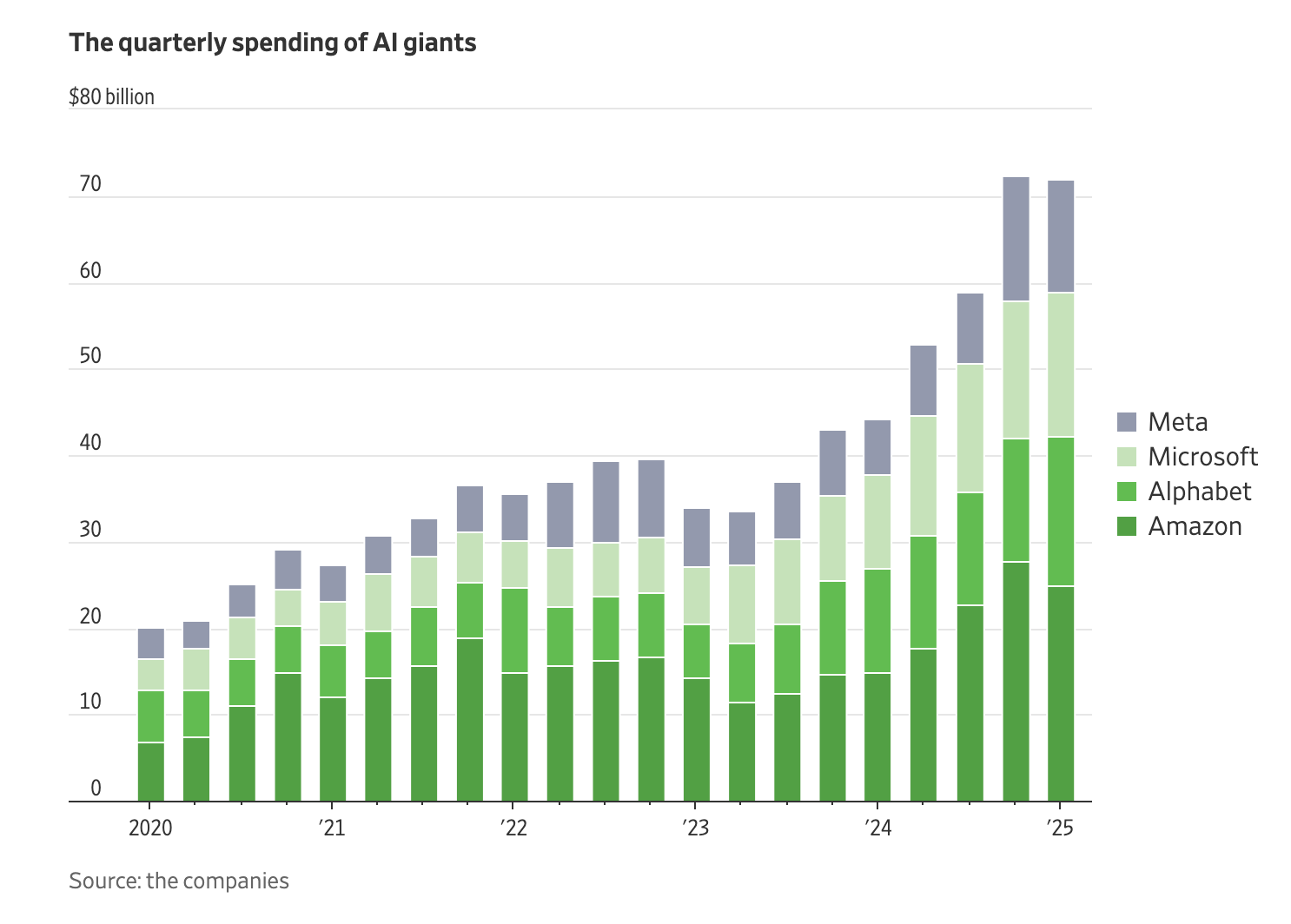
AI is probably not a bubble
AI companies have revenue, demand, and paths to immense value

AI is probably not a bubble
AI companies have revenue, demand, and paths to immense value