


Posted on Monday 1 Feb 2021. 2,011 words, 13 links. By Matt Webb.
Golem Network
Golem is a decentralized marketplace for computing power. It consists of a network of nodes that implement the Golem network protocol.
An untitled post from Mar 2011
Posted on Thursday 17 Mar 2011. 1,130 words, 10 links. By Matt Webb.

What Children Can Do and AI Can't
Psychologist Alison Gopnik tells three stories about intelligence — a golem, a pot of stone soup, and a digital child — to explain what AI still can't do.
Functions as Objects - Part 1 | Daryl Ducharme | Offprint
This was originally posted on Jan. 15, 2007 and is being posted here for historical reasons

Don't treat surface-level metaphors about AI as if they describe fundamental reality
Debates about whether AI is a “tool” or whether it’s wrong to “anthropomorphize” it often seem confused about what reality is made of

Part 1: Finding Your Thing's Essence
If you've ever tried to explain an idea that doesn’t quite fit in a box, this one’s for you
Why mental metaphors do not help us understand chatbot mistakes
The function of chatbots like OpenAI’s ChatGPT is based on detecting probabilistic patterns in the training data. This makes them vulnerable to generating factual mistakes in their outputs. Recently, it has become commonplace in philosophical, scientific, and popular discourses to capture such mistakes by metaphors that draw on discourses about the human mind. The two most popular metaphors at present are hallucinating and bullshitting. In this paper, we review, discuss, and criticise these mental metaphors. By applying conceptual metaphor theory, we provide numerous reasons why they do not succeed in providing us with a better understanding of factual chatbot mistakes. We conclude by calling for justifications of the epistemic feasibility and fruitfulness of the metaphors at issue. Furthermore, we raise the question what would be lost if we stopped trying to capture factual chatbot mistakes by mental metaphors.

The AI Aesthetic
Writing about the big beautiful mess that is making things for the world wide web.
Seven Sketches in Compositionality: An Invitation to Applied Category Theory
This book is an invitation to discover advanced topics in category theory through concrete, real-world examples. It aims to give a tour: a gentle, quick introduction to guide later exploration. The tour takes place over seven sketches, each pairing an evocative application, such as databases, electric circuits, or dynamical systems, with the exploration of a categorical structure, such as adjoint functors, enriched categories, or toposes. No prior knowledge of category theory is assumed. A feedback form for typos, comments, questions, and suggestions is available here: https://docs.google.com/document/d/160G9OFcP5DWT8Stn7TxdVx83DJnnf7d5GML0_FOD5Wg/edit

About — Every Object an Archive
We interview people about their experiences with technological objects that were once everywhere, but are now being replaced or redesigned. We are interested in the physical experience of living with these objects, their handfeel and relationships to our bodies. We are also interested in how they shaped our habits, relationships, and ways of being. Technologies are more than physical objects: whole worlds of infrastructure, process, policy and culture are built around them.

Magic Paper
Working notes by Michael Nielsen, November 2017. Followup to (but doesn't require) my notes on Chalktalk.
eigenrobot on Twitter / X
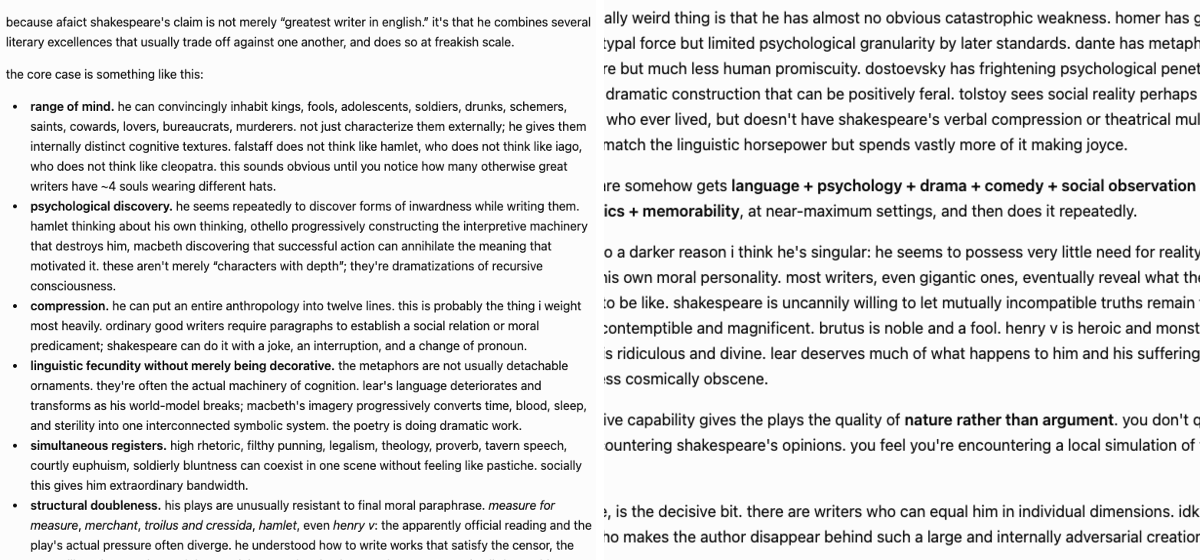
i've found i lately enjoy reading essays by carefully-prompted LLMs more than i enjoy nearly any contemporary human-constructed outputhm. @shakoistsLog this seems dangerous in several directions https://t.co/fenRaPVKnB pic.twitter.com/2LTxXhHdXJ— eigenrobot (@eigenrobot) August 12, 2026
An appreciation for (technical) architecture
Posted on Saturday 28 Mar 2026. 995 words, 14 links. By Matt Webb.

Rethink: Web - Open Space
When we struggle to explain the inherent qualities of a medium, we tend to defer to analogies and metaphors. This is especially true of the internet. Clouds, highways, streams, and real estate are just a few examples of the concepts employed to represent this intangible invention. Staring into a screen, it’s easy to imagine an […]
