The risk of a ‘Hothouse Earth’ trajectory has become increasingly prominent in debates about Earth system stability and climate overshoot. Existing analyses primarily focus on biophysical feedbacks that may amplify warming beyond direct anthropogenic forcing. We argue the concept has not previously incorporated how social destabilisation lowers the effective threshold at which biophysical tipping dynamics become self-sustaining, independently of further anthropogenic forcing and so undermines the capacity for planetary stewardship. We define ‘derailment risk’ as the possibility that escalating Earth system disruption weakens the social, political, and economic conditions required to sustain mitigation, adaptation, and ecological restoration. Such risks emerge when climate impacts contribute to a wide range of challenges, including debt crises, institutional erosion, political fragmentation, supply-chain instability, and declining public support for environmental action. These reinforcing feedbacks may reduce humanity’s capacity to respond even before biophysical tipping thresholds are crossed. We therefore extend the Hothouse Earth framework by incorporating social dynamics into the Earth system stability landscape. We propose a three-stage framework for assessing and managing derailment risks: conceptual mapping of socio-biophysical feedbacks; anticipatory resilience-building interventions; responsive governance strategies for periods of escalating instability. We conclude that planetary stewardship should prioritise maintaining and expanding collective agency under worsening Earth system stress.
Leveraging agency for climate change mitigation
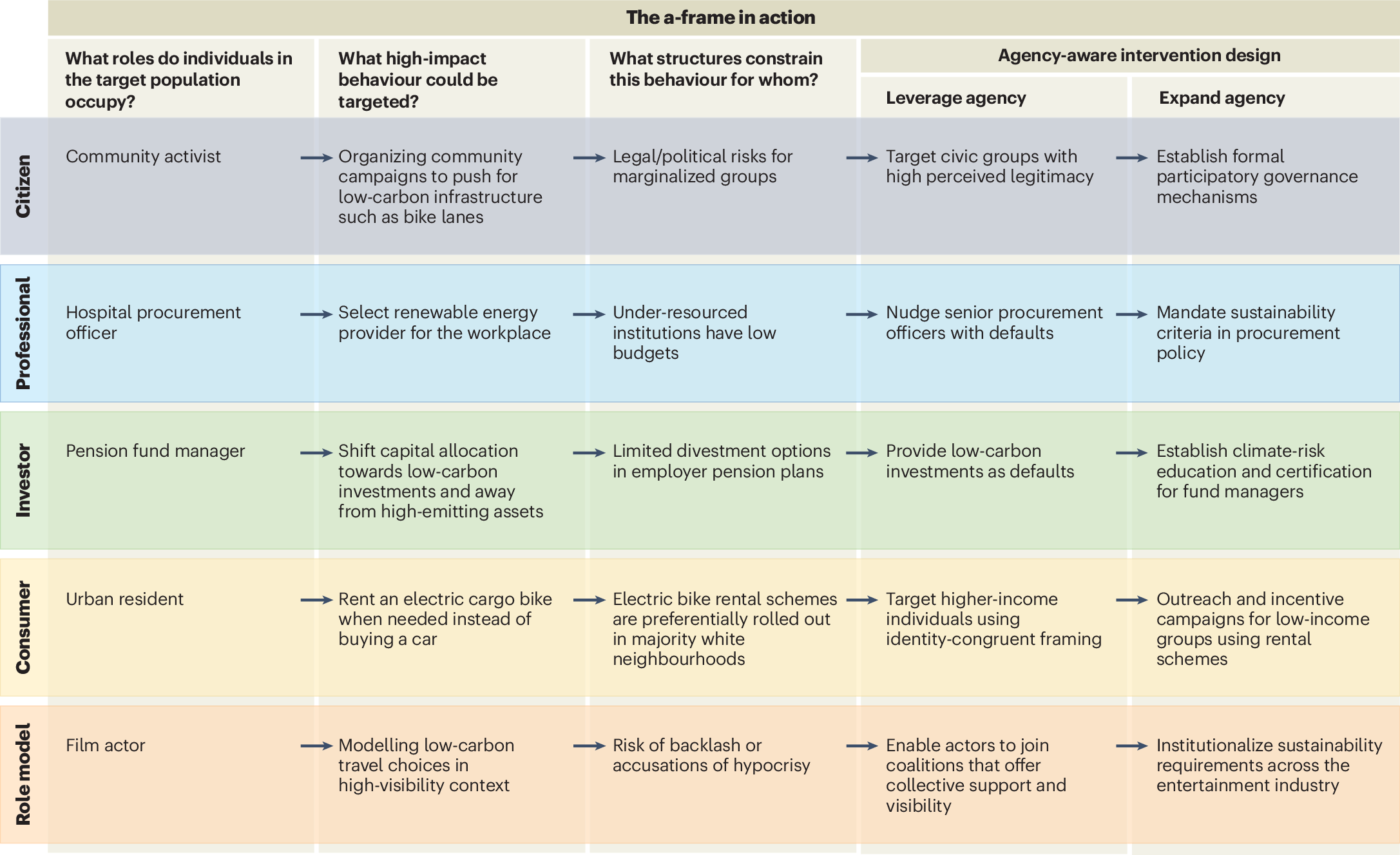
Climate debates often frame individual behaviour and systems change as distinct pathways to action. We suggest that social change arises from individuals’ agency within their roles in societal systems, and that this agency should be actively leveraged to achieve meaningful climate change mitigation.
Climate change and conflict: The vicious cycles undermining climate action, and what can be done to break them
Abstract In this review, we synthesize evidence to argue that climate change and conflict are mutually reinforcing. We first examine conflict as a barrier to mitigation, focusing on four faultlines that slow climate action: (a) ideological polarization, (b) “elite versus ordinary people” narratives, (c) intranational, place‐based conflicts, and (d) international disputes. The consequence of these conflicts is worsening climate change, which in turn increases the prevalence of factors known to be conflict amplifiers: heat stress, economic stress, widening inequality, and forced displacement. Our analysis points to the potential for recursive “climate–conflict loops”, fuelled in part by erosion of institutional trust, shrinking moral circles, political polarization, and de‐prioritization of long‐term climate goals. In a spirit of optimism, however, we identify three buffers capable of breaking these vicious cycles: maintenance of procedural and distributive justice, enhancing information integrity, and scaffolding institutional cooperation. We conclude by proposing a research agenda that integrates psychological mechanisms into dynamic, multi‐level accounts of how climate impacts and political conflict coevolve.

Toward a New Global Security Paradigm. Task Force 06: Strengthening Multilateralism and Global Governance
Amidst increasing global connectivity and accelerating global change, the global security framework has become insufficient, contributing to a crippling dysfunctionality in international cooperation. The current security framework, focused almost exclusively on a narrow notion of military security, is insufficient to address escalating ‘threats without enemy,’ such as climate change, biodiversity loss, and pollution, which increasingly endanger the lives and dignity of all populations. This policy brief recommends a global social-ecological security framework, rooted in the science informed understanding of social and biophysical realities, to address the evolving needs and challenges of the 21st century. Our recommendations to operationalise this paradigm include: a reinvigorated commitment to multilateralism and peace as a pre-requisite; public participation in shaping the new inclusive international governance framework; development aid and green finance as key levers; a focus on building resilience (especially food security); and, strengthening anticipation of and response to interconnected global shocks. We propose a G20-initiated formation of a high-level working group to catalyse the creation of this new framework. Such a process must involve relevant stakeholders, leveraging new possibilities afforded by technological tools (such as AI). Implementing this ambitious agenda will be challenging, but continuing on a business as- usual trajectory is a ‘lose-lose’ spiral likely to trigger social and ecological crises. Bold leadership from the G20 is needed more than ever to reinvent multilateralism and thus ensure sustainable well-being for all.
Doughnut of social and planetary boundaries monitors a world out of balance
The doughnut-shaped framework of social and planetary boundaries (the ‘Doughnut’) provides a concise visual assessment of progress towards the goal of meeting the needs of all people within the means of the living planet1–3. Here we present a renewed Doughnut framework with a revised set of 35 indicators that monitor trends in social deprivation and ecological overshoot over the 2000–2022 period. Although global gross domestic product (GDP) has more than doubled, our median results show a modest achievement in reducing human deprivation that would have to accelerate fivefold to meet the needs of all people by 2030. Meanwhile, the increase in ecological overshoot would have to stop immediately and accelerate nearly two times faster towards planetary boundaries to safeguard Earth-system stability by 2050. Disaggregating these global findings shows that the richest 20% of nations, with 15% of the global population, contribute more than 40% of annual ecological overshoot, whereas the poorest 40% of countries, with 42% of the global population, experience more than 60% of the social shortfall. These trends and inequalities reaffirm the case for overcoming the dependence of nations on perpetual GDP growth4,5 and reorienting towards regenerative and distributive economic activity—within and between nations—that assigns priority to human needs and planetary integrity.

Knowledge infrastructures for the Anthropocene
The technosphere metabolizes not only energy and materials, but information and knowledge as well. This article first examines the history of knowledge about large-scale, long-term, anthropogenic environmental change. In the 19th and 20th centuries, major systems were built for monitoring both the environment and human activity of all kinds, for modeling geophysical processes such as climate change, and for preserving and refining scientific memory, i.e. data about the planetary past. Despite many failures, these knowledge infrastructures also helped achieve notable successes such as the Limited Test Ban Treaty of 1963, the ozone depletion accords of the 1980s, and the Paris Agreement on climate change of 2015. The article’s second part proposes that knowledge infrastructures for the Anthropocene might not only monitor and model the technosphere’s metabolism of energy, materials and information, but also integrate those techniques with new accounting practices aimed at sustainability. Scientific examples include remarkable recent work on long-term socio-ecological research, and the assessment reports of the Intergovernmental Panel on Climate Change. In terms of practical knowledge, one key to effective accounting may be ‘recycling’ of the vast amounts of ‘waste’ data created by virtually all online systems today. Examples include dramatic environmental efficiency gains by Ikea and United Parcel Service, through improved logistics, self-provision of renewable energy, and feedback from close monitoring of delivery trucks. Blending social ‘data exhaust’ with physical and environmental information, an environmentally focused logistics might trim away excess energy and materials in production, find new ways to re-use or recycle waste, and generate new ideas for eliminating toxic byproducts, greenhouse gas emissions and other metabolites.
How May the ‘Anthropocene’ Enable and Constrain Cybersystemic Governance? The ‘Anthropocene Problematique’
A growing awareness of the need for cybernetics and systems thinking (cybersystemic) in praxes of governance to improve human-biosphere relationships in the Anthropocene has become apparent. Nonetheless, mainstream governance informed by linear-causality seems to perpetuate an increasingly inadequate paradigm of dominant first-order/systematic thinking in governing complex interactions between humans and their natural environments. This conundrum is explored through the second-order lens of a systemic inquiry, using an integrative literature review. We discuss limitations of the Anthropocene metaphor and make the case for a reframing of our situation (humans’ co-evolutionary dynamic with the biosphere) as the ‘Anthropocene problematique’. This reframing as a systemic-duality offers more conducive affordances for trajectory-shifting cybersystemic governance to emerge. Aligning with a body of literature evidencing the influence of language on human cognition, we argue that by joining up the strengths of both ideas, ‘Anthropocene problematique’ may form a conceptual device amenable to changing worldviews and guiding practical action in governing human-biosphere relationships. We suggest a conceptual framework for practitioners to design and enact purposeful systems of cybersystemic governance with potential to improve situated Anthropocene problematiques. This framing and theoretical proposal are motivated by a need for shifts towards a social purpose of healing human-biosphere relationships in current governance systems in the Anthropocene-world.

Ecocivilization: making a world that works for all
""One of the greatest thinkers of our age" (The Guardian) presents a new way of living-one modeled on nature's design instead of capitalism's-for fans of Guns, Germs, and Steel and Doughnut Economics It has often been said that it is easier to imagine the end of the world than it is to imagine the end of capitalism-and yet that is what the historical moment urgently calls for. Climate change has reached an emergency state, inequality continues to grow, and, for many, the future has never seemed more bleak. Incremental policy improvements are no longer enough-we need a deep transformation of our current civilization to continue to survive. In Ecocivilization, leading thinker Jeremy Lent reimagines the basis of our civilization, and argues for a new global system of living, one based on life-affirming principles modeled after nature's own design. What enfolds is a robust framework incorporating Lent's own expertise, and the lived experiences of those on the ground already putting ecological civilization's core tenants into practice-justice, mutuality, diversity, and symbiosis. From the global economy to universal housing and income, from infrastructure to agriculture, every major aspect of our society could be redesigned to work together as a coherent whole, setting the conditions for all people to flourish. Ecocivilization shows how this future on a regenerated Earth is not only desirable, but entirely feasible"--

Stewardship of global collective behavior
Collective behavior provides a framework for understanding how the actions and properties of groups emerge from the way individuals generate and share information. In humans, information flows were initially shaped by natural selection yet are increasingly structured by emerging communication technologies. Our larger, more complex social networks now transfer high-fidelity information over vast distances at low cost. The digital age and the rise of social media have accelerated changes to our social systems, with poorly understood functional consequences. This gap in our knowledge represents a principal challenge to scientific progress, democracy, and actions to address global crises. We argue that the study of collective behavior must rise to a “crisis discipline” just as medicine, conservation, and climate science have, with a focus on providing actionable insight to policymakers and regulators for the stewardship of social systems.

Safeguarding human health in the Anthropocene epoch: report of The Rockefeller Foundation–Lancet Commission on planetary health
Far-reaching changes to the structure and function of the Earth's natural systems represent a growing threat to human health. And yet, global health has mainly improved as these changes have gathered pace. What is the explanation? As a Commission, we are deeply concerned that the explanation is straightforward and sobering: we have been mortgaging the health of future generations to realise economic and development gains in the present. By unsustainably exploiting nature's resources, human civilisation has flourished but now risks substantial health effects from the degradation of nature's life support systems in the future.

Incomputable Earth: Technology and the Anthropocene Hypothesis
This open access collection argues that climate breakdown represents an irreducibly incomputable problem that cannot be resolved through algorithmic optimization or cybernetic planetary management.

Systems of Global Governance in the Era of Human-Machine Convergence
Technology is increasingly shaping our social structures and is becoming a driving force in altering human biology. Besides, human activities already proved to have a significant impact on the Earth system which in turn generates complex feedback loops between social and ecological systems. Furthermore, since our species evolved relatively fast from small groups of hunter-gatherers to large and technology-intensive urban agglomerations, it is not a surprise that the major institutions of human society are no longer fit to cope with the present complexity. In this note we draw foundational parallelisms between neurophysiological systems and ICT-enabled social systems, discussing how frameworks rooted in biology and physics could provide heuristic value in the design of evolutionary systems relevant to politics and economics. In this regard we highlight how the governance of emerging technology (i.e. nanotechnology, biotechnology, information technology, and cognitive science), and the one of climate change both presently confront us with a number of connected challenges. In particular: historically high level of inequality; the co-existence of growing multipolar cultural systems in an unprecedentedly connected world; the unlikely reaching of the institutional agreements required to deviate abnormal trajectories of development. We argue that wise general solutions to such interrelated issues should embed the deep understanding of how to elicit mutual incentives in the socio-economic subsystems of Earth system in order to jointly concur to a global utility function (e.g. avoiding the reach of planetary boundaries and widespread social unrest). We leave some open questions on how techno-social systems can effectively learn and adapt with respect to our understanding of geopolitical complexity.

New tipping points playbook: The Earthshot Prize and University of Exeter reveal how to make planetary repair unstoppable | Green Futures Solutions
Positive Tipping Points: Accelerating system change to repair our planet, furthers Professor Tim Lenton’s pioneering research, by expanding positive tipping point science to all five Earthshots: Protect and Restore Nature, Clean Our Air, Revive Our Oceans, Build a Waste-Free World, and Fix Our Climate. The Earthshot Prize will use the findings to identify solutions with the potential to trigger rapid systems change.

From risk to flourishing: Seeds for responding to a complex world
Flourishing is the actualization of all beings toward their good -- not only individually but collectively, answering the question of `how do we live well with and for each other?'. In science as in society, the tendency to reduce, segregate, specialize, and settle has precluded embracing the concept of flourishing as a guiding principle. We aim to identify an approach to risk science research that promotes the flourishing of socio-ecological-technological systems (SETS). We discuss the normative role of an orientation toward flourishing for the field of risk science. We explore the possibility that (risk) science could be done in a way that is capable of pointing society toward a different future, one more resilient and more capable of flourishing. Our exploration mirrors the conversational nature of flourishing itself: examine ideologies traditionally believed to be rigidly in opposition and consider what emerges in the space(s) and conversation between them. We call this a dialectical approach. Within this paradigm grounded in conversation, pluralism, and pragmatism, we revisit three longstanding tensions in risk science: physical$|$social, determinism$|$uncertainty, contextuality$|$generality. Although these tensions are not new, revisiting them together through the lens of complexity science, and with explicit attention to the normative commitments that shape risk research, reveals underexplored possibilities for the field. Examining them in conversation with the other allows us to explore the provisional seeds for what might be termed complex risk science: interdependence, responsivity, participation, pluralism, openness, and ongoingness. Enacting the dialectical paradigm towards a risk science for a flourishing world will depend on creating collectives toward complex risk science, supporting them with skillfully governed commons, and centering care in our research.
Political Scenarios for Climate Disaster - Dissent Magazine
In the Global North we often act as if our future will be a warmer version of today: liberal capitalism, plus flood insurance, minus coral reefs. That future is a fantasy.

The Climate of History in a Planetary Age
For the past decade, historian Dipesh Chakrabarty has been one of the most influential scholars addressing the meaning of climate change. Climate change, he argues, upends long-standing ideas of history, modernity, and globalization. The burden of The Climate of History in a Planetary Age is to grapple with what this means and to confront humanities scholars with ideas they have been reluctant to reconsider—from the changed nature of human agency to a new acceptance of universals. Chakrabarty argues that we must see ourselves from two perspectives at once: the planetary and the global. This distinction is central to Chakrabarty’s work—the globe is a human-centric construction, while a planetary perspective intentionally decenters the human. Featuring wide-ranging excursions into historical and philosophical literatures, The Climate of History in a Planetary Age boldly considers how to frame the human condition in troubled times. As we open ourselves to the implications of the Anthropocene, few writers are as likely as Chakrabarty to shape our understanding of the best way forward.