

Abstract Urban sustainability initiatives often encompass such goals as increasing local food production, closing nutrient loops through recycling organic waste, and reducing water pollution. However, there are potential tradeoffs among these desired outcomes that may constrain progress. For example, expansion of urban agriculture for food production may create hotspots of nutrient pollution if nutrient recycling is inefficient. We used gardener and urban farmer survey data from the Twin Cities Metropolitan Area (Minnesota, USA) to characterize phosphorus (P) and nitrogen (N) inputs and harvest in order to determine nutrient use efficiencies, and measured soil P concentrations at a subset of these sites to test whether excess soil P was common. All survey respondents (n = 142) reported using some form of soil amendment, with plant-based composts being the most common. Median application rates were 300 kg P/ha and 1400 kg N/ha. Median nutrient use efficiencies were low (2.5% for P, 5.0% for N) and there was only a weak positive relationship between P and N inputs and P and N harvested in crop biomass. Garden soils had a median Bray P value of 80 ppm, showing a buildup of plant-available P far exceeding recommended levels. Our results show that urban gardens are characterized by high nutrient inputs and inefficient conversion of these nutrients into crops, leading to buildup and potential loss of P and N from garden soils. Although urban gardens make up only 0.1% of land area in the Twin Cities, compost application to these urban gardens still constitutes one of the largest inputs of P to the watershed. In order to maximize desired outcomes from the expansion of urban agriculture (UA), it will be necessary to target soil amendments based on soil nutrient levels and crop nutrient demand.
Absolutely wasted: the inner-city garden using food scraps to create top grade soil
An urban compost project has fostered an ingenious way to turn all kinds of waste food into fertiliser

Biogeochemical constraints on climate change mitigation through regenerative farming
This review suggests that most of the management practices associated with regenerative agriculture are not likely to lead to a large net sequestration of organic carbon in soils. Some improved management practices, such as increased fertilizer use, manuring, and applications of biochar, are constrained by biogeochemical stoichiometry and the availability of organic inputs. Other management practices, such as fertilizer applications, irrigation, and applications of ground silicate minerals, entail ancillary and off-site emissions of carbon dioxide that reduce the net sequestration of carbon in soils. Carbon sequestration in agricultural soils, even with best management practices, is only likely to offer a small net storage of carbon that can be marketed as a credit to emissions from other sectors of the economy.

Are We Reaching Peak Phosphorus? Maybe
The mineral is crucial for fertilizers, but nobody knows how much there is.

Soil C Sequestration as a Biological Negative Emission Strategy
Soil carbon (C) sequestration in one of three main approaches to carbon dioxide removal and storage through management of terrestrial ecosystems. Soil C sequestration relies of the adoption of improved management practices that increase the amount of carbon stored as soil organic matter, primarily in cropland and grazing lands. These C sequestering practices act by increasing the rate of input of plant-derived residues to soils and/or by reducing the rates of turnover of organic C stocks already in the soil. In addition to carbon dioxide removal potential, increases in soil organic matter/soil C content are highly beneficial from the standpoint of soil health and soil fertility Practices to increase soil C stocks include well-known, proven techniques or “best management practices” (BMP) for building soil carbon. A second category includes what we refer to as frontier technologies for which significant technological and/or economic barriers exist today, but for which further R&D and/or economic incentives might offer the potential for greater sequestration over the longer term. We reviewed published estimates of global soil carbon sequestration potential, representing the biophysical potential for managed cropland and/or grassland systems to store additional carbon assuming widespread (near complete) adoption of BMPs. The majority of studies suggests that 4 to 5 GtCO2/y as an upper limit for global biophysical potential with near complete adoption of BMPs. In the longer-term, if frontier technologies are successfully deployed, the global estimate might grow to 8 GtCO2/y. There is a strong scientific basis for managing agricultural soils to act as a significant carbon (C) sink over the next several decades. A two-stage strategy, to first incentivize adoption of well developed, conventional soil C sequestering practices, while investing in R&D on new frontier technologies that could come on-line in the next 2-3 decades, could maximize benefits. Implementation of such policies will require robust, scientifically-sound measurement, reporting, and verification (MRV) systems to track that policy goals are being met and that claimed increases in soil C stocks are real.

Phosphate shortage: The dwindling resource required to grow food
By 2030, the world's population is projected to be about 8.5 billion people. Global food security is a major concern for governments—zero hunger is the second most important of the United Nations Sustainable ...

Soil, Yield and Biodiversity Tests Project | Permaculture Association
Download the files at the bottom of this page.We identified and developed a number of simple tests which can be used by researchers and practitioners throughout the world. These include tests for measuring biodiversity, soil quality and cropping.
‘Soil is more important than oil’: inside the perennial grain revolution
Scientists in Kansas believe Kernza could cut emissions, restore degraded soils and reshape the future of agriculture

Dirt Poor: Have Fruits and Vegetables Become Less Nutritious?
Because of soil depletion, crops grown decades ago were much richer in vitamins and minerals than the varieties most of us get today

Benefits of Native Mycorrhizal Amendments to Perennial Agroecosystems Increases with Field Inoculation Density
Perennial polyculture cropping systems are a novel agroecological approach used to mirror some of the ecological benefits provided by native perennial ecosystems including increased carbon and nitrogen storage, more stable soils, and reduced anthropogenic input. Plants selected for perennial agroecosystems are often closely related to native perennials known to be highly dependent on microbiome biota, such as arbuscular mycorrhizal (AM) fungi. However, most plantings take place in highly disturbed soils where tillage and chemical use may have rendered the AM fungal communities less abundant and ineffective. Studies of mycorrhizal amendments include inoculation densities of 2–10,000 kg of inocula per hectare. These studies report variable results that may depend on inocula volume, composition, or nativeness. Here, we test the response of 19 crop plant species to a native mycorrhizal fungal community in a greenhouse and field experiment. In our field experiment, we chose eight different densities of AM fungal amendment, ranging from 0 to 8192 kg/hectare, representing conventional agricultural practices (no AM fungi addition), commercial product density recommendations, and higher densities more typical of past scientific investigation. We found that plant species that benefited from native mycorrhizal inocula in the greenhouse also benefited from inoculation in the field polyculture planting. However, the densities of mycorrhizal inocula suggested on commercial mycorrhizal products were ineffective, and higher concentrations were required to detect significant benefit plant growth and survival. These data suggest that higher concentrations of mycorrhizal amendment or perhaps alternative distribution methods may be required to utilize native mycorrhizal amendment in agroecology systems.

A Soil-Science Revolution Upends Plans to Fight Climate Change | Quanta Magazine
A centuries-old concept in soil science has recently been thrown out. Yet it remains a key ingredient in everything from climate models to advanced carbon-capture projects.

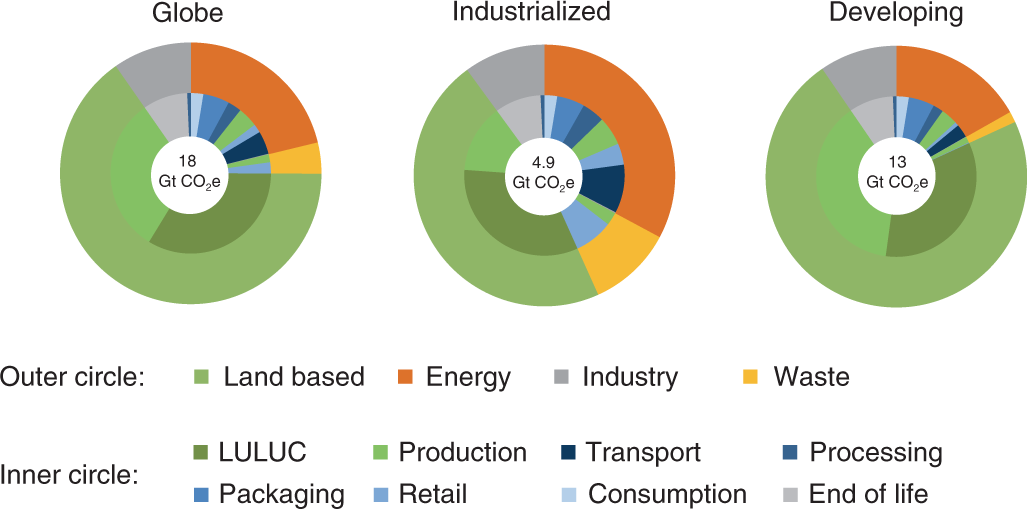
Food systems are responsible for a third of global anthropogenic GHG emissions
We have developed a new global food emissions database (EDGAR-FOOD) estimating greenhouse gas (GHG; CO2, CH4, N2O, fluorinated gases) emissions for the years 1990–2015, building on the Emissions Database of Global Atmospheric Research (EDGAR), complemented with land use/land-use change emissions from the FAOSTAT emissions database. EDGAR-FOOD provides a complete and consistent database in time and space of GHG emissions from the global food system, from production to consumption, including processing, transport and packaging. It responds to the lack of detailed data for many countries by providing sectoral contributions to food-system emissions that are essential for the design of effective mitigation actions. In 2015, food-system emissions amounted to 18 Gt CO2 equivalent per year globally, representing 34% of total GHG emissions. The largest contribution came from agriculture and land use/land-use change activities (71%), with the remaining were from supply chain activities: retail, transport, consumption, fuel production, waste management, industrial processes and packaging. Temporal trends and regional contributions of GHG emissions from the food system are also discussed.
Biological Fertiliser - Human Urine
Regenerative Agriculture, Polyculture, Ecology, Regenerative Landscape Desing, Permaculture, Gardening, Ecological Gardening

We should discuss soil as much as coal (2019) | Hacker News
Then on the vein of soils, we're actually running out of arable soil. Soil erosion is a huge problem around the world and industrial farming is a large part of the problem. Farm plots are never left to fallow and replenish, all nutrients and organic matter are stripped out and replaced with liquid chemical fertilizers, that run off the fields and pollute waterways.
‘Humanure’: RHS plans rollout of first compost toilet to fertilise flowerbeds
The horticultural charity’s showpiece garden in Surrey is setting aside an space to test human waste fertiliser

FoodMesh
Reduce food waste costs by 40% while feeding your community. Join governments and businesses diverting surplus food from landfills.
https://www.thegardensaltspring.com/The Garden Salt Spring Island | cold-hardy citrus & avocado production in Canada | growing healthy soils & nutrient dense food | anaerobic digestion & Johnson-Su
The Garden is an innovative farm in Canada's Pacific Southwest. It focuses on developing resource-efficient systems for greenhouse and orchard production. It applies regenerative practices for on-farm nutrient cycling. The farm operates a small-scale anaerobic digester, has extensive rainwater catchment, and assesses progress with on-farm analysis of soil and plants using Soil Food Web microscopy, brix, and off-farm leaf sap analysis. Visit our blog, YouTube channel and workshop opportunities.