


As Ms. Lin reflects on the trouble her students are having with writing, she realizes that many of her students need help incorporating the four elements of the writing process (i.e., planning, organizing, writing, and editing and revising) into their essays. She concludes that they need a guide or strategy to follow as they write.[.....]

Write Things Down
Writing things down is powerful, for humans and for AI; what comes first, however, is what to write, why to do it, and actually getting things done.


afterword
Writing this handbook has been a process of not over-thinking it. In deciding to do it post-by-post, day-by-day, I practiced sharing as I went, posting to a ...

Logial Thinking Process (LTP) / Issue Tree App and Exploration - Issue Trees & Logical Thinking Process
Collaboration of Rufus Pollock with David Joseph to build tooling for structured thinking — specifically a Logical Thinking Process (LTP) / Issue Tree app. Both David and Rufus share a long-standing desire to improve public discourse and improve collaboration: aligning efforts to goals, making claims or hypotheses and their logical structure clearer (claim-trees), allowing debate to accumulate, mapping evidence clearly to specific sub-claims.

Writing is Thinking: Learning to Write with Confidence
Learning to write is learning to think, because writing is thinking. They are two peas in a powerful pod. This article goes over my writing process, focused on minimizing the activation energy to get started.

Toward a durable writing stack – Writings and rehearsals by Nathan Schneider
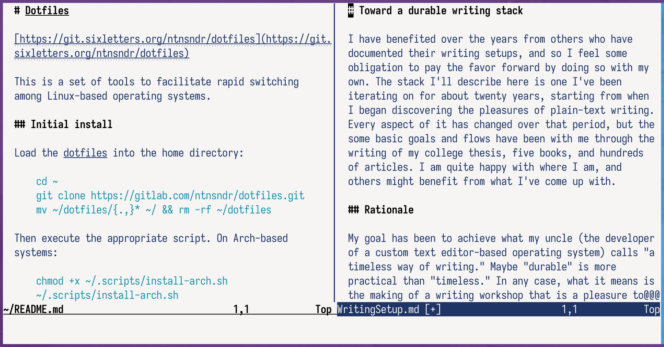
I have benefited over the years from others who have documented their writing setups, and so I feel some obligation to pay the favor forward by doing so with my own. The stack I’ll describe here is one I’ve been iterating on for about twenty years, starting from when I began discovering the pleasures of plain-text writing. Every aspect of it has changed over that period, but the some basic goals and flows have been with me through the writing of my college thesis, five books, and hundreds of articles. I am quite happy with where I am, and others might benefit from what I’ve come up with.
MATT THOMPSON
As part of my EngD project, I am creating ways for story authors to easily write narratives with multiple branches, along the lines of the Choose Your Own Adventure stories from the 1990s. Typically, this kind of story authoring is hard, as the number of material that needs to be written increases exponentially with the number of decision points.
On Writing #3
Periodically I like to gather various observations about writing, and share my perspective.

The Golden Rule for Becoming a Better Writer - T.R Napper
I’m obsessed with the craft of writing. I write every day, I read about the craft often, and in my...

Creative Reading: Scaffolding Reading for Transformation
However, recent work on augmenting reading largely focuses on making reading more efficient, especially in knowledge-intensive contexts where people must rapidly make sense of research papers and other complex documents (Lo et al., 2024). These systems often aim to help readers skim, summarize, and synthesize large volumes of information in order to reduce cognitive effort and accelerate document- and corpus-level sensemaking at scale (Gu et al., 2025; Lo et al., 2024; Fok et al., 2023). At one extreme, the form of reading implicitly envisioned by these systems may resemble what we call “reading to discard”: extracting the essential, actionable informational core of a document as quickly and efficiently as possible, so that the rest can be swiftly tossed aside—much like we often process inbound mail. This motivates us to ask what scaffolding approaches might resist “reading to discard,” what alternative forms of reading we might scaffold, and what alternative views and values of reading might guide the conversation.
Docs as Code: The Best Guide for Technical Writers
Recently, my work has involved writing a lot of documentation and. Doing this has introduced me to...

Protocolized Writing Workshop
Your chance to race to the frontier of modern AI-forward writing and publishing

How do LLMs affect writing? Talks by visitors to the AI STORIES project | UiB
The AI STORIES project is hosting a day of research talks focused on analysing AI-generated writing, with approaches ranging from the qualitative analysis of a professor of writing to large-scale computational analysis finding that prompting an LLM to edit a text to improve its grammar leads to significiant shifts in meaning.

Minimum Queue Publishing - Wesley's notes
A strategy for writing more often without losing momentum
Different models of story structure in creative writing: - Three-act Structure (most common in Western works) - Four-act Structure (me: best for live-action) - Five Elements Plot (me: best for novels) - KiShōTenKetsu (most common in CJK works) #writing
